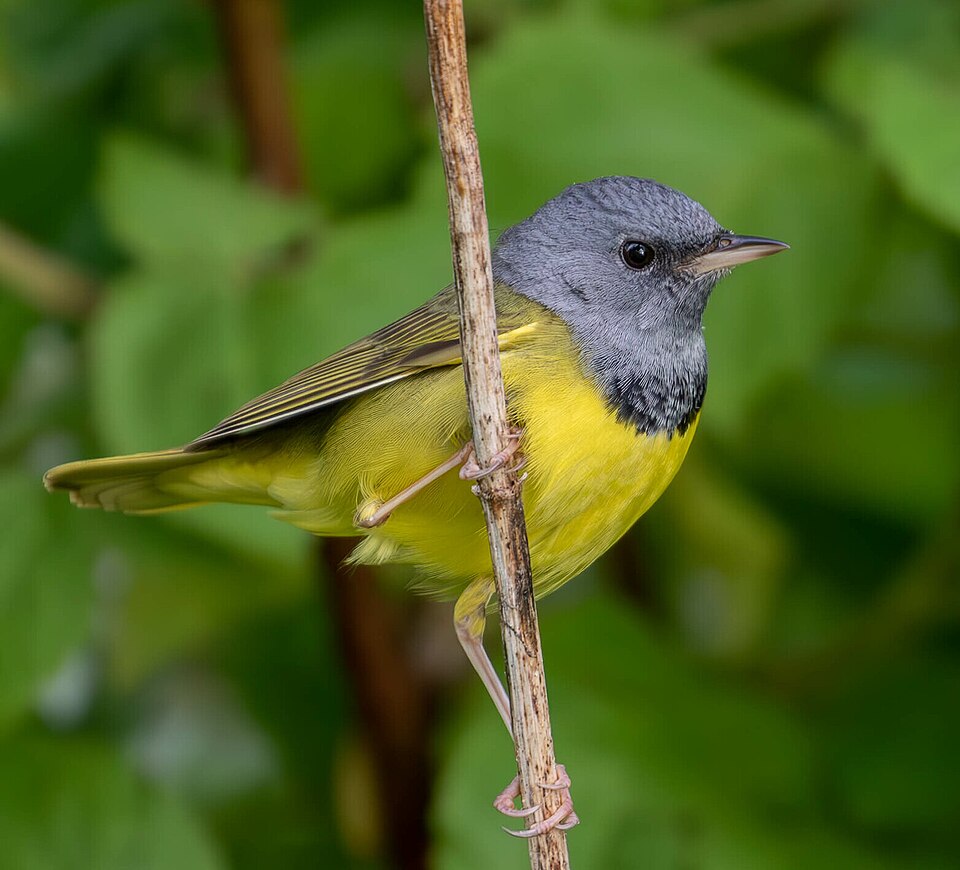
The Mourning Warbler is one of those birds that birders hear far more often than they see. It's a chunky, short-tailed warbler with an olive-green back and a buttery yellow belly, set off by a clean gray hood. On the adult male, the front of that hood is smudged with black, as if a piece of black crepe were draped across his chest in mourning, which is where the name comes from. Despite the somber name, there is nothing gloomy about the bird itself, a vigorous, energetic skulker that spends most of its life low in dense, brushy cover.
This is a warbler of disturbed and recovering landscapes. It thrives in the tangled regrowth that follows logging, fire, or abandonment of fields, where dense shrubs, raspberry brambles, and young saplings create the impenetrable thickets it loves. Because it favors these temporary habitats, the Mourning Warbler can be locally common one decade and scarce the next as forests mature. For the birder, finding one usually means tracking down a singing male and then waiting patiently for him to pop briefly into view atop a shrub before dropping back into the green.
This is a relatively stocky, full-bodied warbler with a notably short tail and a fairly stout bill. Structure matters here, because Mourning Warblers spend so much time hidden that you often get only a quick, partial look. Focus on the gray hood, the lack of an obvious eye-ring, and the way the bird stays low and creeps through dense cover with deliberate movements rather than the flitting restlessness of many warblers.
| Hood | Clean gray hood wrapping the head and throat, contrasting sharply with the yellow underparts and olive back |
| Black bib | Adult male shows a distinctive blackish patch on the upper breast resembling a crepe veil |
| Eye-ring | Adult male typically lacks any eye-ring; females and immatures may show a thin, broken, or incomplete one |
| Underparts | Bright yellow below, extending unbroken from the lower breast to the undertail |
| Upperparts | Plain olive-green back, wings, and tail with no wing bars or streaking |
| Size & shape | Chunky body, short tail, stout bill, and longish pink legs suited to ground-level creeping |
Male vs. female
The sexes are similar but separable with a good look. The adult male has the cleanest, most complete gray hood and the diagnostic black "mourning" patch across the upper breast, and he usually shows no eye-ring at all. The female is duller, with a paler, grayer or brownish-tinged hood, no black bib (or only a faint dusky wash), and a paler throat that can look almost whitish. Females also more often show a thin, broken whitish eye-ring, though it is never the bold, complete ring of a Connecticut Warbler.
Juveniles
Immature Mourning Warblers, especially first-fall birds, are the trickiest plumage. They lack the gray hood entirely, instead showing a yellowish-olive wash across the throat and breast that can look like a faint, dingy yellow "necklace." Many show a thin, often broken whitish eye-ring, which is exactly what leads to confusion with Connecticut and MacGillivray's Warblers. Look for yellow extending up onto the throat (rather than a fully gray throat), the short tail, and the bird's habit of staying low in thick cover.
The song is the best way to find this bird. It's a rich, rolling, churry series, often rendered as churry churry churry, chorry chorry, with the notes typically dropping in pitch and slowing toward the end. Many birders describe two parts: a fuller, lower first phrase followed by a lower, sometimes huskier second couplet. The quality is burry and energetic, carrying well across a brushy hillside even when the singer is invisible.
Call notes include a sharp, hard chip or chek, somewhat metallic and louder than you might expect from a small warbler. In flight or when agitated, birds give a buzzy or rough note. Learning the song pays off enormously, since a singing male perched at the top of a sapling is often the only clean view you'll get all day.
The Mourning Warbler breeds across southern Canada and the northern United States, from the boreal edge of British Columbia and Alberta east through the Great Lakes region, New England, and the Appalachians, where it follows suitable brushy habitat south at higher elevations. It is strongly associated with early-successional thickets, so its local presence shifts as forests are cleared and then regrow.
It is a long-distance Neotropical migrant, wintering in Central America and northwestern South America, in second-growth and forest edges. Migration is relatively late in spring and the bird passes through eastern North America largely in May and again from late August into October. Because it migrates through dense cover and skulks even on passage, it is often under-detected, and many birders log it by its sharp call note from a brushy fencerow rather than by sight.
Mourning Warblers are primarily insectivores. They glean caterpillars, beetles, spiders, and other small arthropods from low foliage, stems, and the leaf litter, working methodically through dense, shaded tangles near the ground. They forage with a deliberate, creeping style, hopping along low branches and the ground and reaching to pick prey from the undersides of leaves rather than sallying out for flying insects.
On the wintering grounds and during migration they take a broader range of small invertebrates and will eat some fruit and may visit the protein-rich extrafloral nectaries and insect swarms associated with certain tropical plants. The heavy emphasis on insect prey, especially caterpillars during the breeding season, makes healthy shrubby habitat with abundant arthropods essential to them.
The nest is built low, usually on or just above the ground, hidden in dense vegetation such as a clump of weeds, a raspberry or blackberry bramble, or a low shrub. It's a bulky open cup of dead leaves, grasses, and weed stems lined with finer grasses, rootlets, and hair, well concealed by the surrounding tangle. The female does most or all of the building.
A typical clutch is three to four eggs, creamy or whitish with brownish spotting concentrated toward the larger end. The female incubates, and both parents feed the nestlings, which grow quickly and leave the nest before they can fly strongly, then continue to be fed in the dense cover nearby. Like many ground-nesting warblers, Mourning Warblers are vulnerable to nest predation and to brood parasitism by Brown-headed Cowbirds where their habitat abuts open or edge country.
The Mourning Warbler is not a feeder bird and won't be drawn to seed, suet, or nectar. It is an insect-eating habitat specialist, so the way to "attract" it is by offering the dense, brushy, early-successional cover it needs. Most backyard birders encounter it only as a migrant slipping through a weedy edge, but if you have land, you can genuinely make it more likely.
- Leave or encourage dense low thickets, raspberry and blackberry brambles, young saplings, and weedy tangles are exactly what this warbler seeks out
- Avoid over-tidying brushy edges and field margins; the messy, regenerating cover birders often clear away is prime Mourning Warbler habitat
- Skip pesticides so that caterpillars and other arthropods remain abundant, since this is an insect specialist that needs healthy prey populations
- If you have acreage, value early-successional habitat, recently logged, burned, or abandoned patches grow the shrub tangles this bird depends on
- During migration, watch and listen at low brushy edges at dawn; a sharp chip from a fencerow tangle is often your first clue one is present
- MacGillivray's Warbler: The western counterpart; nearly identical but shows bold white crescents above and below the eye (broken eye-arcs) in all plumages, whereas adult male Mourning typically shows none. Ranges overlap minimally.
- Connecticut Warbler: Larger and longer-tailed with a complete, bold white eye-ring in all plumages, a more uniform gray-to-brownish hood, and a distinctive walking (rather than hopping) gait on the ground.
- Common Yellowthroat: Shares brushy habitat, but the male has a black mask and yellow throat, and females are browner with whitish bellies and lack the clean gray hood and even yellow underparts.
- Nashville Warbler: Smaller and more active, with a gray head set off by a bold complete white eye-ring and a yellow throat, plus it forages higher and more openly rather than skulking near the ground.
Why is it called a Mourning Warbler?
The adult male has a blackish patch across the upper breast that looks like a piece of black mourning crepe draped over the gray hood, suggesting funeral attire. The name refers to that somber-looking bib, not to the bird's song or behavior.
How do I tell a Mourning Warbler from a MacGillivray's Warbler?
The clearest difference is the eye. MacGillivray's shows bold white crescents above and below the eye in every plumage, while an adult male Mourning typically shows no eye-ring at all and females and immatures show at most a thin, broken one. Range also helps: Mourning is eastern, MacGillivray's is western, and they barely overlap.
Is the Mourning Warbler rare?
No, it's classified as Least Concern and is fairly common within its breeding range, but it is so secretive and tied to dense thickets that many birders find it hard to see. Its local abundance shifts as brushy habitats grow up into mature forest.
Where can I find a Mourning Warbler?
Look in dense, brushy, early-successional habitat: recently logged or burned areas, abandoned fields, raspberry brambles, and tangled forest edges across the northern U.S. and southern Canada in summer. Listen for the rolling churry song and watch for a male to briefly perch up on a sapling.
Will Mourning Warblers come to a bird feeder?
No. They are insect specialists and won't visit seed, suet, or nectar feeders. The best way to encourage them is to maintain dense, brushy, pesticide-free habitat, especially if you have land with regenerating thickets.
What does the Mourning Warbler's song sound like?
It's a rich, rolling, burry series often written as churry churry churry, chorry chorry, usually with a fuller first part and a lower, slower second part that drops in pitch. The call is a sharp, hard chip note that often gives the skulking bird away.