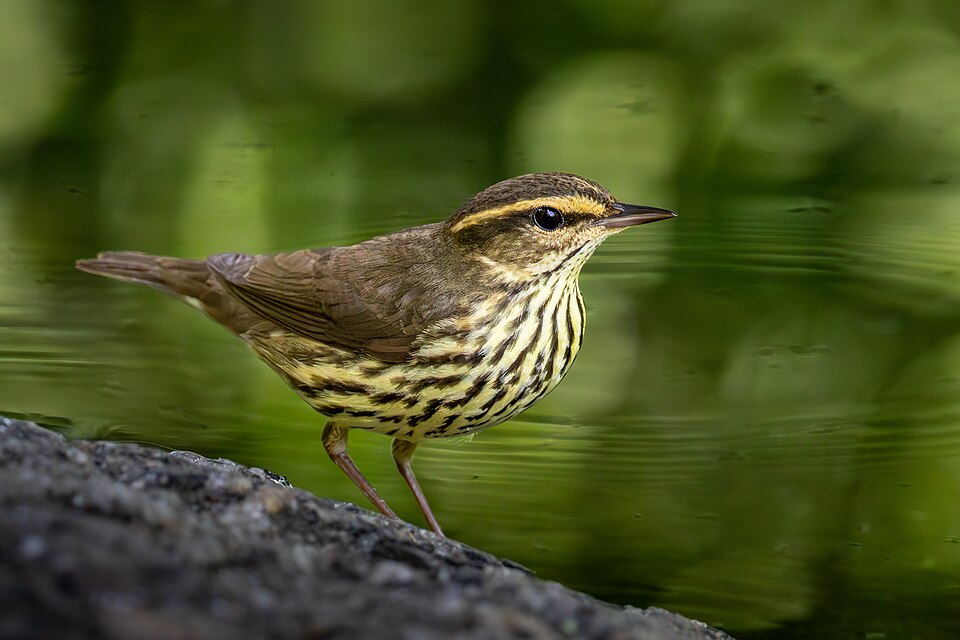
The Northern Waterthrush is a wood-warbler that acts nothing like a typical warbler. Instead of flitting through the treetops, it walks deliberately along the muddy edge of a woodland pool, bog, or slow stream, constantly teetering its rear end up and down as though it can't quite keep its balance. Brown above and heavily streaked below, it looks more like a small thrush or a pipit than a warbler, which is exactly how it got its name. The constant tail-bobbing and the loud, ringing call notes give it away long before you get a clear look.
This is a bird of wet, shady places across the northern forests of North America. It breeds from Alaska across Canada and into the northern United States, favoring spruce bogs, alder swamps, and the tangled margins of beaver ponds and streams. Despite skulking in dense cover, it is far from shy about announcing itself: males sing an emphatic, accelerating song that carries well through the trees. For many birders, learning the Northern Waterthrush means learning to separate it from its near-twin, the Louisiana Waterthrush, a puzzle that turns on subtle plumage and habitat clues.
Think of a small, slim, ground-walking warbler with the proportions of a tiny thrush: a fairly long bill, a rounded body, longish pink legs, and a short tail it can't seem to hold still. The plumage is plain brown above and crisply streaked below, with a bold pale eyebrow stripe being the single most useful field mark. The near-constant teetering of the tail and rear body is diagnostic of waterthrushes among the warblers.
| Upperparts | Uniform dark olive-brown from crown to tail, with no wing bars or bold pattern. |
| Underparts | Whitish to pale buffy-yellow, heavily streaked with dark brown from the throat down through the breast and flanks. The throat is usually finely spotted or flecked. |
| Eyebrow stripe | A long, narrow pale supercilium that is buffy or dingy yellow, fairly even in width and tapering behind the eye (not flaring broadly white at the rear). |
| Legs and feet | Long, dull pink to flesh-colored legs, well suited to walking along mud and shallow water. |
| Behavior | Walks rather than hops, and constantly bobs its tail and rear end up and down in a teetering motion. |
| Size and shape | Sparrow-sized but slimmer, with a horizontal, slightly long-billed profile and a short tail. |
Male vs. female
Male and female Northern Waterthrushes look alike. There is no reliable plumage difference you can see in the field, no seasonal change in color, and no size gap obvious enough to use. During breeding season the singing bird is almost always the male, since males do the territorial singing, but that is behavior rather than appearance. If you are watching a silent waterthrush, there is no way to sex it visually.
Juveniles
Fresh juveniles, seen only briefly near the breeding grounds, are similar to adults but look a little softer and buffier, with paler edges to the wing feathers giving a faintly scaled or warm-toned look. By the time most birders encounter young birds on migration in late summer and fall, they have molted into a plumage essentially identical to adults, often with a slightly more saturated yellow wash on the underparts and eyebrow. There is no juvenile plumage that creates a serious identification trap beyond the usual confusion with the Louisiana Waterthrush.
The song is loud, ringing, and emphatic, a series of clear notes that tumble downward and speed up toward the end, often written as sweet sweet sweet swee-wee-wee chew-chew-chew. It typically starts with a few well-spaced, deliberate notes and then accelerates into a rapid, falling jumble. The voice has a bright, almost metallic clarity that carries across a wet woodland, and once learned it is hard to mistake.
The call note is just as useful: a sharp, hard, metallic chink or spwik, harder and more clipped than the softer call of many warblers. You often hear this loud chip from a bird working an edge before you ever see it. Compared with the Louisiana Waterthrush, the Northern's song is generally faster, more even, and lacks the slurred, musical opening whistles that the Louisiana drawls out at the start.
Northern Waterthrushes breed across an enormous swath of the boreal and northern temperate zone, from Alaska east across virtually all of forested Canada and south into the northern tier of the United States, including New England, the upper Great Lakes, the northern Rockies, and parts of the Northeast and northern Appalachians. They are long-distance migrants, leaving the breeding range in late summer and fall.
In winter the species heads to the tropics, occupying mangroves, swampy thickets, and stream edges from Mexico and the Caribbean through Central America and into northern South America. Migration takes them through much of the eastern and central United States, where birders most often see them in spring and fall at the edges of ponds, wet woodlands, and even urban parks with a damp corner. They are typically among the earlier fall warbler migrants, with southbound birds appearing as early as late July and August.
This is an insect-and-invertebrate eater that forages almost entirely on the ground and in shallow water. It walks methodically along muddy shorelines, leaf litter, and the edges of pools, flipping over wet leaves and probing into mud to flush and seize prey. The diet is dominated by aquatic and terrestrial invertebrates: insect larvae, beetles, flies, ants, caterpillars, small crustaceans, snails, and even tiny minnows or aquatic worms snatched from shallow water.
Its foraging style is distinctive. Rather than gleaning from foliage like most warblers, the Northern Waterthrush behaves like a small shorebird, picking and probing at the waterline while teetering its tail with nearly every step. That constant bobbing motion is thought to help flush hidden prey or simply to be an ingrained habit tied to its edge-walking lifestyle.
Northern Waterthrushes nest on or very near the ground, almost always in damp, shaded settings close to water. The female builds a cup-shaped nest tucked into the upturned roots of a fallen tree, a mossy hummock, a stream bank cavity, or a sheltered niche among ferns and debris. The nest is made of moss, leaves, bark strips, and rootlets, lined with finer material, and is often surprisingly well hidden in the dim understory of a bog or swamp.
A typical clutch is four to five eggs, creamy or buffy white with brown and gray speckling. The female does most or all of the incubation, which lasts roughly twelve to thirteen days, and both parents feed the nestlings. The young leave the nest after about ten days, often before they can fly well, and clamber about the wet undergrowth while the adults continue to feed them. Most pairs raise a single brood per season, reflecting the short northern summer.
The Northern Waterthrush is not a feeder bird and will not come to seed, suet, or nectar. It is a shy, ground-walking insectivore tied to wet, wooded habitat, so the way to "attract" it is really about habitat and timing rather than offering food.
- If your property has a wet woodland edge, pond, stream, or boggy corner, leave it natural and undisturbed. Muddy margins with leaf litter and downed wood are exactly what this bird hunts along.
- Look for them during spring and fall migration, when they turn up at the damp edges of ponds and parks far from their breeding range. Migration is your best (often only) chance in much of the country.
- Leave fallen logs, root tangles, and leaf litter at the water's edge rather than tidying them up; these provide both foraging cover and the invertebrate prey the bird depends on.
- A ground-level water feature or shallow pool with a muddy, vegetated edge is far more appealing to a waterthrush than any elevated birdbath.
- Learn the loud, metallic chink call note; you will usually hear a migrant waterthrush before you spot it teetering along a shoreline.
- Avoid using pesticides near wet areas, since a healthy population of aquatic and ground insects is what makes the habitat attractive to this species.
- Louisiana Waterthrush: Very similar, but has a bolder white eyebrow that flares wider behind the eye, cleaner white (less yellow) underparts, an unstreaked or only faintly marked throat, and bubblegum-pink legs. Prefers fast-flowing streams; its song starts with clear, slurred whistles.
- Ovenbird: Also a ground-walking warbler with streaked underparts, but has a bold white eye-ring (not an eyebrow stripe), an orange crown stripe bordered in black, and walks daintily on dry forest floor rather than wet edges. Its song is a ringing teacher-teacher-teacher.
- American Pipit: A slim, streaked, ground-walking songbird that also bobs its tail, but it is a pipit of open fields, shores, and tundra, with thin streaking, white outer tail feathers, and a very different thin call note.
How do you tell a Northern Waterthrush from a Louisiana Waterthrush?
Look at the eyebrow stripe, throat, and habitat. The Northern has a buffy or dingy-yellow eyebrow of fairly even width, a finely spotted throat, and yellowish-tinged underparts, and it favors still water like bogs and pond edges. The Louisiana has a brighter, broader white eyebrow that flares behind the eye, a clean unspotted white throat, whiter underparts, brighter pink legs, and prefers fast, rocky streams. Their songs also differ: the Louisiana begins with clear, slurred whistles, while the Northern's song is more even and accelerates into a falling jumble.
Is the Northern Waterthrush actually a thrush?
No. Despite the name and its thrush-like brown, streaked appearance and ground-walking habits, it is a New World warbler in the family Parulidae, not a true thrush. The name comes purely from its looks and behavior, which mimic those of a small thrush.
Why does the Northern Waterthrush bob its tail?
Waterthrushes teeter their tail and rear body almost constantly as they walk along the water's edge. The exact reason isn't fully settled, but the motion may help flush hidden insect prey, aid balance on slick surfaces, or serve as a visual signal. Whatever the cause, the constant bobbing is one of the best ways to recognize a waterthrush in the field.
Where and when can I see a Northern Waterthrush?
In the breeding season look in spruce bogs, alder swamps, and wet woodlands across Canada, Alaska, and the northern United States. During spring and fall migration they pass through much of the eastern and central U.S., often appearing at the muddy edges of ponds, wet thickets, and even city parks. Fall migration starts early, with some birds moving south by late July and August.
Will a Northern Waterthrush come to my backyard feeder?
Not in the usual sense. It is an insect-eating, ground-walking bird that doesn't visit seed, suet, or nectar feeders. The only way to draw one in is with suitable habitat, a damp, shady woodland edge with a pond, stream, or boggy area and undisturbed leaf litter, especially during migration when wandering birds are looking for wet spots to forage.