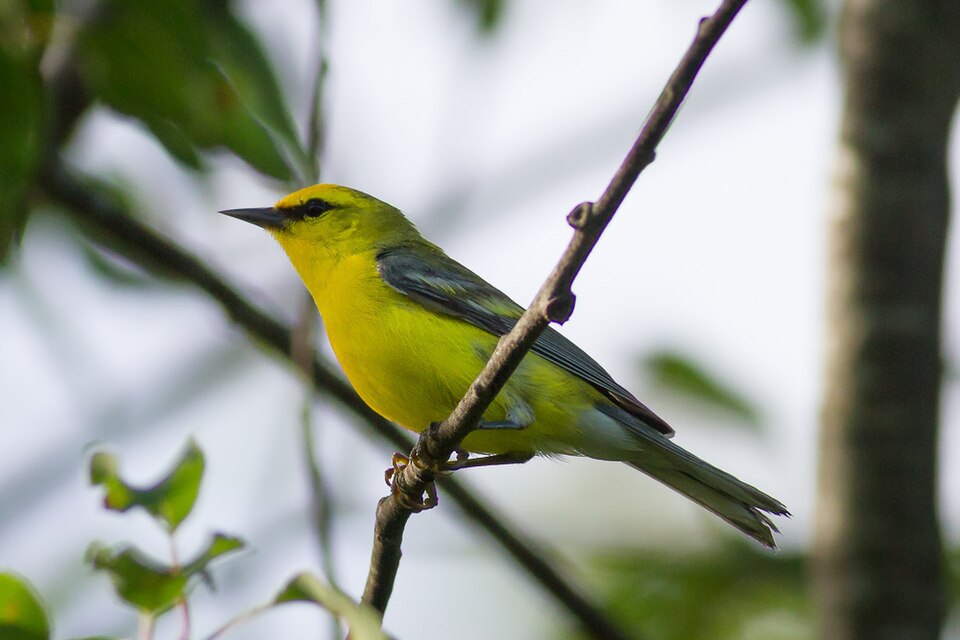
The Blue-winged Warbler is one of those birds you almost always hear before you see. Tucked into brushy fields, power-line cuts, and scrubby forest edges across the eastern United States, this tiny, lemon-yellow warbler announces itself with a lazy, insect-like "bee-buzz" drifting up from a tangle of saplings. Track the sound down and you're rewarded with a real stunner: a glowing yellow bird with a crisp black line through the eye and a pair of soft blue-gray wings stamped with two white bars.
It's a bird of the in-between places, the messy, growing-back habitat that follows abandoned farmland and old clear-cuts. That makes it a kind of barometer for early-successional shrubland, a habitat that has shifted dramatically over the past century. The Blue-winged Warbler is also famous among birders for its tangled relationship with the Golden-winged Warbler: the two interbreed where their ranges overlap, producing well-known hybrids called "Brewster's" and "Lawrence's" warblers. Understanding one species really means keeping the other in mind.
This is a small, slim, active warbler with a fairly long, sharply pointed bill that it uses to probe curled leaves and dead-leaf clusters. The overall impression is of a vivid yellow bird with bluish wings, perched low or working through brushy growth at eye level rather than high in the canopy.
| Body color | Bright, even lemon-yellow underparts and head; yellow-green back blending toward the wings. |
| Eye-line | A clean, narrow black line running straight through the eye, the most diagnostic mark on the face. |
| Wings | Soft blue-gray wings with two bold white (sometimes whitish) wing bars. |
| Bill | Thin, sharply pointed, and noticeably long for a warbler, dark above and paler below. |
| Tail | Bluish-gray with large white spots in the outer tail feathers, flashed in flight. |
| Undertail | Whitish undertail coverts contrasting with the yellow belly. |
Male vs. female
The sexes look very similar, which is unusual among warblers, and many birders can't reliably separate them in the field. Males average a touch brighter and cleaner, with a more saturated yellow crown and a slightly bolder, blacker eye-line. Females and first-year birds tend to be a shade duller and greener overall, with the eye-line a little softer and more gray-black. Behavior helps more than plumage in spring: the bird buzzing persistently from an exposed perch is almost always the male.
Juveniles
Juveniles fresh out of the nest are duller and grayer-green than adults, with washed-out yellow underparts, an indistinct eye-line, and buffy or grayish wing bars rather than crisp white ones. By their first fall, immatures closely resemble adult females, though young birds can show a more olive cast to the head and slightly less contrast in the face. The signature blue-gray wings and the dark eye-line are usually visible even on young birds, which is the quickest way to confirm the species in late summer.
The primary song is unmistakable and easy to learn: a buzzy, two-parted "bee-buzz," often written as "beeee-bzzzz." The first note is a thin, drawn-out inhaled-sounding buzz on a higher pitch, and the second is a lower, raspier exhaled buzz, like a tiny sigh or a sleepy bee. It carries a surprising distance across open shrubland and is one of the few warbler songs that genuinely sounds insect-like rather than musical.
Males also give a more complex, rambling secondary song with a series of buzzy and chippy notes, usually heard later in the season or during territorial disputes. Call notes include a sharp, dry "chip" and a buzzy flight note. Be cautious: hybrid and "mixed-singing" individuals occasionally deliver a Golden-winged Warbler's song while wearing Blue-winged plumage, so song alone isn't always a perfect ID.
Blue-winged Warblers breed across much of the eastern and midwestern United States, from the lower Great Lakes and New England south through the Appalachians and the Ohio Valley, with the range continuing to expand slowly northward into areas the Golden-winged Warbler once occupied. They favor brushy old fields, regenerating clearcuts, forest edges, and shrubby wetland margins, generally below the dense closed canopy.
They are long-distance migrants. In fall, birds head south to wintering grounds in southern Mexico and Central America, from roughly southern Mexico through Panama, where they join mixed-species flocks in semi-open and second-growth tropical habitats. Spring migration brings them back to the breeding grounds mainly from late April into May, with the buzzy song appearing in shrublands as soon as males arrive.
The Blue-winged Warbler is almost entirely insectivorous, feeding on caterpillars, beetles, spiders, leafhoppers, and other small arthropods gleaned from foliage. It has a distinctive feeding style: it often hangs upside down, chickadee-like, to probe into hanging dead leaves and curled-up leaf clusters where caterpillars and spiders hide. That long, pointed bill is built for poking into tight spaces and dead-leaf tangles.
It forages low to mid-level in shrubs and small trees, working methodically along branches and hover-gleaning at leaf tips. On the wintering grounds it continues to favor dead-leaf clusters and readily joins mixed flocks moving through second-growth forest.
Nesting happens on or very near the ground, tucked into a clump of grass, sedge, or the base of a shrub in dense early-successional cover. The female builds a fairly bulky, deep cup, often wrapped in dead leaves and grapevine bark and lined with finer grasses and hair, sometimes with the rim of leaves giving it a slightly upright, cone-like profile.
A typical clutch is around 4-5 eggs, white with fine brown speckling, and the species usually raises a single brood per season. The female does the incubation, which lasts roughly 10-12 days, and both parents feed the nestlings. Because the nest sits low in open habitat, Blue-winged Warblers are frequent hosts to Brown-headed Cowbird parasitism, one of the pressures on local populations.
This is not a feeder bird, so don't expect one at your seed or suet. Blue-winged Warblers are insect-eaters tied to a specific kind of habitat, and the way to "attract" them is to provide or protect that habitat rather than to put out food.
- Think habitat, not feeders. They want brushy, early-successional growth: old fields growing back into saplings, shrubby thickets, and untidy edges, not manicured lawn.
- Leave a wild corner. If you have acreage, letting a field or edge go to shrubs and young trees (or mowing only every few years) creates exactly the scrubby tangle they nest in.
- Protect leaf litter and native plants. Healthy native shrubs and the caterpillars they support are the real draw; avoid broad insecticide use that wipes out their food.
- Listen in late spring. Your best shot at seeing one in or near a yard is recognizing the buzzy "bee-buzz" during May migration and looking low in brushy growth.
- Offer water if you have cover. A clean, low water source near dense shrubs can briefly draw migrants even though they ignore feeders.
- Golden-winged Warbler: Gray (not yellow) body with a yellow wing patch and a black-and-white face mask; the two interbreed, so watch for intermediate hybrids.
- Brewster's Warbler: A common Blue-winged x Golden-winged hybrid: whitish-and-yellowish bird with the Blue-winged's eye-line but reduced yellow underparts and often yellow wing bars.
- Prothonotary Warbler: Even more intensely golden, but it has plain blue-gray wings with no wing bars and lacks the black eye-line; a bird of wooded swamps, not dry shrubland.
- Yellow Warbler: All-over yellow with yellow (not white) wing bars and no black eye-line; males show reddish breast streaks the Blue-winged never has.
What does a Blue-winged Warbler sound like?
Its signature song is a lazy, buzzy two-note "bee-buzz" (beeee-bzzzz): a thin, drawn-out higher buzz followed by a lower, raspier one, sounding more like a sleepy insect than a typical songbird. It also gives sharp dry "chip" calls.
How do I tell a Blue-winged Warbler from a Yellow Warbler?
Look at the wings and face. The Blue-winged has blue-gray wings with two white wing bars and a clean black line through the eye. The Yellow Warbler has yellow wing bars, no black eye-line, and males show reddish streaks on the chest.
Where do Blue-winged Warblers live?
They breed in brushy old fields, forest edges, and regenerating clearcuts across the eastern and midwestern U.S., generally in low scrubby habitat. In winter they migrate to southern Mexico and Central America.
Will Blue-winged Warblers come to a bird feeder?
No. They are insect-eaters and do not visit seed or suet feeders. The way to draw them in is to provide brushy, early-successional habitat and avoid insecticides; a low water source near dense shrubs may occasionally tempt migrants.
What are Brewster's and Lawrence's warblers?
They are hybrids between the Blue-winged and Golden-winged Warblers, which interbreed where their ranges meet. "Brewster's" is the more common hybrid type and "Lawrence's" is the rarer recessive form; both can confuse identification, so check wings and face carefully.