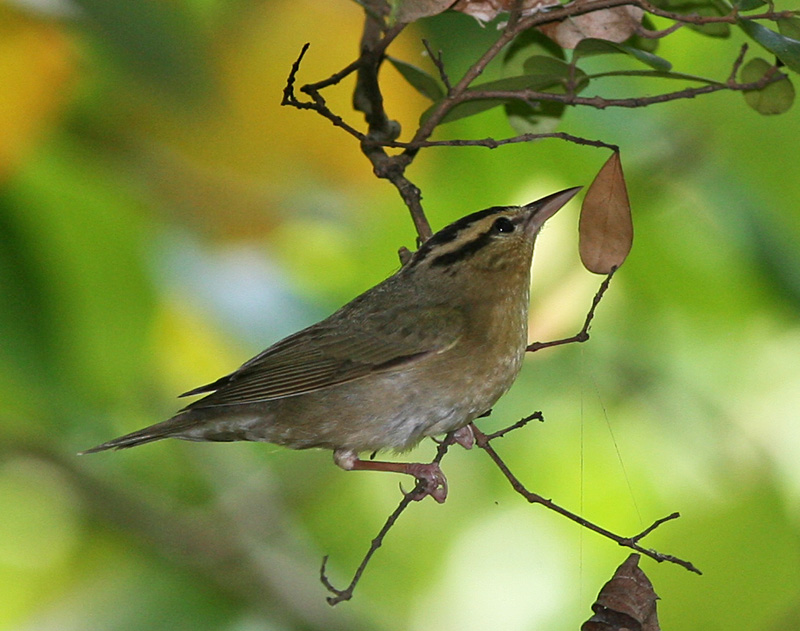
The Worm-eating Warbler is one of those birds whose name promises more drama than its plumage delivers. There's no flash of yellow rump or scarlet throat here, just a warm, olive-brown bird with a buffy chest and a head boldly striped in black and tan. What it lacks in color it makes up for in character: this is a secretive, hillside-loving warbler that spends its life poking through dead leaves, both the ones hanging in the trees and the curled brown clusters that snag in the understory. Birders often find it by sound and by patience rather than by a lucky glance.
Despite the name, it doesn't eat earthworms. The "worms" in question are caterpillars and other soft-bodied larvae, which it gleans from foliage and especially from hanging clusters of dead leaves. It's a bird of mature deciduous forest in the eastern United States, particularly steep, wooded slopes and ravines with a thick leaf layer. Quiet, well-camouflaged, and easy to overlook, it rewards birders who learn its insect-like song and take the time to walk shaded hillsides in late spring.
This is a small, compact, rather plain warbler with a relatively large head, a flat forehead, and a fairly long, sharp, pinkish bill that looks built for probing. The body is uniform warm olive-brown above and pale buff below, but the head pattern is the giveaway: clean black stripes on a warm buff-and-tan ground.
| Head stripes | Bold black stripes through the eye and on the crown, separated by buffy-tan stripes, the single best field mark |
| Underparts | Plain buffy to warm tan below, with no streaking, spotting, or wing bars |
| Upperparts | Unmarked warm olive-brown to grayish-olive; no wing bars or tail spots |
| Bill | Long, sharp, and pale pinkish, proportionally large for a small warbler |
| Size & shape | Small and stocky with a flat-headed look; about chickadee-sized |
| Legs | Pinkish, often seen as the bird clings to leaf clusters and trunks |
Male vs. female
Males and females look essentially identical in the field. Both sexes share the same striped head, plain buffy underparts, and warm olive-brown back, and there is no reliable plumage difference a birder can use to separate them. In the breeding season your best clue to a male is behavior rather than appearance: only males sing the territorial song, so a bird delivering the dry, buzzy trill from a perch is almost certainly a male.
Juveniles
Juveniles look much like adults but are softer and warmer overall, with the head stripes appearing slightly more diffuse or brownish rather than crisp black. Freshly fledged young can show faint buffy or cinnamon edging on the wing feathers and a more washed-out face pattern. By their first fall, immatures are very close to adults and the head striping is well defined, so a fall bird is generally safe to identify on the same marks you'd use in spring.
The primary song is a flat, dry, rapid trill on one pitch, a buzzy chip-chip-chip-chip-chip run together so fast it blurs into a single insect-like rattle. It sounds remarkably like the trill of a Chipping Sparrow, and the two are often confused; the warbler's version tends to be a touch buzzier, thinner, and slightly faster, often delivered from cover on a shaded slope.
Listen also for a higher, sweeter, more musical flight song given mostly at dawn and dusk, which is more complex and warbler-like. Common calls include a sharp, dry chip or tzip and a thin, high tzeet often given in flight. Because the bird is so easy to overlook visually, learning that buzzy trill is the most reliable way to find it.
Worm-eating Warblers breed across the eastern United States, with a stronghold in the Appalachians and the Ohio and Mississippi valley regions. The range stretches from southern New England and the lower Great Lakes south to the Gulf states and from the Atlantic coast west to roughly the eastern edge of the Great Plains. They favor large blocks of mature deciduous forest, especially steep, leaf-littered hillsides, ravines, and slopes, a habitat preference that makes them patchy and local rather than evenly distributed.
They are long-distance migrants. After breeding, they head south to winter in the Caribbean, Mexico, and Central America, where they continue their leaf-probing habits in tropical forests. Spring migration brings them back through the southeastern U.S. mostly in April and May, and southbound movement runs from late summer through fall. Migrants can turn up in woodlots and parks outside the breeding range, but they remain easy to miss.
The diet is overwhelmingly insects and other small invertebrates, with caterpillars (the "worms" of the name) forming a large share, along with spiders, beetles, and assorted larvae. This warbler has a signature foraging move that sets it apart from most of its relatives: it specializes in probing clusters of dead, curled leaves that hang up in the understory and lower canopy, prying them open to flush out the hidden insects and spiders sheltering inside.
Watch one forage and you'll see it work methodically along branches and through leaf litter, hanging upside down, clinging to trunks, and poking its long bill into dead-leaf clumps like a small, brown investigator. This dead-leaf-probing niche is a key part of its ecology and a fun behavior to confirm an ID by.
True to its hillside habits, the Worm-eating Warbler nests on the ground, almost always on a sloped surface. The female builds a cup nest tucked into the leaf litter at the base of a small shrub, sapling, or on a steep bank, lining it with fine materials and often hair-like fungal fibers and leaf skeletons. The nest is well hidden among dead leaves, which makes it extremely hard to find and helps explain how secretive these birds remain through the breeding season.
A typical clutch is four to five eggs, white with brown speckling. The female incubates, and both parents feed the young. Pairs generally raise one brood per season, though they may re-nest if a first attempt fails. As a ground-nester in forest interior, the species is sensitive to forest fragmentation and to nest predators, and it can also be parasitized by Brown-headed Cowbirds along forest edges.
This is not a backyard or feeder bird, and no amount of seed or suet will bring one in. It's a forest-interior insect specialist that needs large, unbroken tracts of mature deciduous woods with a deep leaf layer and shaded slopes. The best way to "attract" one is to go where it lives and to protect that habitat.
- Look on steep, wooded hillsides and ravines in mature deciduous forest, flat, open yards simply aren't its habitat.
- Learn the buzzy, Chipping-Sparrow-like trill before you go; you'll hear far more of these birds than you'll ever see.
- Visit during late spring (April-May) when males are singing on territory and most detectable.
- If you own forested land, keep large blocks of woods intact and preserve the leaf litter and understory rather than clearing it.
- Walk slowly and scan clusters of hanging dead leaves in the understory, its dead-leaf probing is a telltale behavior.
- Support forest conservation, since this species depends on unfragmented woodland for nesting success.
- Swainson's Warbler: Also a plain brown ground-loving warbler of southeastern forests, but lacks bold black head stripes, instead shows a rusty crown and pale eyebrow with a longer, heavier bill.
- Ovenbird: Another ground-walking forest warbler, but olive-green above with bold black breast streaking and an orange crown stripe bordered in black, versus the unstreaked buffy underparts of the Worm-eating.
- Chipping Sparrow: Not a warbler at all, but its dry trill sounds nearly identical; the sparrow has a rusty cap, gray underparts, and a stout seed-eating bill rather than the warbler's striped head and thin pointed bill.
- Tennessee Warbler: A plain, drab warbler that can confuse at a glance, but it is greener above, whiter below, and shows a clean pale eyebrow without the Worm-eating's strong black-and-buff head stripes.
Do Worm-eating Warblers actually eat worms?
Not earthworms. The name refers to caterpillars and other soft-bodied insect larvae, which were historically called 'worms.' Their real specialty is prying open clusters of dead, curled leaves to flush out the caterpillars and spiders hiding inside.
Why is the Worm-eating Warbler so hard to see?
It's a quiet, well-camouflaged bird of shaded forest interiors and steep hillsides, with plain brown plumage that blends into leaf litter. It forages low and methodically rather than flitting in the open, so most birders detect it by its buzzy trill long before they spot it.
How do I tell its song from a Chipping Sparrow?
The two are famously similar dry trills on one pitch. The warbler's trill is usually a bit buzzier, thinner, and faster, and it comes from shaded, sloped deciduous woods, while Chipping Sparrows favor more open, edgy habitat like yards, parks, and pine edges.
Where do Worm-eating Warblers build their nests?
On the ground, almost always on a sloped surface like a hillside or steep bank. The female hides a cup nest among dead leaves at the base of a shrub or sapling, which makes the nests extremely difficult to find.
Will a Worm-eating Warbler ever come to my feeder?
No. It's a forest-interior insect specialist that doesn't visit feeders or backyards. To find one you need to seek out large tracts of mature deciduous forest with leafy, sloping ground, ideally in late spring when males are singing.