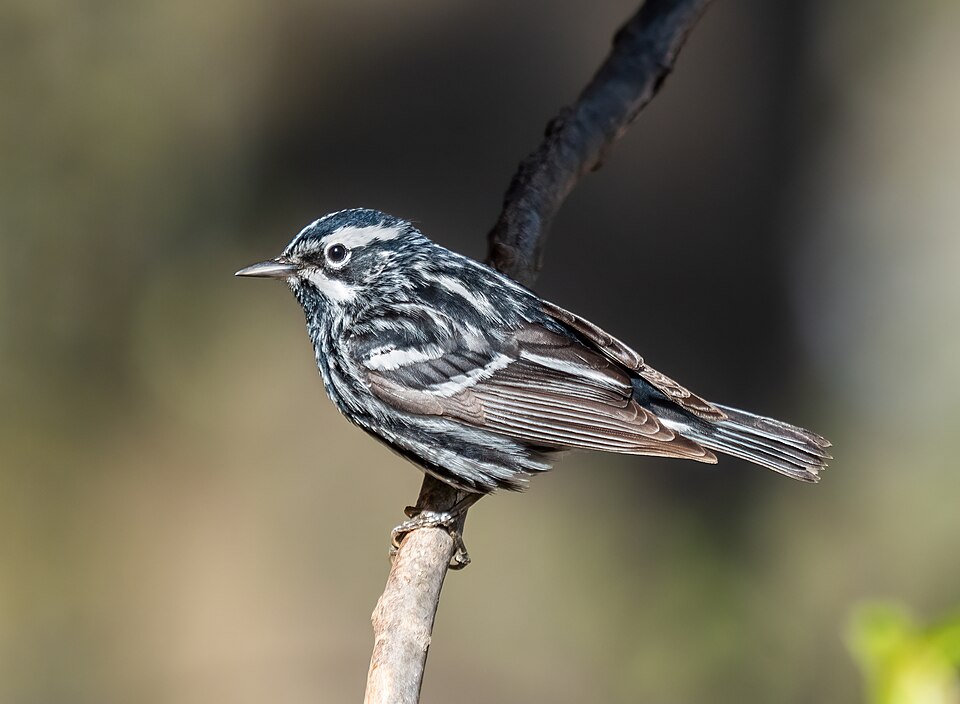
The Black-and-white Warbler is one of the easiest warblers for a beginner to learn, and one of the most fun to watch. Boldly streaked in black and white from head to tail, it looks a bit like a tiny flying zebra, and it behaves like no other warbler in North America. Instead of flitting through the outer leaves, it hitches up, down, and around tree trunks and big limbs like a nuthatch or a creeper, probing the bark for hidden insects. That single habit gives it away long before you sort out the stripes.
It is also a bird of firsts each spring. Black-and-white Warblers are among the earliest warblers to push north, arriving while many trees are still bare, which makes them refreshingly easy to see against open branches. They breed across a huge swath of eastern and northern North America in mixed and deciduous woodlands, then retreat to the tropics for the winter. Their thin, squeaky, repetitive song carries surprisingly far through the woods and is often the first clue that one is working a nearby trunk.
This is a small, slim, long-billed warbler with a striking black-and-white striped pattern over the entire body, including a boldly striped crown. The clincher is behavior plus plumage: a streaky little bird creeping along bark, head often pointed downward, is almost always this species.
| Overall pattern | Black-and-white streaking head to tail, including bold streaks on the back, flanks, and undertail |
| Crown | Striped black and white, with a distinct white central crown stripe and white eyebrow |
| Bill | Relatively long and slightly downcurved for a warbler, suited to bark-probing |
| Wings | Dark with two white wingbars |
| Behavior | Creeps along trunks and limbs like a nuthatch, diagnostic among warblers |
| Size and shape | Small and slender, roughly chickadee-sized, with a fairly flat-headed, long-bodied look |
Male vs. female
The sexes look similar at a glance but can be told apart with a good view. The breeding male has a solid black throat and black cheek (auricular) patch, giving the face a heavily marked, high-contrast look. The female and non-breeding male have a white or pale-gray throat and a cleaner, grayer face, and their flank streaking tends to be softer. Females also often show a faint buffy or warm wash on the flanks. If the throat is jet black, it is a breeding male.
Juveniles
Juveniles and first-fall birds resemble adult females: black-and-white overall but somewhat duller and softer-edged, with grayer or buff-tinged underparts and less crisply defined streaking. Young birds lack the male's black throat. By their first spring they are essentially adult-like, though some young males show only partial blackening of the throat.
The song is a thin, high, repetitive series often written as weesy-weesy-weesy-weesy or wee-see wee-see wee-see, a squeaky two-note phrase repeated rapidly six or more times, frequently compared to a tiny, dry squeaking wheel that needs oiling. It is high-pitched and easy to overlook, especially for ears that have lost the top of their hearing range.
Calls include a sharp, flat chip or tick and a thin, high seet flight note. Males may give a slightly different, more complex song when interacting with other males. Because it sings early in the season and from open perches on trunks, this is a good warbler song to learn first.
Black-and-white Warblers breed across much of eastern and central North America and far up into the boreal forest, from the Maritimes and New England west across the Great Lakes and southern Canada to the edge of the Rockies and the Northwest Territories, and south through the Appalachians and into parts of the southeastern states. They favor mature and second-growth deciduous and mixed forests.
They are long-distance migrants and among the earliest warblers to move in spring, often appearing in late March and April. In winter they head to the southeastern U.S. coast, Mexico, Central America, the Caribbean, and northern South America. During migration they turn up almost anywhere with trees, including small urban parks and backyards, which makes them a familiar early-spring treat far outside the breeding range.
This warbler is an insect specialist that gleans prey from bark and crevices rather than from foliage. Its long bill and strong feet let it work trunks and large limbs, picking off caterpillars, beetles, ants, flies, spiders, leafhoppers, and the eggs and larvae of bark-dwelling insects. It is especially fond of caterpillars and is a useful predator of forest pests.
The feeding style is the giveaway: it creeps methodically up and down trunks and along the undersides of branches, sometimes hanging upside down, probing into bark furrows. Unlike true creepers it moves in any direction, not just upward. In migration it will also forage lower in shrubs and even on fallen logs.
Black-and-white Warblers are ground nesters. The female builds a cup of leaves, grasses, bark strips, and rootlets, usually tucked at the base of a tree, against a stump or rock, or under a log or in leaf litter on the forest floor, where it is well hidden. This ground-nesting habit makes them vulnerable to predators and to forest fragmentation.
The female typically lays 4 to 6 eggs (commonly about 5), creamy white with brown speckling, and does most or all of the incubation for roughly 10 to 12 days. Both parents feed the nestlings, which leave the nest in around 8 to 12 days. Pairs usually raise a single brood per season. Like many ground- and low-nesting warblers, they are sometimes parasitized by Brown-headed Cowbirds.
This is not a feeder bird, it will not visit seed, suet, or nectar, because it eats insects gleaned from bark. You won't lure one with food, but you can absolutely host them during migration and, in the right habitat, in summer by offering the woody structure and insects they need.
- Keep mature trees with rough, furrowed bark, oaks, maples, and other large hardwoods give them the trunks and limbs they forage on.
- Go pesticide-free. Caterpillars, beetles, and spiders are their food; spraying removes their entire diet.
- Leave the leaf litter and a few logs. Fallen wood and undisturbed ground edges provide foraging and potential nesting cover.
- Plant native trees and shrubs that support native insects, which in turn feed migrating and breeding warblers.
- Offer water. A clean, shallow birdbath or a dripper can draw in tired migrants in spring and fall.
- Watch the trunks, not the treetops, scan big limbs and bark in April and May and you'll spot the telltale creeping motion.
- Blackpoll Warbler: Breeding male has a solid black cap and clean white cheek, lacks the striped crown, and feeds in foliage rather than creeping on bark.
- Black-throated Gray Warbler: A western species with gray (not white) tones, a small yellow spot before the eye, and a bolder black face; does not creep on trunks.
- White-breasted Nuthatch: Shares the trunk-creeping habit but is chunkier, has a clean blue-gray back and white face, a long straight bill, and lacks all the body streaking.
- Brown Creeper: Also creeps on bark but is brown and camouflaged, spirals only upward, and uses a thin decurved bill; no black-and-white stripes.
Is the Black-and-white Warbler a woodpecker or a nuthatch?
Neither, it's a true wood-warbler. It just behaves like a nuthatch or creeper, hitching along trunks and limbs to glean insects from bark, which is unusual among warblers and is the easiest way to recognize it.
How do I tell a male from a female Black-and-white Warbler?
Look at the throat and cheek. A breeding male has a solid black throat and black cheek patch for a heavily marked face. Females and non-breeding birds have a whitish or pale-gray throat, a cleaner gray face, and often a faint buffy wash on the flanks.
What does a Black-and-white Warbler sound like?
A thin, high, squeaky song often described as weesy-weesy-weesy, a two-note phrase repeated rapidly several times, commonly likened to a tiny squeaky wheel. Its call is a sharp chip and a high seet flight note.
Will Black-and-white Warblers come to my feeder?
No. They eat insects and spiders pried from bark and won't take seed, suet, or nectar. The best way to attract them is to keep mature trees, avoid pesticides, and offer water for migrants in spring and fall.
When and where can I see one?
They're among the earliest warblers in spring, often arriving in late March and April when trees are still bare. Watch trunks and large limbs in deciduous and mixed woods, parks, and wooded backyards across eastern and northern North America during migration and the breeding season.