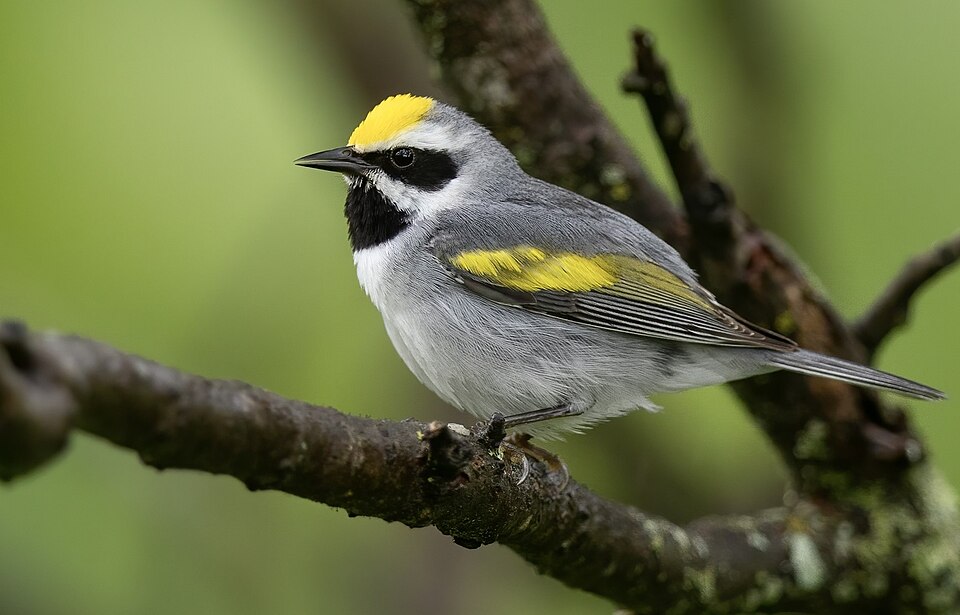
The Golden-winged Warbler is one of North America's most coveted spring warblers, a crisp study in silver-gray, white, and gold that birders travel considerable distances to find. Small even by warbler standards, it favors a very particular habitat: scrubby, shrubby openings, regenerating clearcuts, old fields growing back to forest, and brushy wetland edges. Because that early-successional habitat is fleeting on the landscape, this bird tends to come and go from a given spot over the years, following the patchwork of disturbance and regrowth.
It is also a species of real conservation concern. Populations have fallen sharply across much of the historic range, and the bird now nests primarily in two strongholds: the Great Lakes region and the Appalachian Mountains. Hybridization with the closely related Blue-winged Warbler, along with widespread loss of young-forest habitat, has reshaped its range and made it a flagship for shrubland conservation efforts. For the backyard birder, it is less a feeder visitor than a prize to seek out on a May morning in the right tangle of brush.
This is a tiny, slim, active warbler with a thin pointed bill and a habit of probing dangling clusters of dead leaves. The clean gray upperparts, white underparts, and bold face pattern make a well-seen male unmistakable, but the bird is often heard before it is seen and can stay frustratingly high in the canopy or buried in brush.
| Wing patch | Bright golden-yellow panel across the folded wing (two yellow wing bars that merge), the bird's namesake mark |
| Face pattern | Black or gray mask through the eye and a black throat patch, bordered by clean white, a striking masked-and-bibbed look |
| Crown | Bright yellow cap on the male, duller yellowish on the female |
| Body | Soft silvery-gray above, clean white below with no streaking |
| Bill & shape | Thin, sharp, slightly decurved bill; small slim body, often hangs upside down to feed |
| Tail | Gray with large white spots in the outer feathers, flashed in flight |
Male vs. female
Males and females share the same basic pattern, so the sexes look broadly alike, but males are bolder and cleaner. The male shows a jet-black mask and a solid black throat bib set off crisply against white cheeks, plus a vivid yellow crown and wing patch. The female wears a muted version of the same costume: her mask and throat are gray rather than black, her yellow crown is paler and washed out, and the overall contrast is softer. With a good look the difference is clear, but a quick glimpse of a female can be confusing.
Juveniles
Juveniles and first-fall birds are washed-out and easy to misjudge. They show the same gray-and-white scheme but with a faint, dingy face pattern, a duller yellow wing patch, and an overall greenish or buffy cast, especially on the head. Immatures in fall resemble dull females, and separating young Golden-wingeds from young Blue-wingeds (and hybrids) in autumn is a genuine identification challenge even for experienced birders.
The classic song is an insect-like, buzzy series usually rendered as bee-bzz-bzz-bzz, one slightly higher introductory buzz followed by two to four lower, trailing buzzes on the same dry, rasping quality. It carries a lazy, droning tone that, once learned, is easy to pick out of a brushy hillside. The bird often delivers it from an exposed perch atop a shrub or sapling.
Complicating things, Golden-wingeds frequently sing songs typical of Blue-winged Warblers, and the reverse happens too, so song alone is not a reliable ID where the two species overlap. Common call notes include a sharp, dry tzip or chip, similar to other Vermivora warblers.
Golden-winged Warblers breed in two main regions of eastern North America: the western Great Lakes (especially Minnesota, Wisconsin, and Michigan, plus adjacent Manitoba and Ontario) and the central and southern Appalachians (from New York and Pennsylvania south through the mountains). The Appalachian population is small and declining, while the Great Lakes population holds the bulk of the species. The breeding range has shifted northward and upward in elevation over the past century as Blue-winged Warblers expanded and habitat changed.
It is a long-distance migrant. Birds leave the breeding grounds in late summer and winter in the mountains of southern Central America and northern South America, chiefly from Guatemala and Honduras south to Colombia and Venezuela, where they join mixed-species foraging flocks in mid-elevation forest. Spring migration brings them back through the eastern and central United States, peaking for many areas in early to mid-May.
This warbler is an insectivore, feeding heavily on caterpillars, moths, spiders, and other small arthropods. Its signature foraging move is hanging acrobatically from dead, curled leaves and probing inside them, a behavior that lets it extract caterpillars and spiders hidden in leaf clusters. It works the tips of branches and dangling foliage, often hovering briefly or clinging upside down like a chickadee.
On its tropical wintering grounds it continues to glean insects from foliage and dead-leaf clusters, frequently traveling with mixed flocks of resident and migrant birds. Animal prey makes up essentially the entire diet year-round; this is not a seed-eater.
The nest is built on or very near the ground, tucked at the base of a shrub, grass clump, or weedy tangle in open shrubby habitat. The female constructs a bulky, somewhat loose cup of grasses, leaves, grapevine bark, and other plant fibers, often with a foundation of dead leaves, and lines it with finer material and hair. Nests are well concealed in dense low vegetation, which makes them vulnerable to ground predators and to cowbird parasitism.
The female lays a small clutch and does the incubating, while both parents feed the young once they hatch. The species typically raises a single brood per season. Because the bird depends on early-successional habitat that is constantly maturing out of suitability, breeding sites often shift from year to year as the brush grows up into closed forest.
Honestly, the Golden-winged Warbler is not a backyard or feeder bird, it eats insects, not seed or suet, and it needs specific shrubby young-forest habitat. You attract it not with a feeder but by protecting or seeking out the right landscape.
- It will not come to seed or suet feeders; it is an insect-eater of brushy openings, not a yard visitor.
- If you own acreage, the best help is habitat: maintaining shrubby young forest, brushy old fields, and regenerating clearcuts rather than letting everything grow into closed woods or mowing it to lawn.
- To see one, target early to mid-May in brushy edges, powerline cuts, reverting pastures, and wetland thickets within its breeding range.
- Learn the buzzy bee-bzz-bzz-bzz song first, you will almost always hear this bird before you spot it.
- Support shrubland and young-forest conservation programs; this species is a flagship for that habitat and is genuinely declining.
- Bring patience and look for its dead-leaf-probing foraging style at branch tips and dangling leaf clusters.
- Blue-winged Warbler: Yellow body with a thin black eyeline and blue-gray wings with white bars; the two interbreed freely and produce hybrids, so watch for mixed traits.
- Black-capped Chickadee: A common feeder bird with a superficially similar black cap and bib, but it is plumper, has no yellow wing patch, and gives a clear chickadee-dee-dee call.
- Chestnut-sided Warbler: Shares shrubby habitat and shows yellow on the wing/crown, but has chestnut flanks (breeding) and a different face pattern and song.
What does a Golden-winged Warbler look like?
It's a tiny gray-and-white warbler with a bright golden-yellow patch on the wing and a yellow crown. Males show a bold black mask and black throat bib outlined in white; females wear a softer gray version of the same pattern.
What sound does the Golden-winged Warbler make?
Its song is a buzzy, insect-like bee-bzz-bzz-bzz, one higher buzz followed by two to four lower trailing buzzes. The call note is a sharp dry chip. Note that it sometimes sings Blue-winged Warbler songs, so song isn't always reliable for ID.
Where do Golden-winged Warblers live?
They breed in shrubby young-forest and brushy openings in two main areas: the western Great Lakes region and the Appalachian Mountains. In winter they migrate to mid-elevation forests in Central America and northern South America.
Why is the Golden-winged Warbler declining?
Two main reasons: loss of the early-successional shrubland habitat it needs as old fields and clearcuts grow into mature forest, and hybridization and competition with the expanding Blue-winged Warbler. It's listed as Near Threatened and is a priority for shrubland conservation.
Can I attract a Golden-winged Warbler to my backyard?
Not with feeders, it eats insects, not seed, and needs specific brushy habitat. If you have land, maintaining shrubby young forest helps. Otherwise, the best bet is to seek it out in brushy edges within its range during May migration.
How do you tell a Golden-winged from a Blue-winged Warbler?
A Golden-winged is gray-bodied with a black mask, black throat, and yellow wing patch; a Blue-winged is yellow-bodied with a thin black eyeline and white wing bars. Because they hybridize, watch for in-between birds (Brewster's and Lawrence's hybrids) showing mixed features.