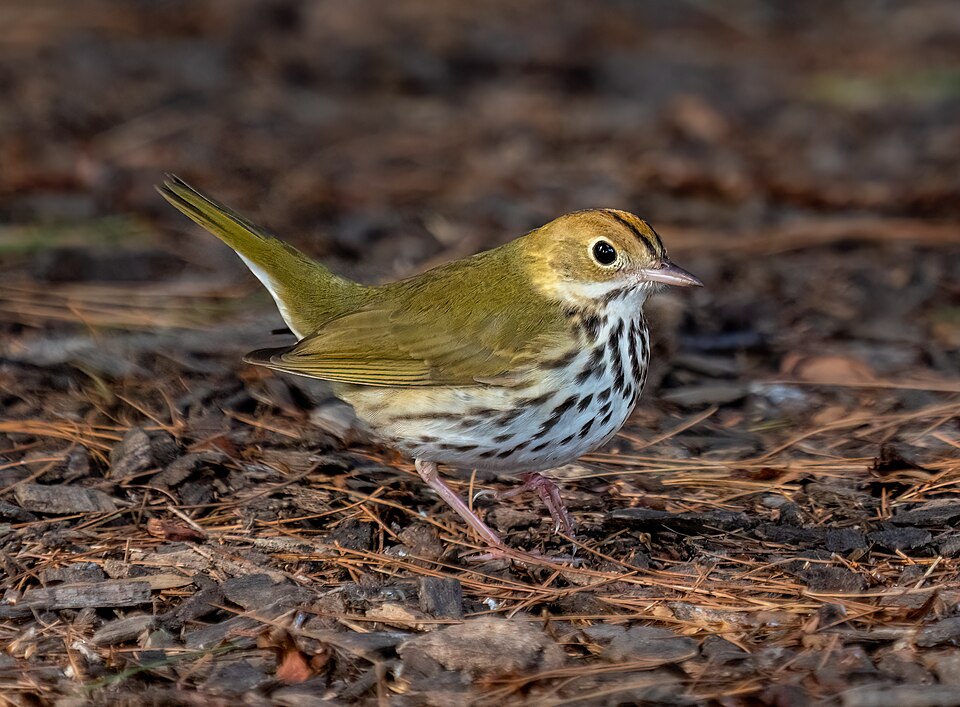
The Ovenbird is one of those birds you almost always hear before you see. Walk into an eastern deciduous woodland in late spring and a ringing, accelerating teacher-TEACHER-TEACHER rolls through the understory, growing louder with each repetition. Track it down and you'll find a small, round, surprisingly thrush-like warbler walking deliberately across the leaf litter, tail cocked, picking through the duff for insects. Despite belting out one of the loudest songs in the forest, it can be maddeningly hard to spot among the shadows.
The bird takes its name from its remarkable nest, a domed structure built on the ground that looks like an old-fashioned Dutch oven with a side entrance. The Ovenbird is a true forest-interior specialist, and its presence is often used as a sign of a healthy, mature woodland. It belongs to the wood-warbler family but breaks the warbler mold: instead of flitting through the canopy, it strolls the forest floor like a tiny thrush with attitude.
Look for a plump, large-headed little bird about the size of a sparrow, with a relatively short tail and long pinkish legs built for walking. Its olive-brown back and crisp white underparts boldly streaked with black give it a thrush-like impression, but the orange crown bordered by dark stripes and the bold white eye-ring set it apart on a good look.
| Crown stripe | Rusty-orange central crown bordered by two blackish lateral stripes; often hard to see unless the bird is close or excited |
| Eye-ring | Bold, complete white eye-ring giving a wide-eyed, spectacled expression |
| Underparts | Clean white below with heavy black streaking and spotting across the breast and flanks |
| Upperparts | Uniform olive-brown to olive-green back, wings, and tail with no wing bars |
| Legs | Long, sturdy, pinkish legs used for walking (not hopping) on the ground |
| Shape | Round-bodied, large-headed, short-tailed; often holds tail slightly cocked |
Male vs. female
Male and female Ovenbirds look essentially identical in the field. Both sexes show the same orange crown stripe, white eye-ring, and streaked underparts, and they cannot be reliably told apart by plumage. In the breeding season, behavior is the clue: the male is the one singing the loud teacher song from a low perch or the ground, while the female stays quiet and is most often seen slipping to and from the nest. In the hand, females may show a slightly less vivid crown, but this overlaps too much to be useful in the field.
Juveniles
Recently fledged juveniles look much like adults but a bit softer and scruffier. Their crown stripe is duller and less sharply defined, the back can show a faint scaly or buffy edging, and the breast streaking may look slightly more diffuse. By their first fall, young birds are nearly indistinguishable from adults, and Ovenbirds of all ages share the same olive-brown back, white eye-ring, and walking habit, so age is rarely something backyard birders need to puzzle over.
The song is unmistakable and is the way most people detect this bird: a loud, ringing series that builds in volume, usually written as teacher-teacher-TEACHER-TEACHER or tea-CHER, tea-CHER, tea-CHER. The phrases speed up and crescendo, ending abruptly, and a single male can dominate a patch of forest with it. Males also give a very different, rambling "flight song" at dusk, an excited jumble of notes delivered as the bird flutters up above the canopy.
Calls include a sharp, dry chip or chuck given when alarmed or foraging, and a thin high seet used in flight or migration. The contrast between the explosive daytime song and the modest call notes often surprises new birders who finally lay eyes on the small bird behind such a big voice.
Ovenbirds breed across a vast swath of eastern and central North America, from the Atlantic seaboard west through the Great Lakes and the boreal forest of central and western Canada, reaching into parts of the Rockies and the northern Plains. They favor large, unbroken tracts of mature deciduous and mixed forest with a relatively open, leaf-littered understory.
They are long-distance migrants. In fall they head south to winter in the southeastern United States, Mexico, Central America, the Caribbean, and northern South America, returning north in spring. During migration they turn up widely, including in city parks and yards far outside their nesting range, which is when many backyard birders get their best looks at a bird that is otherwise tucked deep in the woods.
The Ovenbird is an insectivore that forages almost entirely on the ground, walking slowly and methodically through the leaf litter and flicking aside leaves to expose hidden prey. Its diet is dominated by invertebrates: beetles, ants, caterpillars, flies, spiders, snails, earthworms, and other small creatures of the forest floor. It picks items directly from the leaves, soil, and low vegetation rather than catching food in flight.
On its tropical wintering grounds it continues this ground-foraging lifestyle, working the floor of forests and shade-coffee plantations. In late summer and fall it will add some small fruits and seeds to the menu, but insects and other invertebrates make up the overwhelming bulk of its year-round diet.
The nest is the bird's namesake and one of the most distinctive in North America. Built on the ground, it is a domed structure of dead leaves, grass, and plant stems with the entrance on the side, resembling a miniature Dutch oven. The female does the building, weaving a roof over the cup so the nest is well hidden and looks like just another mound of leaf litter to a passing predator.
She lays a clutch of about 3 to 6 eggs (commonly 4 to 5), white or cream and speckled with brown, and incubates them for roughly two weeks. The young leave the nest in another week to ten days, often before they can fly well, scattering on foot into the undergrowth where the parents continue to feed them. Ovenbirds typically raise one brood per season, occasionally attempting a second. As a ground nester in forest interiors, the species is vulnerable to nest predators and to cowbird parasitism, especially where forests are fragmented.
The Ovenbird is not a feeder bird and won't be tempted by seed, suet, or nectar. It's a shy forest-floor insect specialist, so the way to "attract" it is to provide the kind of habitat it needs and to catch it during migration. If you have wooded property or live near a large woodland, your odds go way up.
- Preserve mature, leafy forest with a natural understory; Ovenbirds need large unbroken woodland and avoid small, fragmented patches.
- Leave the leaf litter on the ground rather than raking everything clean; that layer is where they hunt for insects, spiders, and worms.
- Avoid pesticides, which wipe out the ground invertebrates this bird depends on.
- Keep cats indoors and minimize disturbance, since this is a ground-walking, ground-nesting species that is highly vulnerable to predators.
- During spring and fall migration, watch shady corners of yards and parks where leaf litter collects; migrants often pause to forage on the ground.
- Listen as much as you look; learning the loud teacher-teacher song is the single best way to know one is nearby.
- Northern Waterthrush: Also a ground-walking, streaked warbler, but has a bold pale eyebrow stripe instead of an orange crown and white eye-ring, lacks the orange crown, constantly bobs its rear, and sticks to wet edges and swamps.
- Louisiana Waterthrush: Similar streaky warbler that walks and bobs along streams; shows a broad white eyebrow, buffy flanks, and no orange crown, and is tied to flowing water rather than dry forest floor.
- Wood Thrush: Much larger with a rusty-brown head and back and round dark spots on white underparts; lacks the orange crown stripe and the Ovenbird's small warbler proportions.
- Swainson's Thrush: A true thrush, larger and longer-tailed, with buffy spectacles and diffuse breast spotting rather than crisp black streaks and an orange crown.
What bird sings "teacher teacher teacher"?
That ringing, accelerating teacher-teacher-TEACHER song is the Ovenbird, a small ground-walking warbler of eastern and central North American forests. The song gets louder with each phrase and can carry a surprising distance through the woods.
Is the Ovenbird a warbler or a thrush?
It's a true wood-warbler, despite looking and acting thrush-like. Its streaked white underparts, ground-walking habit, and round shape recall a thrush, but its small size, orange crown stripe, white eye-ring, and warbler bill give it away.
Why is it called an Ovenbird?
The name comes from its nest. The female builds a domed nest of leaves on the forest floor with the entrance on the side, so it resembles an old-fashioned Dutch oven. The unusual covered nest, not the bird's appearance, gave the species its name.
Will Ovenbirds come to a bird feeder?
No. Ovenbirds eat insects, spiders, worms, and other invertebrates they find by walking through leaf litter, so they ignore seed and suet feeders. The best way to see one is to provide leafy wooded habitat or to look for migrants foraging on shady ground in spring and fall.
How do you tell an Ovenbird from a waterthrush?
Look at the head and the habitat. An Ovenbird has an orange crown stripe and a bold white eye-ring and forages on dry forest floor. Waterthrushes have a strong pale eyebrow stripe (no orange crown), constantly bob their tails, and stay near streams, swamps, and wet edges.