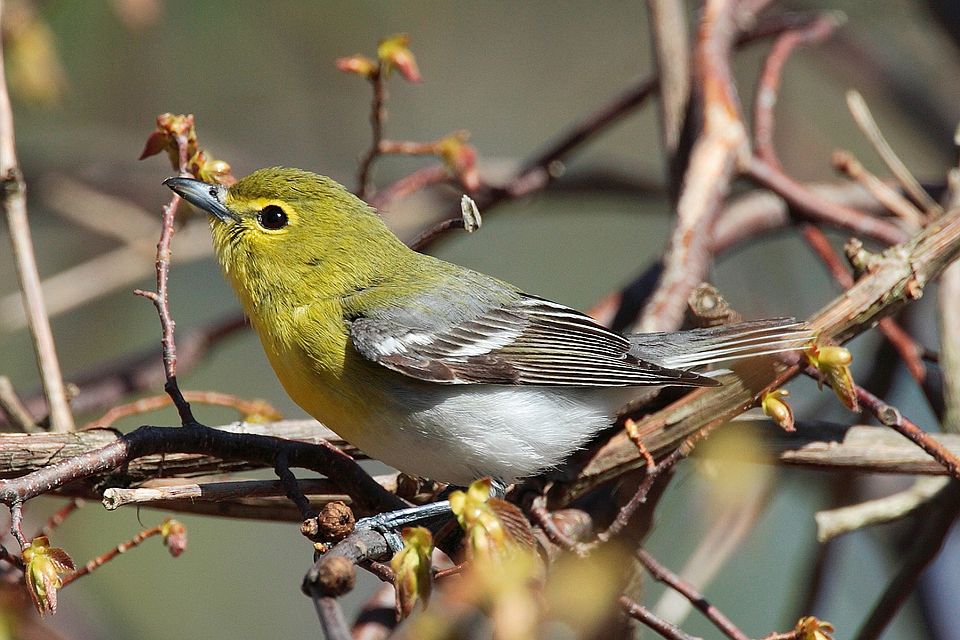
The Yellow-throated Vireo is the showiest member of an otherwise subdued family. While most vireos wear muted olives and grays, this one flashes a bold lemon-yellow throat and breast, set off by matching yellow "spectacles" around the eyes. It is a bird of mature deciduous woodland across the eastern United States, where it spends the breeding season high in the leafy crowns of oaks, maples, and sycamores, deliberately gleaning insects from twig to twig. Birders often hear it long before they see it: a slow, husky, two- and three-note song repeated patiently from the canopy.
Despite its bright plumage, the Yellow-throated Vireo can be surprisingly easy to overlook because it stays high and moves slowly. It is not a hyperactive warbler-style sprite but a heavier, more methodical forager that pauses often. The species declined in parts of its range during the mid-20th century, likely from forest fragmentation and pesticide use, but populations have largely recovered and the bird is now considered stable. For anyone learning to bird by ear in eastern woods, separating its burry phrasing from the sweeter song of the Red-eyed Vireo is a satisfying milestone.
This is a compact, big-headed songbird with a thick, slightly hooked vireo bill and a fairly short tail. It is chunkier and slower-moving than a warbler, and the combination of a vivid yellow throat with crisp white wing bars is distinctive among eastern vireos.
| Throat & breast | Bright lemon-yellow throat and upper breast, sharply set against a clean white belly |
| Spectacles | Bold yellow eye-ring connected to a yellow patch in front of the eye (lores), forming "spectacles" |
| Wings | Gray wings with two crisp white wing bars |
| Upperparts | Olive-green head and back contrasting with a grayer rump and tail |
| Bill | Thick, pale blue-gray, slightly hooked at the tip |
| Size & shape | Small but stocky with a large head and short tail; slow, deliberate movements |
Male vs. female
Males and females look alike. Both sexes show the same bright yellow throat, yellow spectacles, white wing bars, and olive upperparts, so you cannot reliably sex a Yellow-throated Vireo in the field by plumage alone. In a breeding pair, behavior is the clearest clue: the singing bird is almost always the male, though females do give quieter calls.
Juveniles
Juveniles and fresh fall immatures resemble adults but tend to look a touch duller and softer, with slightly buffier or paler yellow on the throat and somewhat less crisp wing bars. The basic field-mark package (yellow spectacles, yellow throat, white belly, two wing bars) is present from the time young birds leave the nest, so even hatch-year birds are recognizable as Yellow-throated Vireos with a good look.
The song is a leisurely series of short, burry, low-pitched phrases separated by clear pauses, often rendered as "three-eight... see-you... too-late" or a husky "eyeore, eyeore." Compared with the Red-eyed Vireo's endless, sweeter, run-on phrasing, the Yellow-throated's voice is slower, raspier, and lower, with noticeably longer silences between phrases. It sings persistently through the day, even in midsummer heat when many birds fall quiet.
Its calls include a harsh, scolding, chattering rattle or "chee-chee-chee" given when agitated, similar in quality to other vireo scold notes but distinctive once learned.
The Yellow-throated Vireo breeds across the eastern United States and into southern Canada, from the Great Plains east to the Atlantic coast and from the Gulf states north to the Great Lakes, New England, and southern Ontario. It favors mature deciduous and mixed forest, especially open woodland edges, riparian groves, and tall shade trees in parks and rural neighborhoods.
It is a long-distance migrant. Most birds leave the breeding grounds by September, crossing the Gulf of Mexico to winter from southern Mexico and Central America south to northern South America, with some wintering in the Caribbean. Spring migrants return to the southern United States in April and reach the northern edge of the range by May.
The Yellow-throated Vireo is primarily insectivorous through the breeding season, taking caterpillars, moths, beetles, true bugs, stinkbugs, and other arthropods, along with the occasional spider. It forages by methodically gleaning prey from leaves and twigs high in the canopy, moving slowly and deliberately and frequently pausing to scan, sometimes hovering briefly to pluck an insect from the underside of a leaf.
In late summer and on the wintering grounds it adds small fruits and berries to its diet. This more varied diet helps fuel migration and sustain the bird through the tropical winter.
Both members of a pair help build the nest, a neat cup suspended by its rim in the fork of a horizontal branch, often well up in a deciduous tree. The nest is woven from grasses, bark strips, and plant fibers, bound with spider silk and decorated on the outside with lichen and mosses that help camouflage it against the bark.
The female typically lays 3 to 5 creamy or pinkish-white eggs lightly spotted with brown. Both parents share incubation and later feed the nestlings. Like many woodland songbirds, the Yellow-throated Vireo is sometimes parasitized by the Brown-headed Cowbird, which lays its eggs in the vireo's nest.
The Yellow-throated Vireo is not a feeder bird and will not visit seed or suet stations, since it forages for insects high in the treetops. You attract it through habitat rather than food, and the best way to enjoy one is to learn its song and watch the canopy of mature trees.
- Preserve large, mature deciduous trees such as oaks, maples, and sycamores, which provide the high, leafy canopy this vireo needs.
- Maintain wooded edges and tall shade trees in yards bordering forest, parks, or riparian corridors, the habitat the species favors.
- Avoid broad-spectrum insecticides so caterpillars and other insect prey remain abundant in the tree canopy.
- Learn the slow, burry song so you can detect birds that stay hidden in the treetops during May and June.
- Support native plantings and forest conservation at the neighborhood scale, since this bird depends on healthy, connected woodland rather than backyard handouts.
- Pine Warbler: Also yellow-throated with white wing bars, but it is a slimmer warbler with a thin pointed bill (not a thick hooked vireo bill), lacks the bold yellow spectacles, and favors pines.
- White-eyed Vireo: Shares yellow spectacles and white wing bars but has yellow flanks (not a yellow throat), a white throat, a pale eye in adults, and skulks low in thickets rather than the canopy.
- Blue-headed Vireo: Has the same bold white-rimmed spectacles and wing bars but shows a blue-gray head, white throat, and yellow-washed flanks instead of a bright yellow throat.
- Red-eyed Vireo: Similar size and canopy habits but lacks wing bars and yellow throat; shows a gray cap, white eyebrow stripe, and dark eyeline, with a sweeter run-on song.
What does a Yellow-throated Vireo look like?
It is a small, stocky songbird with a bright lemon-yellow throat and breast, bold yellow "spectacles" around the eyes, two white wing bars on gray wings, olive-green upperparts, and a clean white belly. The thick, slightly hooked bill marks it as a vireo rather than a warbler.
How do I tell a Yellow-throated Vireo from a Pine Warbler?
Both have a yellow throat and white wing bars, but the vireo has a thick hooked bill, bold yellow spectacles, and a clean white belly, while the Pine Warbler has a thin pointed bill, no spectacles, and more diffuse yellow that blends down the breast. The vireo also moves more slowly.
What does the Yellow-throated Vireo sound like?
It sings a slow, husky, low-pitched series of two- and three-note phrases with long pauses between them, often described as a burry "three-eight... see-you" or "eyeore, eyeore." It is raspier and slower than the sweet, run-on song of the Red-eyed Vireo.
Where do Yellow-throated Vireos live?
They breed in mature deciduous and mixed forest across the eastern United States and into southern Canada, favoring tall shade trees, woodland edges, and riparian groves. They migrate to Mexico, Central America, the Caribbean, and northern South America for the winter.
Will Yellow-throated Vireos come to a bird feeder?
No. They are insect-eaters that forage high in the tree canopy and do not visit seed or suet feeders. The best way to attract them is to keep mature trees, maintain wooded habitat, and avoid pesticides, then learn their song to find them.