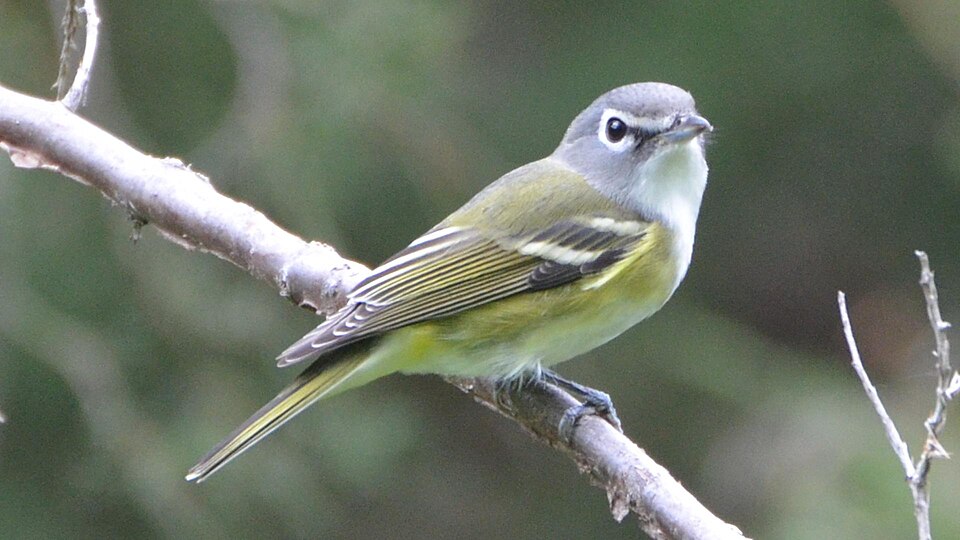
The Blue-headed Vireo is one of the most handsome members of its family, a small, sturdy songbird with a clean blue-gray hood, sharp white "spectacles," and bright yellow flanks set against gray-green upperparts. Once lumped together with the Cassin's and Plumbeous vireos under the single name "Solitary Vireo," it was split into its own species in 1997, and it remains the most colorful and crisply marked of that trio. It breeds across the cool conifer and mixed forests of Canada, the northeastern United States, and down the spine of the Appalachians.
For many birders, the Blue-headed Vireo is a welcome harbinger of the seasons. It is among the earliest vireos to arrive in spring and one of the latest to leave in fall, and its slow, deliberate movements through the foliage make it easier to study than most warblers. It is generally tame and unbothered by observers, often pausing to peer down at a quiet birder with its big-eyed, deliberate gaze. Though it isn't a feeder bird, it is a rewarding find for anyone walking a wooded trail in migration or breeding season.
The Blue-headed Vireo is a compact, big-headed songbird, chunkier and slower-moving than a warbler, with a stout, slightly hooked bill typical of vireos. Its combination of a clean gray-blue head, bold white spectacles, and contrasting yellow sides makes it one of the easier vireos to identify with confidence.
| Head | Solid blue-gray hood that contrasts sharply with a white throat |
| Spectacles | Bold, complete white eye-ring connected to the bill by a white loral line, forming clean 'spectacles' |
| Underparts | White throat and breast with bright yellow-green flanks and sides |
| Wings | Two crisp yellowish-white wingbars on dark wings; yellow-edged flight feathers |
| Upperparts | Olive-green back contrasting with the grayer head |
| Bill & shape | Short, thick, slightly hooked bill; stocky build with a large-headed look |
Male vs. female
Males and females look essentially alike, and they cannot be reliably told apart in the field. Both sexes show the same blue-gray hood, white spectacles, and yellow flanks. Females may average very slightly duller, but the difference is too subtle to use for identification. Pairs are most easily distinguished by behavior during the breeding season, when the singing bird is usually the male.
Juveniles
Freshly fledged juveniles resemble adults but are softer and slightly buffier overall, with a browner-gray head and less crisply defined spectacles. By early fall, immatures have molted into a plumage very close to that of adults, often looking especially bright and clean, with vivid yellow flanks and bold wingbars. At that point they are difficult to separate from adults in the field.
The song is a series of short, sweet, slurred phrases delivered with deliberate pauses between them, often described as a slow, musical conversation: "see-me... here-I-am... over-here... cheerio." The phrases rise and fall in pitch and have a slightly sweeter, higher quality than the harsher, burrier song of the Red-eyed Vireo. Males can sing persistently through the heat of midday when many other birds fall silent.
Common calls include a harsh, scolding, descending "chway" or a nasal, chattering "shree-shree-shree" rattle given when agitated or defending territory. These churring scold notes are a good clue to a bird hidden in dense foliage.
Blue-headed Vireos breed across a broad band of southern Canada, from the Maritimes and Quebec west through Ontario, and across the northern United States from New England and the Great Lakes region. A second arm of the breeding range follows the Appalachian Mountains south through Pennsylvania and West Virginia into the highlands of Georgia. They favor cool, moist coniferous and mixed forests, particularly stands with hemlock, spruce, fir, and pine.
In winter they retreat to the southeastern United States, from the Carolinas and Gulf Coast through Florida and Texas, and on into eastern Mexico and Central America. They are notably hardy for a vireo, arriving early in spring and lingering late into fall, so they are often among the first and last migrant songbirds of the season across the East.
The Blue-headed Vireo is primarily an insect eater, gleaning caterpillars, beetles, true bugs, moths, and other arthropods from leaves and twigs. It forages methodically, hopping along branches and peering deliberately into the foliage, often hanging or reaching to pluck prey from the undersides of leaves. Compared with the quick, flighty warblers it often travels alongside, it moves at an unhurried, almost contemplative pace.
In late summer, fall, and on the wintering grounds, it supplements its diet with small fruits and berries, including those of dogwood, sumac, wax myrtle, and Virginia creeper. This flexibility helps it remain farther north later in the season than most insect-dependent migrants.
The nest is a neat, cup-shaped basket suspended by its rim from a horizontal fork of a branch, typically placed at low to moderate height in a conifer or understory tree or shrub. Both members of the pair build it, weaving together bark strips, grasses, plant fibers, and spider silk, and often decorating the exterior with lichen, moss, or bits of papery birch bark.
A typical clutch is three to five eggs, white with sparse dark spotting concentrated toward the larger end. Both the male and female share incubation, which lasts roughly two weeks, and both parents feed the nestlings. Blue-headed Vireos are frequent hosts to Brown-headed Cowbird parasitism, though their relatively early and northern breeding helps some pairs avoid it.
The Blue-headed Vireo is not a feeder bird and will not visit seed or suet. It is an insect-and-fruit specialist of wooded habitat, so the way to attract it is to offer the kind of forest it needs rather than a feeding station.
- Keep mature trees and conifers. Hemlock, spruce, pine, and mixed woods provide the cool, shaded forest layers this vireo prefers for foraging and nesting.
- Plant native fruiting shrubs. Dogwood, sumac, wax myrtle, and Virginia creeper supply the berries it eats in late summer and fall.
- Avoid pesticides. Caterpillars and other insects are its core food; a chemical-free yard keeps the buffet stocked.
- Offer water. A clean birdbath, especially a moving or dripping source, can draw migrants passing through wooded yards.
- Watch during migration. If you live near woodlands, scan mixed flocks in spring and fall, this is when a yard with good tree cover is most likely to host one.
- Cassin's Vireo: Western counterpart; duller and grayer overall with a less contrasting, washed-out gray head and dingier spectacles. Ranges barely overlap.
- Plumbeous Vireo: Gray and white with little or no yellow and a gray (not blue-gray) head. Found in the interior West, separating it geographically.
- Red-eyed Vireo: Lacks white spectacles and wingbars; has a gray cap bordered by black, a white eyebrow stripe, and a dark eyeline, plus red eyes in adults.
- Warbling Vireo: Plain and pale with no wingbars and only a faint pale eyebrow; lacks the bold spectacles and yellow flanks.
What is the difference between a Blue-headed Vireo and a Solitary Vireo?
They are the same bird historically. 'Solitary Vireo' was the old name for a single species that was split in 1997 into three: the Blue-headed Vireo (East), Cassin's Vireo (West Coast), and Plumbeous Vireo (interior West). The Blue-headed is the brightest of the three, with a blue-gray head and yellow flanks.
How do I tell a Blue-headed Vireo from a Red-eyed Vireo?
Look for the bold white spectacles and two white wingbars on the Blue-headed Vireo. The Red-eyed Vireo has no spectacles or wingbars; instead it shows a white eyebrow stripe, a dark line through the eye, a gray cap, and (in adults) red eyes.
Will Blue-headed Vireos come to a bird feeder?
No. They eat insects and small fruits and do not visit seed or suet feeders. To attract them, maintain wooded habitat with conifers and native berry-producing shrubs, avoid pesticides, and offer a water source.
When do Blue-headed Vireos migrate?
They are hardy migrants, arriving early in spring (often April in much of the East) and leaving late in fall (into October and November). This makes them among the first and last migrant songbirds of the season.
Where do Blue-headed Vireos build their nests?
They build a hanging cup nest suspended from a horizontal branch fork, usually at low to moderate height in a conifer or understory shrub. Both parents build the nest, share incubation, and feed the young.