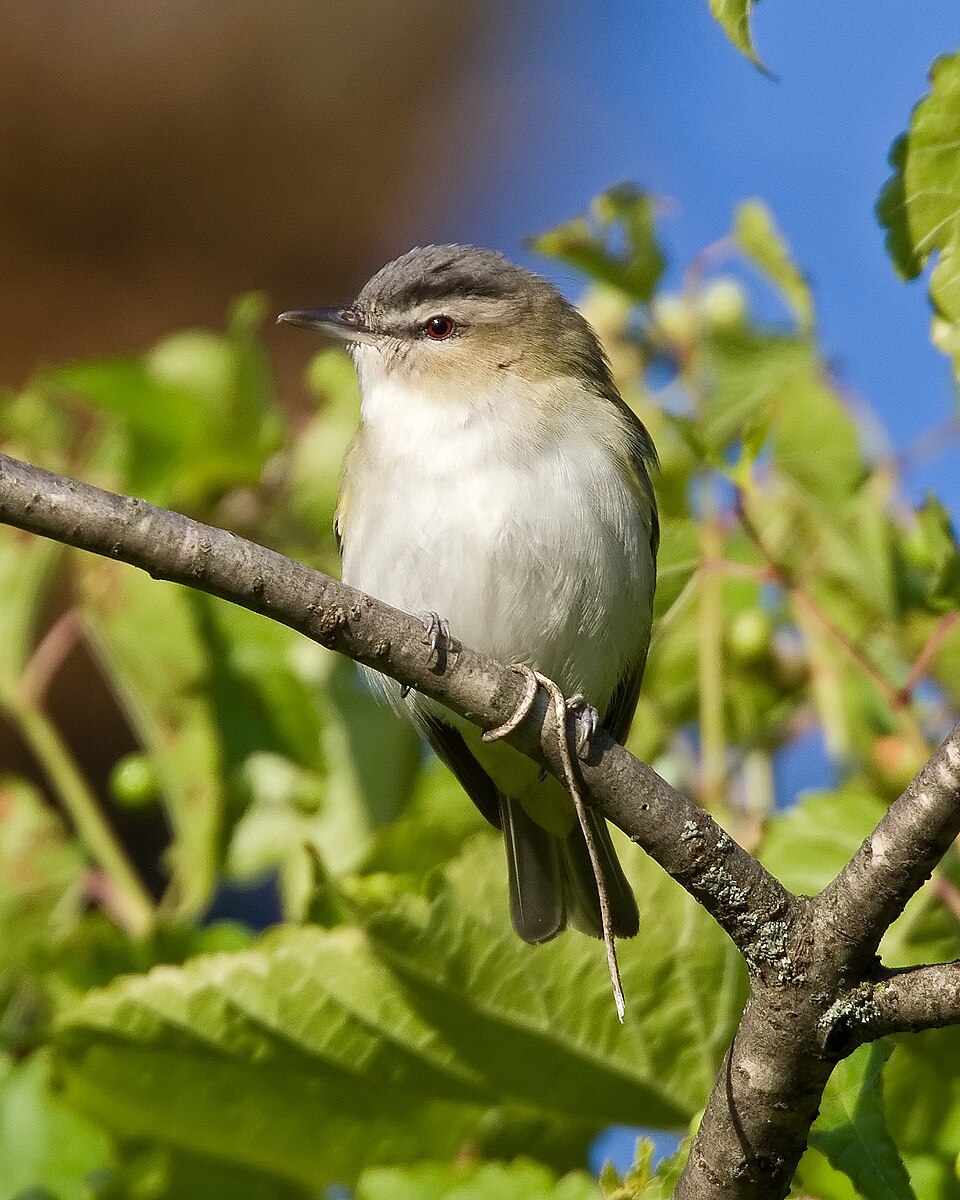
The Red-eyed Vireo is one of the most abundant songbirds in eastern North American forests, yet most people have heard it far more often than they have seen it. Through the long, hot days of summer it stays high in the leafy canopy, working slowly through the foliage and delivering its short, robin-like phrases over and over from dawn until the heat of midday and well beyond. If you have ever stood in a green woodland in June and wondered what bird simply would not stop singing, there is a very good chance it was this one.
It is a plain bird at first glance, olive-green above and clean white below, but a closer look reveals a crisp face pattern and the ruby-red eye that gives the species its name. The Red-eyed Vireo is also a champion long-distance migrant, wintering deep in the Amazon Basin of South America and returning each spring to breed across a huge swath of Canada and the United States. For many birders, learning to recognize its endless song is one of the first real steps into the world of "birding by ear."
The Red-eyed Vireo is a small, sturdy songbird with a noticeably heavier, slightly hook-tipped bill than a warbler, and a more deliberate, methodical way of moving through the leaves. It has a fairly flat-crowned, big-headed look, a relatively short tail, and overall rather drab plumage that makes the bold head pattern its most useful field mark.
| Crown | Gray cap with a thin dark border, contrasting with the olive-green back |
| Eyebrow | Bold white eyebrow stripe (supercilium) with a dark line through and above the eye |
| Eye | Deep red iris in adults; appears dark at a distance or in poor light |
| Underparts | Clean white below, often with a faint yellow wash on the flanks and undertail |
| Wings | Plain olive wings with NO wing bars - a key separator from many warblers and other vireos |
| Bill | Thick, gray, slightly hooked at the tip - heavier than a warbler's fine bill |
Male vs. female
Males and females look alike. There is no visible difference in plumage, size, or the red eye color between the sexes, so in the field you cannot reliably tell them apart by sight. Behavior is the best clue during breeding season: it is almost always the male doing the relentless daytime singing, while the female does the great majority of nest building and incubation.
Juveniles
Juveniles and first-fall birds look much like adults but are duller and softer-edged overall. The most telling difference is the eye: young birds have a dark brown or grayish-brown iris rather than the adult's red, and it can take until the following spring for the full ruby color to develop. Immatures in fall often show a slightly stronger yellow wash on the flanks and undertail coverts, which sometimes causes confusion with other plain vireos.
The song is the signature of this species: an endless series of short, abrupt, robin-like phrases separated by brief pauses, sounding like a question-and-answer delivered to no one in particular - "Here I am... where are you... up here... see me?" Each phrase is a couple of slurred notes, and the bird may repeat the pattern thousands of times a day, often through the heat of midday when most other birds fall silent. One famous count tallied a single male singing more than 20,000 times in a day.
The most distinctive call is a nasal, whining, downslurred "myaah" or "tsway," often given when an intruder is near the nest or during fall migration. Learning the persistent, sing-song phrasing of the song is one of the most reliable ways to detect this canopy-dwelling bird, since it is heard far more easily than seen.
Red-eyed Vireos breed across an enormous range, from the boreal edge of central and eastern Canada south through nearly all of the eastern United States, west across the northern Plains, and into parts of the Pacific Northwest. They favor deciduous and mixed forests with a good leafy canopy, and they are among the most numerous breeding birds in many eastern woodlands.
They are true long-distance migrants. In fall they head to the western Amazon Basin of South America, crossing the Gulf of Mexico on the way, and they return north in spring. Migration brings them through a much wider variety of habitats, including parks, woodlots, and backyard trees, so spring and fall are the seasons when birders in towns and cities are most likely to cross paths with one.
During the breeding season the Red-eyed Vireo is heavily insectivorous, gleaning caterpillars, moths, beetles, true bugs, and other arthropods from the leaves of the upper canopy. It forages with a slow, deliberate, almost sluggish style, peering carefully at the undersides of leaves and reaching or hovering briefly to pick prey, rather than flitting about quickly the way warblers do. Caterpillars are an especially important food, and the species is a notable consumer of forest pest insects.
In late summer and fall, fruit becomes a major part of the diet. The birds switch readily to small berries - including those of dogwood, Virginia creeper, sumac, spicebush, and various wild grapes - which help fuel the long migration to South America.
The nest is a tidy, cup-shaped basket suspended in the fork of a horizontal branch, usually well out from the trunk and anywhere from a few feet to high in the canopy. The female does nearly all of the building, weaving together grasses, bark strips, plant fibers, and rootlets and binding the whole thing with spider silk, often decorating the outside with bits of lichen, paper, or birch bark.
She lays a clutch of typically three or four white eggs lightly spotted at the larger end, and incubates them on her own for roughly two weeks. Both parents feed the nestlings. Red-eyed Vireos are frequent hosts of the Brown-headed Cowbird, which lays its eggs in vireo nests; an alert vireo will sometimes abandon a heavily parasitized nest, but many end up raising cowbird young.
The Red-eyed Vireo is not a feeder bird - it will not come to seed, suet, or nectar, and it spends most of its time high in the leaf canopy hunting insects. That said, you can absolutely make your property more inviting to migrants and breeders, and the payoff is hearing that famous song from your own trees.
- Keep tall, leafy trees. Mature deciduous trees with a dense canopy are exactly the habitat this vireo needs for foraging and nesting.
- Plant native, fruit-bearing shrubs and vines such as dogwood, Virginia creeper, spicebush, and wild grape to feed fall migrants fueling up for South America.
- Avoid pesticides. Caterpillars and other insects are the core of this bird's summer diet, so a chemical-free yard supports far more food.
- Offer a clean water source. A birdbath or shallow moving water can draw in vireos and many other migrants during spring and fall passage.
- Learn the song. Because it stays hidden in the canopy, your ears will find this bird long before your eyes do - listen for the endless robin-like phrasing on summer days.
- Warbling Vireo: Plainer face with a less distinct eyebrow, no dark border on the crown, a paler overall look, and a rambling warbled song rather than short separated phrases.
- Philadelphia Vireo: Smaller, with a yellow wash across the underparts (especially the throat and chest) and a dark spot in front of the eye; dark eye, not red. Song is slower and higher than Red-eyed.
- Tennessee Warbler: Superficially similar plain greenish bird with a white eyebrow, but has a thin pointed warbler bill, moves quickly, and lacks the gray cap and red eye.
- Black-whiskered Vireo: Very similar but has a dark whisker (malar) stripe and is largely restricted to coastal Florida and the Caribbean.
Why does the Red-eyed Vireo sing all day long?
Males sing almost nonstop through the breeding season - even in the midday heat when most birds go quiet - to defend their territory and attract a mate. A single male can deliver well over 10,000 short phrases in a day, which is why the species is sometimes nicknamed the 'preacher bird.'
Do Red-eyed Vireos really have red eyes?
Adults do have a deep red iris, but it is easy to miss. At a distance, in shade, or in poor light the eye simply looks dark. Young birds have brown eyes that turn red over their first year, so a dark eye does not rule out the species.
How do I tell a Red-eyed Vireo from a warbler?
Look at the bill and the way it moves. Vireos have a thicker, slightly hooked bill and forage slowly and deliberately, peering under leaves, while warblers have fine pointed bills and flit about quickly. The Red-eyed Vireo also has a bold white eyebrow, a gray cap with a dark border, and no wing bars.
Where do Red-eyed Vireos go in winter?
They are long-distance migrants that leave North America entirely, wintering in the western Amazon Basin of South America. They cross the Gulf of Mexico during migration and return north each spring to breed.
Will Red-eyed Vireos come to a bird feeder?
No. They are canopy insect-eaters that switch to wild berries in fall, and they do not visit seed, suet, or nectar feeders. The best way to attract them is to maintain leafy native trees and fruiting shrubs and to avoid pesticides.