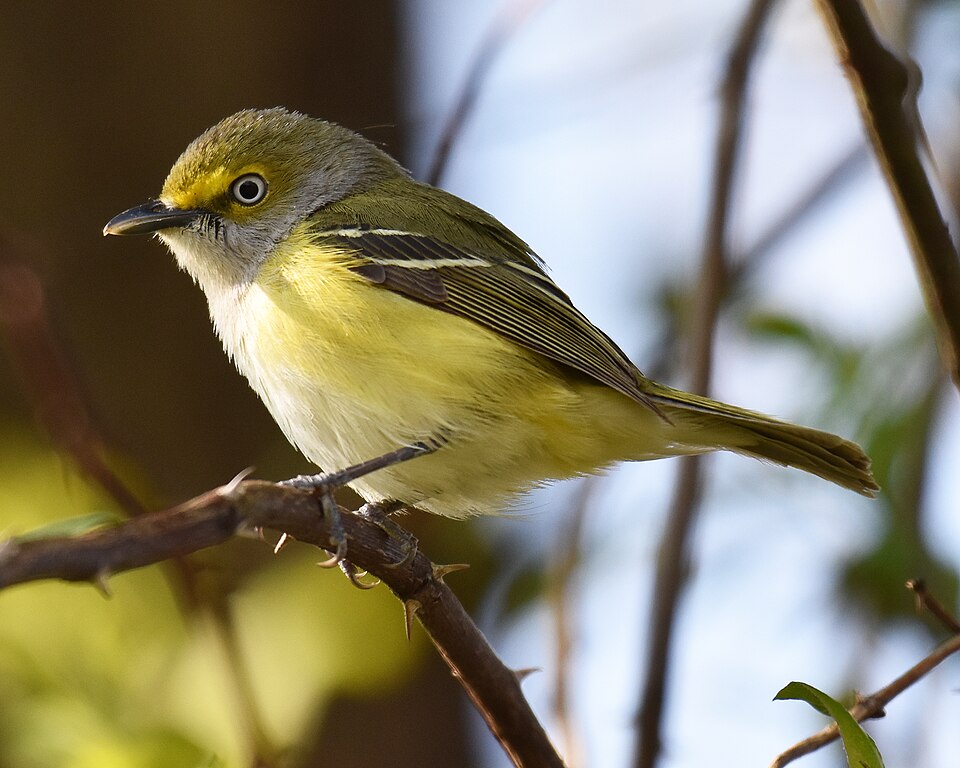
The White-eyed Vireo is one of those birds you almost always hear before you see. Tucked into dense thickets, hedgerows, and overgrown field edges across the eastern and southern United States, this small, stocky songbird announces itself with a snappy, almost percussive song that seems far too loud for a bird you can rarely lay eyes on. When you finally do spot one, the payoff is that startling pale eye set in a green-and-yellow face, a field mark unlike anything else in its tangled habitat.
Despite the "vireo" reputation for being plain and slow-moving, the White-eyed Vireo has an outsized personality. It is curious, scolds intruders readily, and is a gifted mimic that weaves snatches of other birds' calls into its own song. For backyard birders living near brushy second-growth or weedy creek bottoms, it is a rewarding bird to learn, common enough to find with a little patience, distinctive enough to never be confused once you know it.
The White-eyed Vireo is a small, compact songbird with a relatively large head, a short neck, and a stout, slightly hooked vireo bill that is heavier than a warbler's. It moves deliberately and low in vegetation rather than flitting acrobatically. Overall it looks olive-green above and whitish below, brightened by yellow on the flanks and a pair of bold yellow "spectacles."
| Eye | Whitish to pale yellow iris in adults, the namesake feature, visible at close range and unique among small eastern songbirds |
| Spectacles | Bright yellow loral spots and eye-ring connect to form bold yellow 'spectacles' around the eye |
| Upperparts | Olive-green back, crown, and nape; two whitish wing bars on darker wings |
| Underparts | Whitish throat and belly with distinctly yellow sides and flanks |
| Bill | Short, thick, blue-gray with a faint hook at the tip, heavier than a warbler's |
| Size & shape | Small and stocky with a large head; about warbler-sized but chunkier and more sluggish in movement |
Male vs. female
Males and females look essentially identical. Both sexes show the same olive upperparts, yellow spectacles, white iris, and yellow flanks, and they cannot be reliably told apart in the field by plumage. In the hand or with prolonged study during breeding season, males may average slightly larger, but for practical birding purposes you should treat the sexes as alike. Behavior is a better clue than appearance: only the male delivers the loud territorial song, so a singing bird in spring is almost certainly a male.
Juveniles
Juvenile and first-fall White-eyed Vireos differ from adults mainly in the eye. Young birds have a dark grayish or brownish iris rather than the staring white eye, and the iris gradually pales to whitish over their first winter. Otherwise immatures resemble adults but can look slightly grayer and duller, with the yellow spectacles and flanks somewhat muted. A fall vireo in brushy habitat with a dark eye but obvious yellow spectacles is very likely a young White-eyed Vireo.
The song is the bird's signature. It is a sharp, explosive, jumbled phrase that classic field guides render as "Quick, with the beer, check!" or "Chick-per-weeoo-chick." It typically begins and ends with a hard, sharp chick note, with sweeter, slurred whistles sandwiched in the middle. The whole burst lasts only a second or two but carries surprisingly far and is delivered repeatedly from cover.
White-eyed Vireos are also accomplished mimics, frequently borrowing fragments of other species' calls, Great Crested Flycatcher, Eastern Towhee, and various warblers, and stitching them into their phrases. Common calls include a harsh, scolding, descending chatter and a nasal mewing note given when agitated or scolding an intruder near the nest.
The White-eyed Vireo breeds across the eastern and south-central United States, from roughly the lower Great Lakes and southern New England south through the Atlantic and Gulf coastal plains, the Southeast, and into eastern Texas. Its range has expanded somewhat northward in recent decades. It favors shrubby, early-successional habitats, overgrown fields, woodland edges, brushy thickets, swamp borders, and dense regrowth.
Northern breeders are migratory, withdrawing in fall to winter along the Gulf Coast, throughout Florida, and south into eastern Mexico, the Yucatan, and parts of Central America and the Caribbean. Birds in Florida, the Gulf states, and coastal Texas are largely resident year-round. Spring migrants return to northern breeding grounds in April and May.
The White-eyed Vireo is primarily insectivorous through the breeding season, gleaning caterpillars, moths, beetles, bugs, spiders, and other small arthropods from leaves, twigs, and the inner branches of dense shrubs. It forages methodically and rather slowly compared with warblers, hopping along branches and peering under foliage, often staying within a few feet of the ground in thick cover.
In late summer, fall, and on the wintering grounds, it shifts to include a substantial amount of fruit. It readily eats small berries and the fleshy fruits of plants like wax myrtle, sumac, poison ivy, and various wild shrubs, which helps fuel migration and sustain resident birds through winter when insects are scarce.
The nest is a neat, deep little cup suspended hammock-style from a forked horizontal twig, usually low, often within three to six feet of the ground in a shrub or sapling. Both members of the pair build it, weaving together bark strips, grasses, leaves, and plant fibers and binding the outside with spider silk, frequently decorating it with bits of lichen, paper, or wasp-nest material.
The female typically lays three to four white eggs lightly speckled with brown or black. Both parents share incubation, which lasts roughly two weeks, and both feed the nestlings, which fledge about nine to eleven days after hatching. White-eyed Vireos are frequent hosts to Brown-headed Cowbird parasitism, and pairs will sometimes abandon a heavily parasitized nest and renest. In the southern part of the range they may raise two broods in a season.
The White-eyed Vireo is not a feeder bird and will not visit seed or suet, but it can be a regular presence on properties that offer the right habitat. The key is dense, brushy cover rather than tidy, manicured landscaping.
- Leave a brushy, unmowed corner or hedgerow, White-eyed Vireos love dense, tangled thickets and overgrown edges more than open lawn or tall trees.
- Plant or preserve native fruiting shrubs such as wax myrtle, sumac, blackberry, and viburnum to supply both insects and the berries these birds eat in fall and winter.
- Avoid broad-spectrum insecticides, a healthy population of caterpillars and other insects in your shrubs is the bird's main breeding-season food.
- Provide a shallow ground-level or low water source; like many thicket birds, vireos will come to drink and bathe at quiet, sheltered water.
- Be patient and listen, learn the explosive 'Quick-with-the-beer-check!' song, since you will usually detect this bird by ear long before you see it.
- Keep some low, dense vegetation near water or field edges to provide the nesting cover they need within a few feet of the ground.
- Bell's Vireo: Also a thicket-loving vireo with spectacles, but has a dark eye, duller grayer-green plumage, weaker wing bars, and a different, more rambling song; ranges overlap mainly in the south-central US.
- Blue-headed Vireo: Has bold white (not yellow) spectacles, a contrasting blue-gray head, a dark eye, and prefers forest rather than low brush.
- Yellow-throated Vireo: Larger and brighter with a yellow throat and breast and yellow spectacles, but a dark eye; forages high in tree canopy rather than low in thickets.
- Common Yellowthroat: Shares brushy wetland edges and yellow tones, but is a warbler with a thin bill, dark eye, and (in males) a black mask; lacks wing bars and the white iris.
Do White-eyed Vireos really have white eyes?
Yes. Adults have a pale whitish to faintly yellow iris that gives the bird its name and stands out at close range. Young birds hatch with a dark eye that gradually turns white over their first winter, so a brown-eyed bird with yellow spectacles in fall is usually a juvenile White-eyed Vireo.
What does a White-eyed Vireo song sound like?
It is a sharp, explosive, jumbled burst about a second long, often described as 'Quick, with the beer, check!' It typically starts and ends with a hard chick note. The bird is also a mimic and may insert snatches of other species' calls into its phrases.
Will White-eyed Vireos come to my bird feeder?
No. They do not eat seed or suet and won't visit feeders. They feed on insects and small berries in dense shrubs. The way to attract them is to provide brushy thickets, native fruiting shrubs, and a sheltered low water source rather than feeders.
Where do White-eyed Vireos live?
They breed across the eastern and south-central US in shrubby, overgrown habitats such as woodland edges, brushy fields, and swamp borders. Northern birds migrate to the Gulf Coast, Florida, Mexico, and Central America for winter, while birds in the Deep South and Florida are year-round residents.
How can I tell a White-eyed Vireo from a warbler?
Look for the heavier, slightly hooked vireo bill, the slow and deliberate foraging style low in cover, the bold yellow spectacles, and especially the white iris in adults. Warblers have thin pointed bills, dark eyes, and move more quickly and acrobatically.