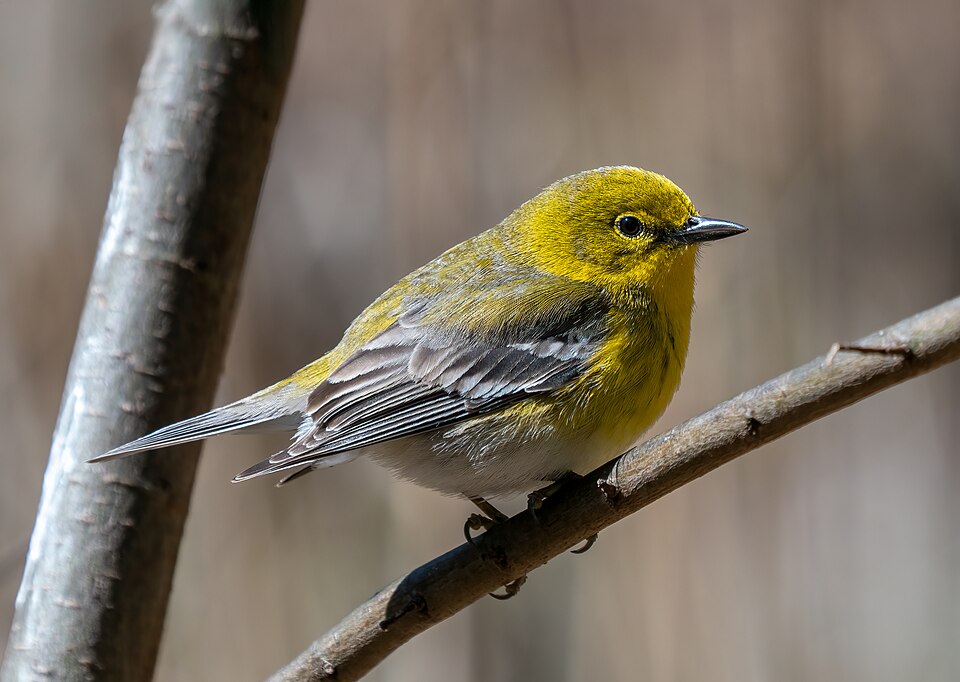
The Pine Warbler is the rare warbler that lives up to its name with near-perfect honesty. As its name promises, it is a bird of pine forests, and across much of the eastern United States you can reliably find one simply by walking into a stand of pines and listening for a steady, musical trill drifting down from the canopy. It is a chunky, slow-moving warbler compared to its hyperactive relatives, and that unhurried manner is one of the first clues to its identity.
What makes the Pine Warbler special to backyard birders is its willingness to break the usual warbler rules. Most wood-warblers are strictly insect-eaters that pass through quickly on migration and ignore feeders entirely. The Pine Warbler, by contrast, eats seeds readily, will visit suet and platform feeders in winter, and is among the few warblers that some lucky homeowners can watch from a kitchen window. It is also a hardy bird that winters in the southeastern states rather than fleeing to the tropics, making it a familiar year-round companion across the South.
The Pine Warbler is a medium-sized, fairly stocky warbler with a relatively long tail, a longish, slightly heavy bill, and a smooth, unstreaked back. Its movements are deliberate, and it often clings to pine bark or shuffles along branches rather than flitting frantically. Plumage is variable and frequently muted, which makes structure and behavior as useful as color for a confident identification.
| Overall color | Olive-yellow above and on the breast in bright birds; duller grayish-olive to nearly brown in females and immatures |
| Wing bars | Two distinct white wing bars on otherwise plain wings |
| Face | Yellow 'spectacles' or eyebrow with a faint dark cheek smudge; a soft, open-faced look |
| Breast streaking | Blurry, diffuse olive streaks on the sides of the breast in adults (never crisp black streaks) |
| Belly | Whitish lower belly and undertail contrasting with the yellower chest |
| Bill & tail | Longish bill and long tail with white spots in the outer tail feathers, visible in flight |
Male vs. female
The sexes look broadly similar but differ in saturation. Adult males are the brightest, with a clean olive-yellow throat and breast, well-defined yellow spectacles, and crisp white wing bars. Females are noticeably duller and grayer, with a paler, more washed-out yellow underneath and less obvious streaking on the sides. In poor light a dull female can look almost gray-brown overall, and the wing bars and faint yellow on the face become the most reliable marks for telling her apart from other plain birds.
Juveniles
Juvenile and first-fall Pine Warblers are the trickiest plumage. They are often grayish-brown with little or no yellow, can show a brownish wash overall, and have muted wing bars. These drab fall birds are a classic identification headache and are responsible for many "confusing fall warbler" misidentifications. Look for the same structural clues as adults: the longish bill, long tail, unstreaked back, two wing bars, and the bird's slow, methodical foraging style. The white tail spots and a hint of yellow at the bend of the wing or on the breast help confirm it.
The Pine Warbler's song is a pleasant, musical trill on a single pitch, often described as a slow, rich version of a Chipping Sparrow or Dark-eyed Junco trill. It is softer and more liquid than the dry, mechanical buzz of a Chipping Sparrow, and the individual notes are often slow enough to count by ear, giving it a sweet, ringing quality. Birders sometimes render it as a loose tre-tre-tre-tre-tre that may rise or fall slightly and often slows or trails off at the end.
Because the song carries far through open pine woods, it is frequently the first sign the bird is present even when it stays high in the canopy. Call notes include a sharp, sweet chip or tsip, and in flight the bird gives a thin, high seet. Distinguishing the song from a Chipping Sparrow takes practice, but the Pine Warbler's trill is generally richer, more relaxed, and more musical.
The Pine Warbler is essentially a bird of eastern North America. It breeds across the eastern United States and into southeastern Canada wherever suitable pine forest occurs, from the pine barrens and woodlands of the Northeast and Great Lakes south through the vast pine belt of the Southeast. Its distribution closely mirrors the distribution of pines, so it can be patchy in regions where pines are scarce.
Unlike most warblers, it is a short-distance migrant and a hardy one. Northern breeders withdraw southward in fall, but the species winters entirely within the southeastern United States rather than heading to the tropics. Across the Deep South it is a year-round resident, present and singing through the winter, which is why southern birders encounter it so readily at feeders in the colder months.
In the breeding season the Pine Warbler eats mostly insects and spiders, which it gleans methodically from pine needles, bark crevices, and cone clusters. It often forages high in the canopy, creeping along branches and probing bark in a slow, nuthatch-like manner, and it will sometimes drop to the ground or flutter out to catch flying insects.
What sets this warbler apart is its appetite for plant food. In fall and winter it readily eats pine seeds, other seeds, and berries, and this flexible diet is exactly what allows it to winter farther north than its insect-dependent relatives. That same trait brings it to feeders, where it will take suet, peanut bits, sunflower hearts, and even cracked corn from platform and ground feeding stations.
True to form, the Pine Warbler nests in pines. The female builds a compact cup nest of grasses, bark strips, pine needles, twigs, and spider silk, typically placed high in a pine and often saddled near the end of a horizontal branch among the needle clusters, where it is well hidden from below. Nest heights vary widely but are frequently well up in the tree.
The female does most of the incubation, and both parents feed the nestlings. In the warm Southeast the species gets an early start and may raise two or even three broods in a season, while northern birds typically manage fewer. Pairs are often loosely solitary nesters scattered through suitable pine habitat rather than concentrated in colonies.
The Pine Warbler is one of the very few warblers you can realistically attract to a backyard, especially if you live in the Southeast and have pines nearby. It is most likely to visit in late fall and winter when insects are scarce and it leans on seeds and suet. Birders with mature pines on or near their property have the best odds.
- Offer suet or suet-based blends, which are among the most reliable foods for drawing Pine Warblers in cold weather.
- Provide shelled sunflower (hearts/chips) and peanut bits on a platform or tray feeder, since this warbler prefers to feed where it can perch and shuffle rather than cling to small ports.
- Try a ground or low platform feeder with cracked corn or mealworms, as Pine Warblers will feed lower than most warblers.
- Keep mature pines in or near your yard; the species rarely strays far from coniferous habitat and is far more likely to visit pine-rich neighborhoods.
- Add a shallow bird bath or moving water for drinking and bathing, which can draw birds that ignore feeders.
- Focus your efforts in winter and early spring in the southern states, when natural food is limited and feeder visits peak.
- Yellow-throated Vireo: Also yellow-breasted with white wing bars and 'spectacles,' but it is chunkier with a thicker, hooked bill, moves more sluggishly, and lacks the warbler's blurry breast streaks and white tail spots.
- Blackpoll Warbler: Drab fall Blackpolls share the wing bars and greenish tones, but they show crisper streaking, often have yellowish or pale legs/feet, and a streaked back rather than the Pine Warbler's plain back.
- Bay-breasted Warbler: Fall birds can look greenish with wing bars, but they are buffier below, lack distinct yellow spectacles, and have dark legs with a different, more compact shape.
- Yellow-rumped Warbler: Common winter companion in the same areas, but always shows a bright yellow rump patch and yellow side patches, plus a sharper face pattern and harder 'check' call.
Do Pine Warblers come to feeders?
Yes, more than almost any other warbler. Especially in fall and winter, Pine Warblers will visit suet, platform feeders, and ground feeders for sunflower hearts, peanut bits, and even cracked corn. They are most likely to show up in the Southeast where they winter and where pines are nearby.
What does a Pine Warbler sound like?
It sings a steady, musical trill on one pitch, like a slower, richer, more liquid version of a Chipping Sparrow or junco trill. The notes are often slow enough to nearly count, and the song carries well through open pine woods, frequently giving the bird away before you see it.
How do I tell a Pine Warbler from a Chipping Sparrow by song?
Both give a single-pitch trill, but the Pine Warbler's is generally slower, sweeter, and more musical, while the Chipping Sparrow's is drier, faster, and more mechanical or insect-like. With practice the Pine Warbler's richer, more relaxed quality becomes easy to recognize.
Are Pine Warblers year-round residents?
Across the southeastern United States, yes, they are present and even singing all winter. Birds that breed farther north migrate south in fall, but the species winters within the southern U.S. rather than heading to the tropics, which is unusual among warblers.
Why is the Pine Warbler so hard to identify in fall?
Females and especially young birds can be dull grayish-brown with little yellow and faint wing bars, making them classic 'confusing fall warblers.' Focus on structure and behavior: the longish bill, long tail, plain unstreaked back, two wing bars, white tail spots, and the bird's slow, deliberate foraging in pines.