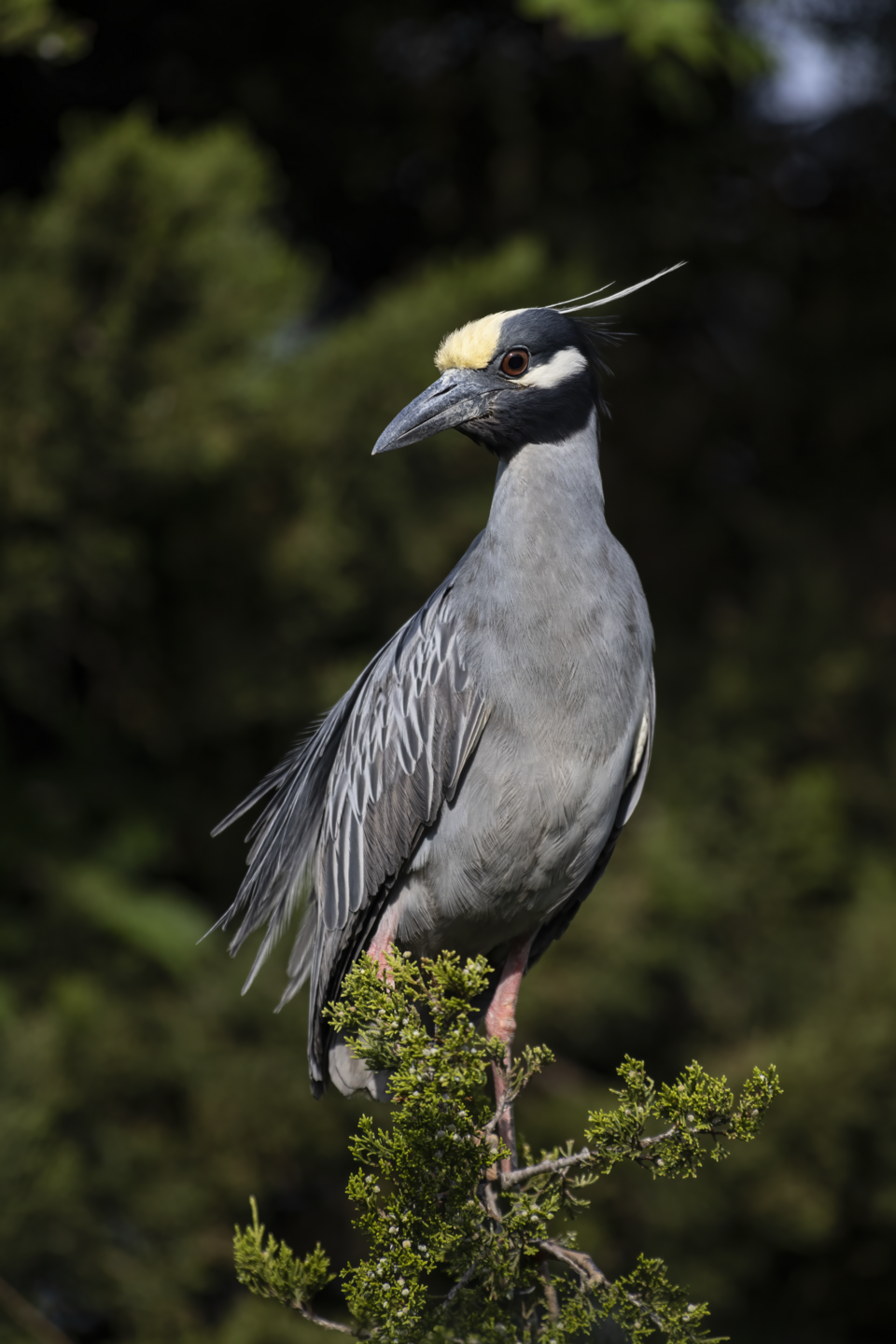
The Yellow-crowned Night Heron is a stocky, medium-sized heron with a personality all its own. Despite the "night" in its name, it is one of the more day-active members of its tribe and is frequently seen stalking the edges of marshes, mangroves, and coastal flats in broad daylight, especially where the tide governs when the crabs come out. Its boldly patterned black-and-white head set against a smooth, dove-gray body makes it one of the more elegant herons in North America, and once you learn its silhouette you'll start picking it out hunched at the water's edge.
This is a specialist at heart. Where the Black-crowned Night Heron is an opportunistic generalist, the Yellow-crowned has built its life around crustaceans, particularly crabs and crayfish, and its short, heavy bill is a tool engineered for cracking them open. It is a bird of warm and temperate coasts and wooded swamps, most common across the southeastern United States, but wandering individuals turn up well north of the breeding range. For backyard birders near tidal creeks, wooded ponds, or southern suburbs, it can be a thrilling and surprisingly approachable find.
Look for a compact, thick-necked heron that often stands in a hunched, patient posture with its bill angled slightly downward. It is noticeably chunkier and shorter-legged in proportion than the slender egrets, and its rounded head and stout bill give it a distinctive heavy-fronted profile even at a distance.
| Head pattern | Bold black head with a creamy-white cheek patch and a pale yellowish-white crown stripe running back over the crown; the namesake 'yellow crown' is often more whitish than gold |
| Body color | Smooth, clean blue-gray to slate-gray overall, with fine pale edging on the back feathers |
| Bill | Short, thick, and entirely black - heavier and blunter than other herons, built for crushing crabs |
| Eyes & legs | Large red-orange eyes; legs yellow to greenish, turning coral-pink or reddish in peak breeding condition |
| Plumes | Two or three long, white wispy head plumes trail off the back of the crown in breeding adults |
| Size & shape | Stocky and short-necked; in flight the legs and feet project well beyond the tail |
Male vs. female
Males and females look essentially identical in plumage, so you cannot reliably sex them by sight in the field. Both sexes carry the same black-and-white head pattern, gray body, and breeding plumes. Males average very slightly larger and may grow marginally longer head plumes, but this difference is too subtle to use with confidence on a lone bird. In a mated pair seen side by side, the male is sometimes the bulkier of the two, but behavior during courtship and nest-building is a far better clue than size.
Juveniles
Juveniles look very different from adults and are a common source of confusion. They are an overall grayish-brown, densely covered with small, neat whitish or buff spots and streaks, giving a finely peppered appearance rather than the bold pattern of the adult. The bill is mostly dark, and the head lacks the adult's black-and-white design. The best way to separate a young Yellow-crowned from a young Black-crowned is structure: the Yellow-crowned juvenile has a stouter, all-dark bill, longer legs that project farther past the tail in flight, and finer, more uniform spotting. It takes two to three years to acquire full adult plumage.
This is not a songbird, and most of what you'll hear is a sharp, barking call given in flight or when flushed. The typical note is a loud, abrupt quawk or kwok - higher pitched, shorter, and less guttural than the deeper quok of the Black-crowned Night Heron. Birders often describe the Yellow-crowned's call as more of a yapping, terrier-like bark.
Around the nest colony the birds become much noisier, adding a variety of clucks, croaks, and squawking notes during courtship and squabbles. Listen at dusk near tidal creeks and wooded swamps in summer, when birds calling overhead as they head out to feed are often the first sign that a colony is nearby.
The Yellow-crowned Night Heron breeds primarily across the southeastern and south-central United States, with the heaviest concentrations along the Gulf and southern Atlantic coasts, from Florida and Texas up through the Carolinas, and inland along major river systems. Its range extends south through Mexico, Central America, the Caribbean, and into parts of South America, where many populations are resident year-round.
Birds breeding in the northern part of the range are migratory, withdrawing south for the winter, so in places like the mid-Atlantic and lower Midwest it is a warm-season visitor. After the nesting season, young birds in particular are prone to wandering, and individuals show up well north of the normal range - sometimes reaching the Great Lakes, New England, and beyond, delighting birders far from the coast.
Crustaceans are the heart of this heron's diet. It feeds heavily on crabs - fiddler crabs, blue crabs, and other coastal species - along with crayfish in freshwater swamps, and it will also take insects, mollusks, small fish, frogs, and the occasional worm. That short, thick bill is the give-away to its specialty: it is built to seize and crush hard-shelled prey, and birds will often hammer or shake a crab apart before swallowing it, sometimes removing the legs first.
It hunts with the classic heron strategy of slow, deliberate stalking, freezing motionless and then striking, but it is more willing than many herons to forage by day, especially around low tide when crabs are exposed and active. You'll see it working the muddy margins of tidal creeks, mangrove roots, marsh edges, and wooded pond shorelines, picking its way along with a deliberate, hunched gait.
Yellow-crowned Night Herons nest in trees and shrubs, often over or near water, and may breed as isolated pairs or in small loose colonies, sometimes alongside other wading birds. They readily nest in wooded suburban areas, and a pair tucked into a backyard live oak or pine is a familiar sight in parts of the South. The nest is a platform of sticks, lined with finer twigs and leaves, that the pair builds together and frequently reuses and adds to in following years.
The female typically lays a clutch of pale blue-green eggs, and both parents share incubation over roughly three weeks. Both adults also feed the young, which grow quickly and clamber about the nest branches before they can fly. Pairs generally raise a single brood per season, though replacement clutches may follow a failed first attempt.
This is not a feeder bird, and you won't lure it with seed or suet - but it is one of the more "backyard-friendly" herons if you live in the right place, since it nests in suburban trees and forages along nearby tidal creeks, ponds, and wooded swamps. Attracting it is really about habitat and tolerance rather than feeding.
- If you live near the coast or a wooded waterway in the Southeast, preserve mature trees like live oaks and pines, which provide the nesting platforms these herons favor.
- Protect and maintain natural shorelines, tidal creeks, and marsh edges nearby - healthy crab and crayfish populations are the real draw.
- Avoid pesticides and keep waterways clean; the herons depend on abundant crustaceans and amphibians that are sensitive to pollution.
- If a pair nests in your yard, give the colony space during breeding season and avoid trimming the nest tree until after the young fledge.
- Reduce nighttime lighting and limit disturbance near the water at dusk and dawn, when these herons are most actively coming and going to feed.
- Watch tidal creeks and pond margins at low tide, when foraging birds are easiest to spot stalking the exposed mud.
- Black-crowned Night Heron: Adult has a black crown and back but a clean white face and underparts and a thinner bill; lacks the Yellow-crowned's bold black-and-white head pattern. More strictly nocturnal and a dietary generalist.
- Green Heron: Much smaller and darker, with a chestnut neck and dark greenish back; crouches low and is far more compact, with no black-and-white face pattern.
- American Bittern: A heavily streaked brown marsh heron that hides in reeds; lacks the gray body and patterned head, and has a distinctive booming call rather than a barking quawk.
- Little Blue Heron: Adult is uniformly slaty blue with a purplish neck and a slim, pale bill tipped black; taller and more slender, lacking the bold head pattern and heavy crab-cracking bill.
Are Yellow-crowned Night Herons nocturnal?
Not strictly. Despite the name, they often forage by day, especially around low tide when crabs are exposed. They are most active at dawn and dusk, but you can readily see them hunting in daylight along tidal creeks and marsh edges.
What do Yellow-crowned Night Herons eat?
They specialize in crustaceans - crabs along the coast and crayfish in freshwater swamps - and supplement this with insects, mollusks, small fish, frogs, and worms. Their short, heavy bill is built to crush hard shells.
How do I tell a Yellow-crowned from a Black-crowned Night Heron?
On adults, look at the head: the Yellow-crowned has a black head with a white cheek patch and pale crown stripe, while the Black-crowned has a black cap with a clean white face and underparts. The Yellow-crowned is grayer overall, has a stouter bill, and is more day-active. Juveniles are trickier - the Yellow-crowned has finer, more even spotting, a heavier all-dark bill, and longer legs.
Do Yellow-crowned Night Herons nest in suburban yards?
Yes, especially in the southeastern U.S., where pairs often nest in tall trees like live oaks and pines in residential neighborhoods, sometimes well away from the water where they feed. A stick platform high in a backyard tree is a familiar sight in parts of the South.
Where can I see a Yellow-crowned Night Heron?
Look along the Gulf and southern Atlantic coasts of the U.S., particularly in tidal creeks, salt marshes, mangroves, and wooded swamps. They also occur inland along rivers in the Southeast, and wandering birds turn up north of the breeding range in late summer and fall.
What sound does a Yellow-crowned Night Heron make?
Its main call is a sharp, barking 'quawk' or 'kwok,' higher and shorter than the deeper call of the Black-crowned Night Heron - often described as terrier-like. It's most often heard from birds flying overhead at dusk or around noisy nesting colonies.