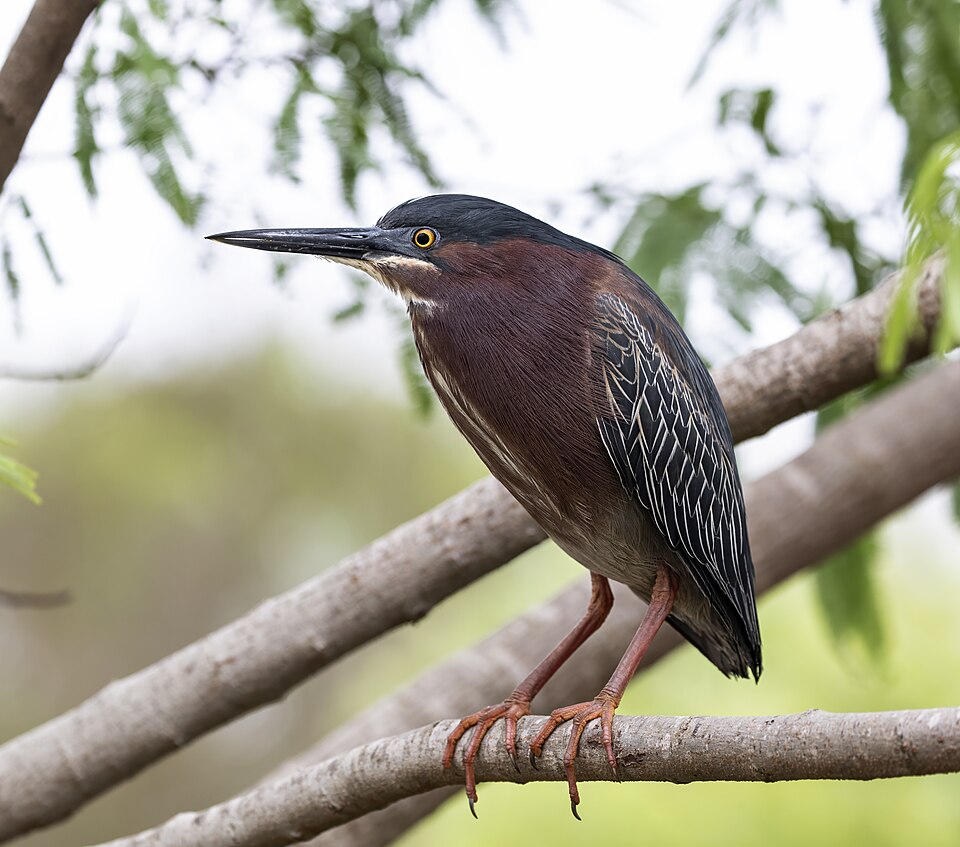
The Green Heron is one of North America's smallest and most resourceful herons, a stocky, crow-sized waterbird that hunches at the edge of ponds, marshes, and slow streams. Where the larger herons stand tall and conspicuous, this one keeps a low profile, often crouched on a half-submerged log or overhanging branch with its neck pulled in and its eyes fixed on the water below. Birders frequently overlook it until it explodes upward with a sharp, scolding skeow and flies off in a flurry of dark wings.
What makes the Green Heron genuinely remarkable is its intelligence. It is one of the very few birds known to use tools, dropping feathers, insects, twigs, or bits of bread onto the water's surface to lure small fish within striking range. That combination of patience, cleverness, and a surprisingly handsome chestnut-and-slate plumage has made it a favorite of pond watchers and a rewarding find for anyone willing to scan the shadowy margins of the water.
Look for a compact, thickset heron about the size of a crow, with short legs, a daggerlike bill, and a habitually hunched posture. When alarmed or curious it stretches its neck out and raises a shaggy crest, transforming from a dark lump into an unmistakably long-necked bird. In flight the wings look broad and dark and the body short, often with the legs trailing only slightly past the tail.
| Size & shape | Small, stocky heron with short yellow-orange legs and a relatively long, thick neck usually held tucked against the body |
| Crown & crest | Dark greenish-black cap that can be raised into a shaggy crest when alert |
| Neck & breast | Rich chestnut to deep rufous on the sides of the neck, with a white-streaked line down the front of the throat |
| Back & wings | Dark blue-gray to greenish, often appearing slate or bottle-green in good light; feathers edged paler |
| Bill | Long, sharp, dark above and yellowish below; daggerlike for spearing prey |
| Legs | Yellow to greenish-yellow, turning bright orange in breeding males |
Male vs. female
Males and females look very similar and are difficult to separate in the field. Males average slightly larger and tend to show somewhat richer, more saturated chestnut on the neck and a glossier cap. The most reliable seasonal clue is leg color: during courtship, the legs of breeding males flush a vivid orange, while females and non-breeding birds keep duller yellow-green legs. Outside the breeding season the sexes are effectively identical to most observers.
Juveniles
Juveniles are noticeably drabber and browner than adults, lacking the clean chestnut neck. They are heavily streaked with brown and buff down the throat and breast, show buffy spots and edges on the wing coverts, and have a duller, more brownish cap. This streaky, washed-out look causes them to be confused with other young herons and bitterns. Young Green Herons hold this plumage through their first fall and winter, gradually acquiring the cleaner adult pattern over their first year.
The Green Heron is not a singer, but its calls are distinctive and often the first sign of one. The classic vocalization is a loud, explosive skeow or kyow, given sharply as the bird flushes and flies off low over the water. It is a startling, almost cat-like squawk that carries well across a quiet pond.
When agitated or interacting, birds give a series of clucking kuk-kuk-kuk notes, and around the nest you may hear softer, lower croaks and raspy calls between mates. The flushing skeow is the sound to learn, since you will often hear it before you ever see the bird.
Green Herons breed across much of the eastern and central United States, north into southern Canada, and along the West Coast, favoring any wooded wetland with quiet water. Birds in the southern United States, along the Gulf Coast, and in coastal California are largely year-round residents.
Populations that breed in the northern and interior parts of the range are migratory, withdrawing in fall to the southern states, Mexico, Central America, and the Caribbean for the winter. Spring migrants typically return to northern breeding areas from March into May. A closely related form ranges through the tropics, and the Green Heron itself occasionally turns up as a rare vagrant in western Europe.
Small fish are the mainstay of the Green Heron's diet, but it is an opportunist that also takes frogs, tadpoles, crayfish, aquatic insects, dragonflies, leeches, snails, and the occasional small snake or rodent. It hunts by standing motionless or creeping in a slow, deliberate crouch at the water's edge, then striking out with a lightning thrust of its sharp bill.
Most famously, the Green Heron is one of the few birds in the world documented to use bait. It will drop a feather, insect, twig, or even a piece of bread or a mayfly onto the water and wait for curious minnows to investigate, then snatch them as they rise. This deliberate tool use, repeated and even adjusted by individual birds, places the species among the most cognitively sophisticated of all herons.
Green Herons usually nest as solitary pairs rather than in the large colonies favored by many herons, though loose groupings do occur. The male typically begins building and then the female finishes the nest, a flimsy platform of sticks placed in a shrub or tree, often over or very near water but sometimes well back in dry woods.
The female lays a clutch of pale green to bluish eggs, and both parents share incubation, which lasts roughly three weeks. Both adults feed the young by regurgitation. Chicks are noisy and may clamber out onto nearby branches before they can fully fly. In the southern part of the range, pairs often raise two broods in a season; northern birds usually manage just one.
The Green Heron is not a feeder bird and will not come to seed, suet, or nectar. It is, however, very much a backyard bird if your yard happens to include the right water. The way to attract one is to provide habitat rather than food.
- A natural-edged pond with shallow margins, fish or frogs, and some cover is the single biggest draw; bare-edged ornamental pools rarely interest them.
- Leave overhanging branches, logs, and dense shrubs at the water's edge so the heron has a low perch to hunt and ambush from.
- Encourage a healthy population of minnows, tadpoles, and aquatic insects rather than treating the water; that prey base is what holds the bird.
- Keep disturbance low near the water, since Green Herons are shy and flush easily; watch from a window or a distance.
- If you stock a backyard fish pond, expect occasional visits, and consider netting or deep-edge refuges if you want to protect prized fish.
- Preserve marshy or brushy corners of the property rather than mowing to the waterline; tangled cover makes the site feel safe.
- Black-crowned Night-Heron: Larger, stockier, and paler gray with a clean black cap and back; juveniles are grayer and coarsely spotted, lacking the Green Heron's chestnut neck.
- American Bittern: Larger, buffy-brown, and heavily streaked, with a bold black neck stripe; it freezes with its bill pointed skyward in reeds rather than perching on branches.
- Least Bittern: Even smaller and slimmer, with buffy wing patches and a habit of clambering among cattail stems; far more secretive and rarely perches in the open.
- Little Blue Heron: Taller and longer-legged with a more upright stance; adults are uniformly slate-blue with a purplish neck and lack the chestnut sides and short crouched build.
Why is it called a Green Heron when it looks dark?
The dark back and cap have a greenish, bottle-green sheen that shows mostly in good, direct light. In shade or poor light the bird simply looks slate-gray or blackish, so the green is easy to miss; the rich chestnut neck is usually more obvious.
Do Green Herons really use tools to catch fish?
Yes. Green Herons are one of the few birds documented to bait their prey, dropping feathers, insects, twigs, or even bread onto the water to lure small fish within striking range. Individual birds have been seen repeating and refining this behavior, which makes the species a celebrated example of tool use in birds.
Where is the best place to see a Green Heron?
Scan the quiet, vegetated edges of ponds, marshes, ditches, and slow streams, especially overhanging branches, logs, and brushy banks. They sit still and hunched, so look for a dark, crouched lump near the water rather than a tall standing heron. Dawn and dusk are good times.
Are Green Herons rare?
No. They are common and widespread across much of North America, but their small size, dark coloring, and shy, secretive habits make them easy to overlook. Learning their explosive skeow flush call is often the easiest way to detect them.
Will a Green Heron eat the fish in my backyard pond?
It can. If your pond holds goldfish, koi, or minnows and has accessible shallow edges or low perches, a Green Heron may stop in to hunt. Deep-sided refuges, netting, or dense edge plants that block easy access help protect prized fish if that becomes a concern.