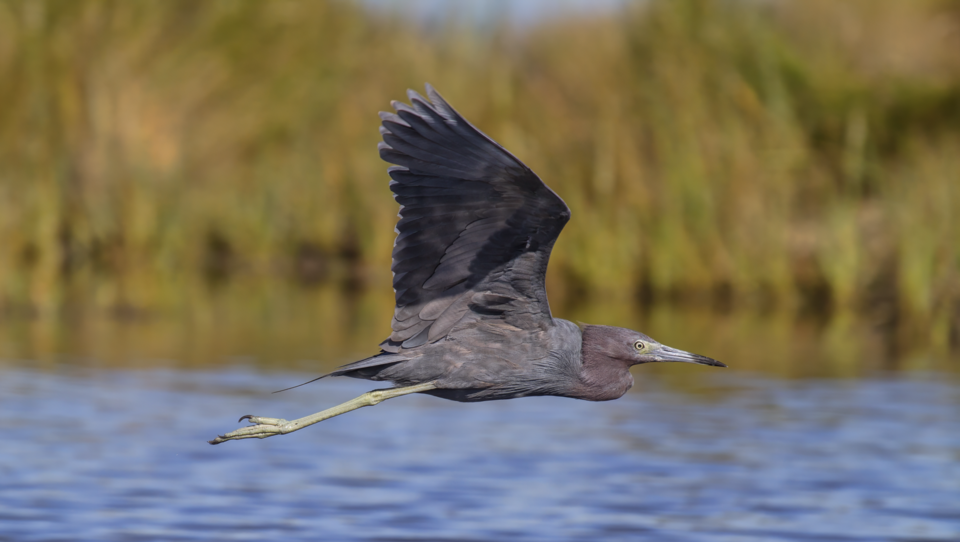
The Little Blue Heron is a medium-sized, slender wading bird of southern marshes, swamps, rice fields, and coastal shallows. Despite the name, it is not especially small as herons go, and its plumage is a deep, smoky slate-blue rather than a bright blue. Adults carry a purplish-maroon wash over the head and neck, giving them a moody, two-toned look in good light. They move slowly and deliberately along the water's edge, stalking prey with a patience that sets them apart from the more frantic, dancing egrets they often feed alongside.
What makes this heron genuinely fascinating is its color change with age. Newly fledged Little Blue Herons are entirely white, looking for all the world like a small egret, and they stay white through their first winter before molting into a patchy, piebald "calico" stage and finally the dark adult plumage. This quirk fools many birders, and the all-white young are one of the most commonly misidentified wading birds in North America. It is a bird worth slowing down for, both for the identification puzzle and for the elegant, unhurried way it hunts.
A trim, mid-sized heron with a long neck, long greenish legs, and a two-toned bill that is the single most reliable field mark at any age. Look for a slim build, a daggerlike bill that is pale blue-gray at the base and abruptly black at the tip, and a deliberate, neck-extended feeding posture.
| Adult plumage | Uniform slate-blue body with a purple-maroon wash over the head and neck; can look nearly black at a distance. |
| Bill | Stout and pointed, pale blue-gray at the base with a sharply contrasting dark tip, the key field mark at every age. |
| Legs and feet | Greenish to dull blue-gray, never bright yellow; legs are long and the bird wades belly-deep. |
| Juvenile | Entirely white with subtle dusky tips to the outer wing feathers (primaries), best seen in flight. |
| Immature (calico) | Blotchy mix of white and slate-blue feathers during the transition, a patchwork look unique to this species. |
| Size and shape | Slender and medium-sized; smaller and thinner-necked than a Great Blue Heron, lankier than a Snowy Egret. |
Male vs. female
Male and female Little Blue Herons look alike. There is no reliable plumage or color difference you can pick out in the field, both sexes show the same slate-blue body and maroon-tinged head. Males average slightly larger, but the overlap is wide enough that size alone won't tell you which is which. During courtship, both sexes develop slightly longer, shaggier plumes on the head, neck, and back, and the bill base and lores can flush a more intense blue.
Juveniles
Juveniles are the famous surprise: pure white for their first year, easily mistaken for a Snowy Egret. Two clues give them away, the bicolored bill (pale base, dark tip) rather than the Snowy's all-dark bill, and the dull greenish legs instead of black legs with yellow feet. Many show faint dusky shading at the very tips of the outer wing feathers, visible in flight. As they mature, white feathers are gradually replaced by slate-blue ones, producing a striking blotchy "calico" or "pied" immature that looks half-painted before the bird finally reaches solid adult color.
The Little Blue Heron is a quiet bird most of the year and is far more often seen than heard. Away from the nest it is largely silent, occasionally giving a low, throaty croak or a hoarse squawk when flushed or disturbed.
At the colony it becomes more vocal, producing a variety of guttural clucks, croaks, and a rasping aaah-aaah in aggressive or courtship interactions. None of these calls are musical, they are the typical low, grating heron noises rather than anything you would call a song. If you hear a sharp croak from a marsh and look up to see a dark, slim heron flapping away on rounded wings, that is usually this bird.
In North America the Little Blue Heron breeds across the Southeast and along the Gulf and southern Atlantic coasts, from Texas and the Gulf states up through the Carolinas, with scattered inland colonies in the Mississippi Valley. Its full range extends well south through the Caribbean, Mexico, Central America, and into much of South America, where it is a year-round resident.
Northern breeders are migratory, pulling back to the Gulf Coast, Florida, the Caribbean, and Central America for winter. The species is also famous for post-breeding dispersal: in late summer, young birds wander widely northward, turning up well beyond the breeding range, sometimes into the northern states and southern Canada, before heading south for the colder months.
Little Blue Herons are patient, methodical hunters that feed mainly on small fish, but their diet is broad and shifts with habitat. In freshwater marshes and flooded fields they take large numbers of crayfish, frogs, tadpoles, aquatic insects, and small crustaceans; in coastal shallows they catch killifish, shrimp, and small crabs. They are notably fond of crustaceans compared with many other herons.
The classic feeding style is slow and deliberate: the bird walks at a creeping pace through shallow water, sometimes pausing for long stretches with neck cocked, then striking with a quick downward jab. They tend to hunt alone and spaced out, in contrast to the active foot-stirring and running of Snowy Egrets. White juveniles sometimes associate with Snowy Egrets and may benefit from feeding in their company, which some researchers think helps protect the young birds while they learn.
Little Blue Herons nest colonially, usually in mixed heronries alongside other herons, egrets, and ibises, in shrubs and trees over or near water. The male selects a nest site and displays to attract a mate, then both birds build a loose, somewhat flimsy platform of sticks and twigs, often lined with finer plant material. Nests are typically placed several feet to a couple dozen feet above the water.
The female lays a clutch of pale blue-green eggs, and both parents share incubation, which lasts a little over three weeks. Both adults feed the chicks by regurgitation. The young clamber around nearby branches well before they can truly fly and fledge in roughly six to seven weeks. Pairs generally raise a single brood per season.
The Little Blue Heron is not a backyard or feeder bird, it eats live fish and crustaceans and needs shallow wetland habitat to hunt. You won't draw one with seed or suet. That said, if you live within its range and have the right setting, there are ways to make your property more inviting.
- If you have a natural pond, marsh edge, or slow stream on your property, keeping the shallows clean and stocked with small fish, frogs, and crayfish is the single biggest draw.
- Protect and maintain shoreline vegetation and shrubby cover near water, herons want quiet, undisturbed edges to stalk along.
- Avoid pesticides and herbicides near water, which knock out the aquatic insects, amphibians, and small fish the bird depends on.
- If you are near a coast or large wetland, scan flooded fields, ditches, and tidal flats, these birds often forage in surprisingly modest patches of shallow water.
- The best 'attraction' strategy is really habitat conservation: support local wetland and rookery protection, since colonial nesters are highly sensitive to disturbance.
- Snowy Egret: Adult Snowies are pure white with an all-black bill, black legs, and bright yellow feet, white juvenile Little Blues have a pale-based dark-tipped bill and dull greenish legs.
- Tricolored Heron: Similar slate-blue tones but slimmer, with a white belly and a long thin bill; the white underside instantly separates it from the all-dark Little Blue.
- Reddish Egret: Larger and shaggier with a pink-and-black bill (dark morph), and feeds with frantic running and canopy-spreading rather than the Little Blue's slow stalk.
- Great Blue Heron: Far larger and grayer with a heavy yellowish bill and a white face stripe; the Little Blue is much smaller and uniformly slate with a maroon-tinged neck.
Why are some Little Blue Herons white?
Those are juveniles. Little Blue Herons are entirely white for their first year, then molt through a blotchy white-and-blue 'calico' stage before reaching the solid slate-blue adult plumage. The white young are often mistaken for Snowy Egrets.
How do I tell a white juvenile Little Blue Heron from a Snowy Egret?
Check the bill and legs. The juvenile Little Blue has a bicolored bill (pale blue-gray base, dark tip) and dull greenish legs. A Snowy Egret has an all-black bill, black legs, and unmistakable bright yellow feet. Juvenile Little Blues also often show faint dusky tips on the outer wing feathers in flight.
Is the Little Blue Heron actually blue?
Not bright blue. Adults are a dark, smoky slate-blue that can look nearly black at a distance, with a purplish-maroon wash over the head and neck. The 'blue' is muted and best appreciated in good light up close.
What does a Little Blue Heron eat?
Mostly small fish, plus a lot of crayfish, frogs, tadpoles, aquatic insects, shrimp, and small crabs. It hunts by walking slowly through shallow water and striking with a quick jab, often feeding alone rather than in active flocks.
Where can I see a Little Blue Heron?
Look in freshwater marshes, swamps, flooded fields, rice paddies, ponds, and coastal shallows across the southeastern United States, the Gulf Coast, and southward through the Caribbean and Latin America. In late summer, young birds wander well north of the breeding range.