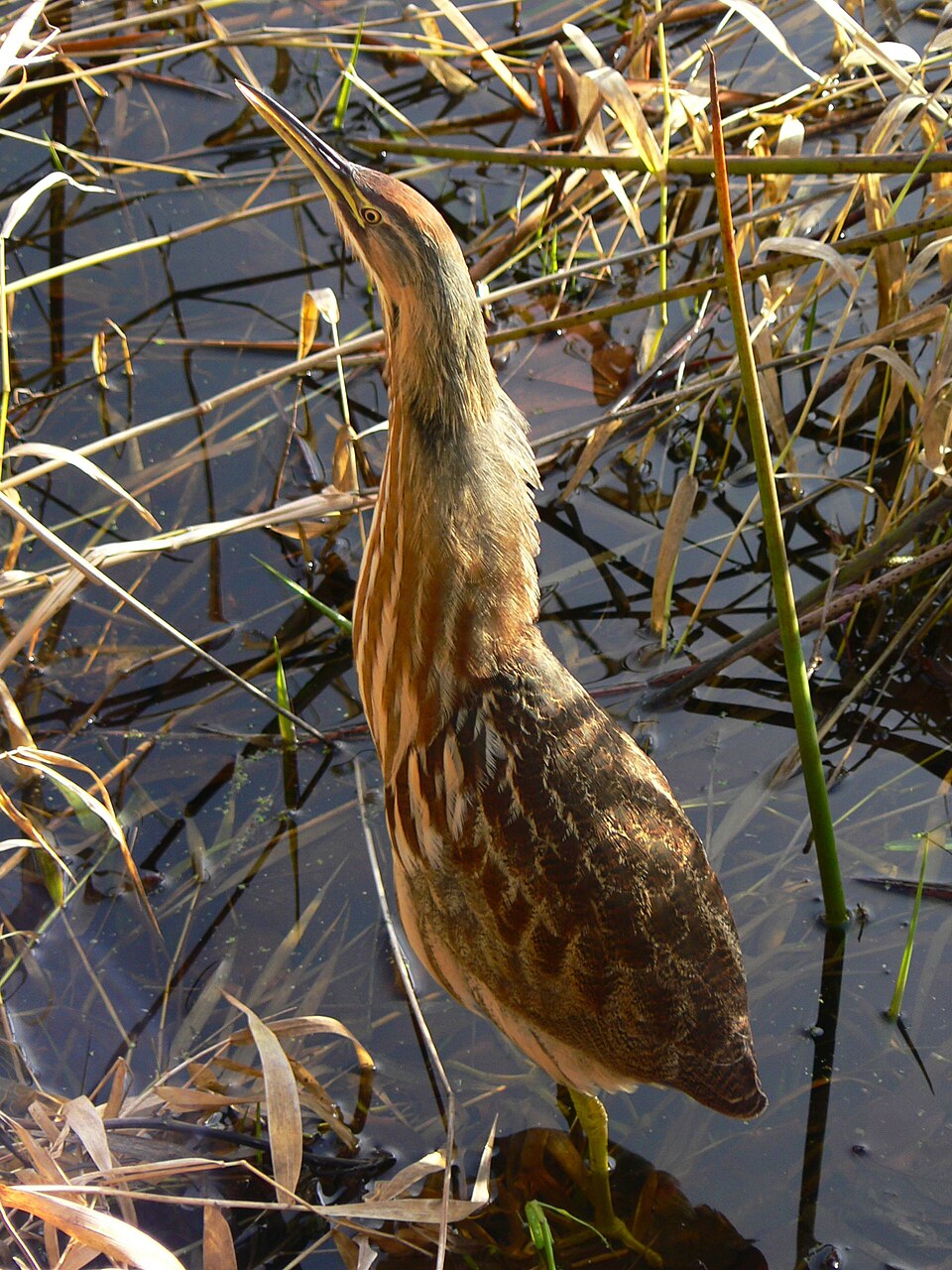
The American Bittern is a stocky, secretive member of the heron family that has turned hiding into an art form. Rather than wading conspicuously like a Great Blue Heron, it lurks among dense cattails and reeds, its streaky brown-and-buff plumage blending so perfectly with the standing vegetation that birders often walk right past one. When it senses danger, it freezes with its bill pointed straight up and its body stretched thin, swaying gently to match reeds moving in the breeze. Most people who have a bittern in their local marsh never lay eyes on it.
What gives the bittern away is one of the strangest sounds in North American wetlands: a deep, gulping, mechanical pump-er-lunk that carries across the marsh at dawn and dusk in spring. The call has earned it folk names like "thunder-pumper" and "stake-driver," and it is so unbirdlike that newcomers often mistake it for a distant pump or a person driving a wooden stake into mud. For birders, learning that sound is the single best way to know a bittern is present, even when the bird itself stays invisible.
The American Bittern is a medium-large, thickset heron with a relatively short neck (when not extended), stout pointed bill, and a hunched, compact posture. In flight it looks chunky, with broad wings and a flap-and-glide style. The key to recognizing it is the overall warm brown, heavily streaked coloration combined with a distinctive dark neck stripe.
| Overall color | Warm brown above, paler buff below boldly streaked with brown, giving a vertically striped look that mimics reeds |
| Neck stripe | A bold blackish stripe running down each side of the neck, diagnostic and visible at close range |
| Bill | Long, straight, stout, and yellowish, perfect for stabbing prey |
| Wings in flight | Outer wings (flight feathers) are noticeably dark blackish-brown, contrasting with the paler brown inner wing and back |
| Posture | Often stands frozen with bill pointed skyward; otherwise hunched and crouched while stalking |
| Eye and face | Yellow eye; in display the eyes can appear to point forward, and a green facial flush develops in breeding males |
Male vs. female
Males and females look essentially alike in plumage, both showing the same cryptic brown streaking and dark neck stripe, so you generally cannot sex a bittern by sight in the field. Males average somewhat larger than females, but the difference is hard to judge unless birds are side by side. Behaviorally, it is the male that gives the famous booming pump-er-lunk call and performs the courtship display, during which white plumes on the shoulders are puffed out conspicuously.
Juveniles
Juvenile American Bitterns closely resemble adults and can be very difficult to separate in the field. Young birds show the same streaky brown camouflage but lack the fully developed bold black neck stripe of breeding adults; their neck markings tend to be more muted and less sharply defined. By their first fall, immatures are foraging independently in marshes and are, for practical purposes, indistinguishable from adults to most observers.
The American Bittern's signature sound is a deep, resonant, three-part call rendered as oonk-a-lunk or pump-er-lunk, often preceded by clicking and gulping noises as the bird inflates its esophagus with air. It is startlingly loud and low-pitched, carrying half a mile or more across open wetlands, and is delivered mostly at dawn, dusk, and at night during the breeding season. The mechanical, almost hydraulic quality is the source of nicknames like "thunder-pumper" and "stake-driver."
Away from the breeding marsh the bittern is largely silent. When flushed, it may give a low, hoarse croak as it flies off, but it has no melodic song in the conventional sense. If you hear that strange gulping boom from a cattail marsh in spring, you can be confident a male bittern is there even if you never see it.
The American Bittern breeds across much of Canada and the northern United States, from coast to coast, favoring freshwater marshes with dense emergent vegetation. It is a migratory bird across most of its range, withdrawing from northern breeding areas in fall and wintering in the southern United States, along the Gulf and Pacific coasts, in Mexico, and into Central America and the Caribbean. In the mildest parts of its range, such as coastal California and the southeastern states, some birds may be present year-round.
Migration is mostly nocturnal and inconspicuous, and because the bird is so secretive, its movements are easy to overlook. Populations have declined in many regions due to the draining and degradation of wetlands, making protected marshes increasingly important for the species.
The American Bittern is a patient ambush hunter that feeds primarily on small fish, frogs, tadpoles, crayfish, aquatic insects, and other small marsh animals. It also takes the occasional small mammal, snake, or salamander. It hunts by standing motionless or stalking with exaggerated slowness at the edge of water and emergent vegetation, then lunging forward to seize prey with a swift thrust of its dagger-like bill.
Much of its foraging happens in the low light of early morning and evening, which suits both its prey and its preference for staying concealed. The combination of stealthy stalking, a freeze-and-wait strategy, and superb camouflage makes the bittern an efficient predator in shallow, vegetated wetlands.
American Bitterns nest on the ground within dense marsh vegetation, typically just above the waterline among cattails, bulrushes, or sedges. The female builds a platform nest of dead reeds and grasses, often well hidden and accessed by the bird walking through the vegetation rather than flying directly in. Unlike colonial herons, bitterns are solitary nesters, with each pair occupying its own patch of marsh.
The female lays a clutch of roughly three to five pale buff to olive-brown eggs and does essentially all of the incubation, which lasts around four weeks. She also tends the young largely on her own. Chicks are fed regurgitated food and leave the nest within a couple of weeks, though they remain dependent on the female for some time afterward. Bitterns generally raise a single brood per year.
The American Bittern is not a backyard or feeder bird, and you will not lure one with seed, suet, or a bird bath. It is a specialist of large, healthy freshwater marshes, so attracting it is really a matter of habitat rather than feeding. If you own or steward wetland property, the best things you can do are protect and restore marsh habitat and resist the urge to "clean up" the cattails and reeds that bitterns depend on.
- Protect and maintain dense stands of cattails, bulrushes, and sedges rather than clearing them, since this cover is essential for both feeding and nesting.
- Support wetland conservation and restoration efforts locally; bitterns need large, undrained marshes and decline sharply when wetlands are lost.
- Keep water quality high and avoid pesticide and fertilizer runoff, which harms the fish, frogs, and insects bitterns eat.
- To actually see one, visit a marsh at dawn or dusk in spring and listen for the booming pump-er-lunk, then scan the reed edges slowly and patiently.
- Minimize disturbance during the breeding season; bitterns nest on the ground and are easily flushed off nests by foot traffic or dogs.
- Least Bittern: Much smaller and more colorful, with buffy wing patches and a black crown and back; lacks the uniform streaky brown camouflage of the American Bittern.
- Green Heron: Smaller and darker, with a chestnut neck, greenish back, and orange legs; lacks the bold neck stripe and reedy streaking.
- Black-crowned Night-Heron: Adults are pale gray with a black cap and back; even streaky brown juveniles are grayer, spottier, and stockier-necked than a bittern.
- Great Blue Heron: Far larger and grayer with a long neck and legs; it wades in the open rather than skulking and freezing among reeds.
What does an American Bittern sound like?
It makes a deep, gulping, mechanical call usually written as 'pump-er-lunk' or 'oonk-a-lunk,' often preceded by clicking sounds. It is so loud and unbirdlike that people compare it to a pump or someone driving a stake into mud, which is why it is nicknamed the 'thunder-pumper' and 'stake-driver.'
Why is the American Bittern so hard to see?
Its brown-and-buff streaked plumage matches marsh reeds almost perfectly, and when threatened it freezes with its bill pointed straight up and sways like wind-blown vegetation. It also stays inside dense cattails and feeds mostly at dawn and dusk, so most birders hear it far more often than they see it.
Where do American Bitterns live?
They live in freshwater marshes with thick emergent vegetation like cattails and bulrushes. They breed across Canada and the northern U.S. and winter in the southern U.S., Mexico, and Central America, with some birds staying year-round in mild coastal areas.
What do American Bitterns eat?
They eat small fish, frogs, tadpoles, crayfish, aquatic insects, and occasionally small snakes, salamanders, or mammals. They hunt by standing still or stalking slowly at the water's edge, then stabbing prey with a quick thrust of their long bill.
Is the American Bittern a heron?
Yes. It belongs to the heron family (Ardeidae) but represents the more secretive, solitary, marsh-dwelling bitterns rather than the open-water wading herons. Unlike most herons it nests alone on the ground rather than in colonies.