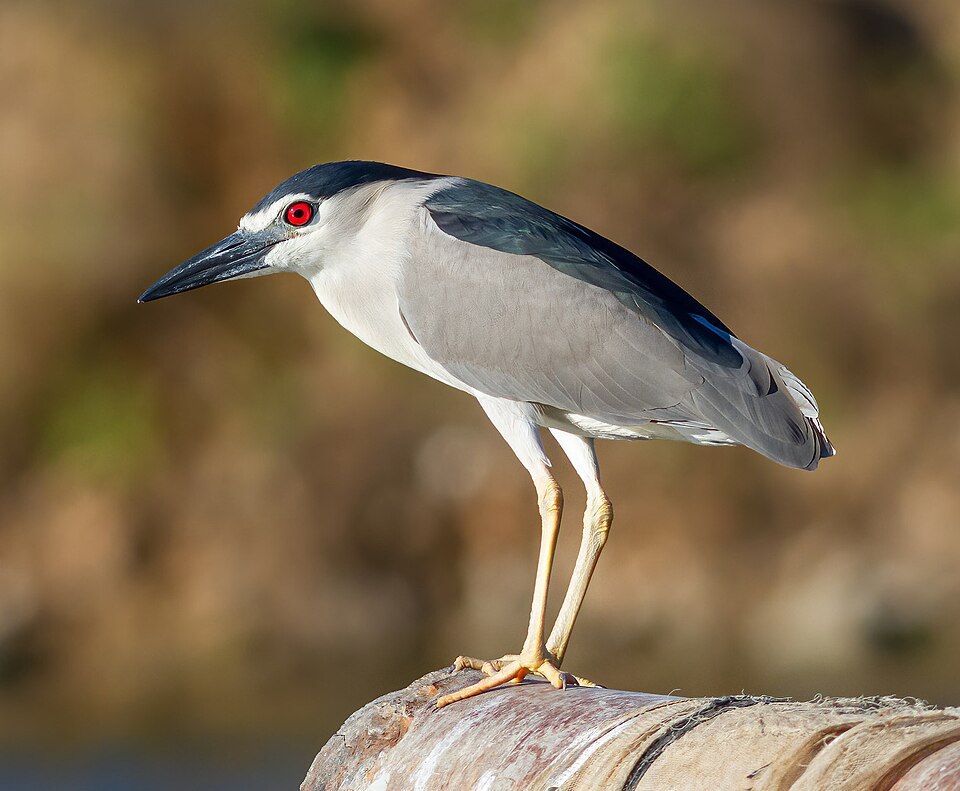
The Black-crowned Night-Heron is one of the most widespread herons in the world, found on every continent except Australia and Antarctica. In North America it is a familiar but easily overlooked bird, partly because it does much of its hunting at dusk and after dark, while the long-legged daytime herons are heading to roost. By day you are most likely to find one hunched and motionless in a streamside willow or among cattails, looking more like a gray football than a heron.
Compact, short-necked, and short-legged for a heron, the adult is a study in muted elegance: pale gray body, a clean black cap and back, and a startling ruby-red eye. Where it occurs it is often abundant, nesting in noisy colonies sometimes shared with egrets and other herons. Its tolerance for people means it shows up in city parks, zoo grounds, harbors, and drainage ditches as readily as in pristine marshes.
This is a heron built low and chunky. The silhouette is the giveaway: a thick-necked, big-headed bird that habitually pulls its neck in tight, so it looks far stockier than the slim, S-necked egrets and Great Blue Herons. Legs are relatively short and barely project past the tail in flight.
| Crown & back | Adults have a glossy black cap and black back contrasting with pale gray wings and whitish underparts |
| Eye | Deep ruby-red iris in adults, a key field mark at close range |
| Plumes | Two or three long, thin white head plumes trail off the nape in breeding adults |
| Bill | Thick, slightly drooping black bill, heavier than the daggers of typical herons |
| Legs | Short yellowish to greenish legs that turn pinkish-red at peak breeding |
| Build | Stocky, hunched, short-necked; about crow-to-small-goose bulk but heron-shaped |
Male vs. female
Males and females look essentially alike in plumage and color, so you cannot reliably sex them in the field. Males average a little larger and may grow slightly longer head plumes during the breeding season, but the difference is subtle and not dependable for a casual observer. Behavior at the nest, rather than appearance, is usually the only practical clue to which bird is which.
Juveniles
Juveniles look like a completely different bird and cause endless confusion. They are warm brown overall, heavily streaked below and spangled above with large buff or whitish teardrop spots on the wings and back. The eye is yellow-orange rather than red, and the bill is mostly yellowish-green with a dark tip. It takes about three years to reach full adult plumage, so you will commonly see in-between birds that are grayer but still show some spotting and a not-yet-red eye.
The signature sound is a loud, abrupt quok! or wok! often given as the bird flushes or flies overhead at dusk. It is a flat, barking, almost crow-like squawk, and once you learn it you will detect night-herons passing overhead in the dark when you would never see them. This call is the source of the old folk name "quawk" or "quok bird."
Around the colony the birds are far noisier, with a range of harsh croaks, raps, and guttural notes during courtship and squabbles over nest sites. They are otherwise fairly silent while hunting, where stillness is the whole strategy.
Black-crowned Night-Herons breed across much of the United States and into southern Canada, with a patchy distribution tied to wetlands, and they are widespread through Central and South America. Northern populations are migratory, withdrawing from inland and northern areas in fall to winter along the southern and coastal United States, Mexico, and beyond. Birds in mild coastal and southern regions are often year-round residents.
Globally the species is enormously successful, occupying suitable wetlands across Europe, Africa, and much of Asia. Wherever they live they favor a mix of shallow water for feeding and dense trees or marsh vegetation for roosting and nesting.
This is a patient, opportunistic predator that eats whatever the local wetland offers. Fish make up much of the diet, but it readily takes frogs, crayfish, aquatic insects, small snakes, leeches, mussels, and even small mammals and the eggs and nestlings of other birds. At some colonies they are notorious for raiding the nests of terns and other waterbirds after dark.
It hunts mainly by standing still or moving with exaggerated slowness at the water's edge, then striking with a quick jab. Most foraging happens from late afternoon through the night and into early morning, which lets it exploit prey and reduces competition with the day-active herons and egrets it often nests alongside.
Black-crowned Night-Herons nest colonially, sometimes in large mixed heronries with egrets, ibis, and other herons. Nests are loose platforms of sticks and reeds placed in trees, shrubs, or dense emergent vegetation over or near water. The male typically starts the nest and displays to attract a mate, then the pair finishes it together, with the male often bringing material that the female arranges.
The female lays a clutch of about 3 to 5 pale blue-green eggs, and both parents share incubation over roughly three weeks. Both adults feed the young, which clamber actively around the nest branches well before they can fly. Colonies can be raucous and pungent, and the same sites are often reused year after year.
This is not a feeder bird and there is no seed or suet that will bring one to your yard. It is a wetland predator, so "attracting" it really means providing or protecting the habitat it needs and knowing where to look.
- If you have a large, fish-stocked pond bordered by dense shrubs or trees, you may genuinely host hunting night-herons at dusk - though they will happily eat your fish.
- Look for them at dawn and dusk along marsh edges, slow streams, drainage canals, harbors, and even urban park ponds.
- Scan willows, alders, and other dense waterside trees by day; roosting birds sit hunched and motionless and are easy to walk past.
- Listen for the loud quok flight call overhead at night - often your first sign one is around.
- Support and visit local wetland preserves and heronries, which is where you will reliably see breeding colonies.
- Avoid disturbing nesting colonies; they are sensitive to repeated intrusion during the breeding season.
- Yellow-crowned Night-Heron: Adult is uniformly gray (not black-and-pale) with a black face and creamy crown; juveniles are grayer with finer spots and longer legs than young Black-crowned.
- Green Heron: Much smaller and darker with chestnut neck; also crouches low but lacks the pale-gray-and-black adult pattern.
- American Bittern: Brown and streaky like a juvenile night-heron, but it is more secretive, has a longer neck it points skyward, and gives a pumping booming call rather than a quok.
- Great Blue Heron: Far larger, taller, and long-necked with a slender daggered bill; never has the squat, hunched build of a night-heron.
Why is it called a night-heron?
Because it does much of its feeding from dusk through the night, unlike most herons that hunt by day. This shift lets it avoid competition with day-active herons and egrets, including ones it may share a nesting colony with.
What does a Black-crowned Night-Heron sound like?
Its trademark sound is a loud, flat barking quok or wok, usually given in flight at dusk or when flushed. Around nesting colonies it makes a wider range of harsh croaks and raps.
Why does a young night-heron look so different from the adult?
Juveniles are brown and heavily spotted with a yellow eye, while adults are pale gray with a black cap and back and a red eye. It takes about three years to reach full adult plumage, so you will often see streaky in-between birds.
How can I tell a Black-crowned from a Yellow-crowned Night-Heron?
Adult Black-crowned has a clean black-and-pale-gray pattern, while adult Yellow-crowned is uniformly gray with a black face and pale crown. Juveniles are trickier; young Yellow-crowned are grayer with finer spots and longer legs.
Are Black-crowned Night-Herons rare?
No. They are widespread and often locally common across North America and much of the world. They can be easy to miss because they are quiet, well camouflaged, and most active at dawn and dusk.