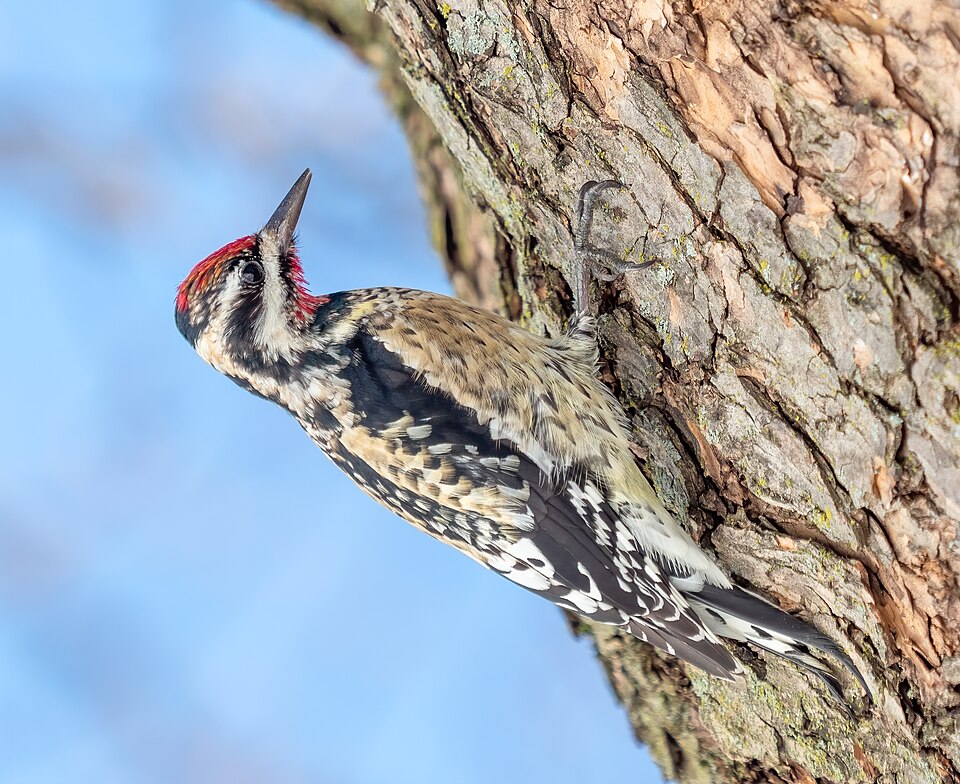
The Yellow-bellied Sapsucker is a medium-sized woodpecker of eastern and northern North America, and despite the slightly comical name it is one of the most ecologically important birds in any forest it visits. Rather than chiseling deep into wood for grubs like most woodpeckers, the sapsucker drills neat, orderly rows of shallow holes called sap wells in living trees, then returns again and again to lap up the leaking sap and the insects it traps. Those wells become a free buffet for hummingbirds, warblers, squirrels, and bats, which is why a single sapsucker can quietly shape the lives of dozens of other animals.
It is a strongly migratory bird, breeding across Canada and the northeastern and Appalachian United States and wintering in the southeastern states, Mexico, and Central America. Where most woodpeckers are year-round neighbors, the sapsucker tends to be a seasonal visitor, slipping through wooded backyards and parks on migration and quietly working the trees. Look for the messy black-and-white pattern, the long white wing stripe, and a habit of sitting motionless and clinging to a trunk for long stretches, and you have probably found one.
This is a robin-sized woodpecker with a stocky body, a relatively long bill, and a stiff tail it props against bark for support. The overall impression is a mottled black-and-white bird with a bold red cap, but the field mark that clinches it on a perched bird is the long vertical white stripe down the folded wing, formed by the white wing coverts. The "yellow belly" is real but subtle, usually just a faint wash on the underparts that is hard to see in the field.
| Wing stripe | Long white vertical patch on the folded wing (the wing coverts) - the single best perched field mark |
| Crown | Bright red forecrown bordered in black in both sexes |
| Throat | Red in males, white in females - a quick way to tell the sexes apart |
| Back | Messy, mottled black and pale-yellow barring rather than clean bars or a solid color |
| Belly | Pale with a soft yellow wash, often hard to see |
| Size & shape | Robin-sized woodpecker, stocky, with a stiff propped tail and medium-long chisel bill |
Male vs. female
The sexes look broadly similar but the throat is the giveaway. Adult males have a fully red throat and chin in addition to the red crown, so their whole face front looks washed in red. Adult females share the red crown but have a clean white throat, giving them a more two-toned head. If you can see the throat well, you can sex the bird instantly. Both sexes have the bold black "bib" across the chest below the throat and the diagnostic white wing stripe.
Juveniles
Juveniles look notably different and trip up many birders in late summer and fall. They are a dingy, brownish, scaly-looking version of the adult, largely lacking the crisp black bib and red crown, with a mottled brown wash over the head and breast. The telltale long white wing stripe is still present, which is the best way to recognize them. Young sapsuckers can keep this brownish, washed-out plumage well into fall and even early winter, molting gradually into adult-like pattern, so a "drab woodpecker with a white wing stripe" in autumn is very often a young Yellow-bellied Sapsucker.
Sapsuckers do not really sing; they communicate with calls and with drumming. The signature call is a nasal, slurred, cat-like "mew" or "neeah" that falls in pitch, often described as sounding mewling or whiny. They also give a stuttering series of squealing notes during interactions, and a sharp "wika-wika" or churring scold around the nest.
The most distinctive sound is the drum, which is unlike the steady machine-gun roll of most woodpeckers. The sapsucker drums in an irregular, stuttering rhythm - a few quick raps followed by slower, spaced taps, often rendered as a Morse-code-like pattern. Once you learn that hesitant, syncopated drum, you can identify the bird without ever seeing it, and they will readily hammer on resonant metal like gutters, signs, and chimney caps to amplify the message.
Yellow-bellied Sapsuckers breed across a broad northern band: through most of Canada's boreal forest, into the northeastern United States, the upper Great Lakes, New England, and down the spine of the Appalachians. They favor young, regenerating deciduous and mixed forests with plenty of birches, aspens, and maples to tap.
They are genuinely migratory, which sets them apart from most North American woodpeckers. In fall they head south to winter across the southeastern United States, the Gulf Coast, Mexico, and Central America, with some reaching the Caribbean. During spring and fall migration they turn up well outside the breeding range, including in backyards and city parks across the eastern half of the continent, so even people who never see them in summer may host one passing through.
True to the name, sap is central to the diet, but so are insects and fruit. The bird drills two kinds of wells: round, deep wells that it probes for sap, and shallow, rectangular wells arranged in tidy horizontal or vertical rows that it must keep maintaining to keep the sap flowing. It uses a brush-tipped tongue to lap the sap rather than suck it, and it eats the many insects - especially ants - that get trapped in the sticky flow.
Beyond sap, sapsuckers glean and catch insects, sometimes flycatching in midair, and they eat fruit and berries, particularly in fall and winter. Their sap wells are a keystone resource for an entire community of animals: Ruby-throated Hummingbirds time part of their northward migration to follow active sapsucker wells, and warblers, kinglets, squirrels, and various insects all feed at them. In effect, the sapsucker runs a feeding station the whole forest borrows from.
Sapsuckers are cavity nesters that excavate a fresh hole most years, typically in a live deciduous tree such as a trembling aspen, often one softened by heart-rot fungus that makes the wood easier to dig while the outer trunk stays solid. They show a strong preference for aspens and birches and frequently reuse the same tree or even the same general site in successive years, though usually drilling a new entrance.
Both sexes excavate the cavity, incubate the eggs, and feed the young, with the male typically taking the night shift on the eggs. The female lays a clutch of about 4 to 6 white eggs, incubated for roughly two weeks, and the nestlings remain in the cavity for around three to four weeks before fledging. They raise a single brood per year. The old cavities they leave behind become valuable nest and roost sites for chickadees, swallows, and other small hole-nesters.
The Yellow-bellied Sapsucker is generally not a seed-feeder bird, so you will rarely lure one to a sunflower or millet feeder. It is, however, attractable - just on its own terms, by offering the kinds of trees and foods it actually uses. The best approach is to make your yard a welcoming patch of woodland during migration and, in the South, through winter.
- Keep sap-producing trees like birch, maple, and aspen on the property - these are exactly what sapsuckers seek out for drilling wells.
- Offer suet, which sapsuckers will visit far more readily than seed, especially during cold-weather migration and winter in the southern states.
- Put out fruit or fruiting shrubs (such as serviceberry, dogwood, or grapes); sapsuckers eat berries heavily in fall and winter.
- Leave a dead or dying tree (snag) standing if it is safe to do so - it provides nesting and roosting cavities and foraging habitat.
- Be patient and watch the trunks, not the feeders - sapsuckers cling quietly to bark and are easy to overlook.
- Tolerate their neat rows of holes on healthy trees; the wells rarely kill an established tree and signal a working sapsucker on your land.
- Downy Woodpecker: Smaller and cleaner-looking, with a white back and no red crown on females; males show only a small red nape patch, never a red forecrown or a black bib.
- Hairy Woodpecker: Similar black-and-white pattern but with a clean white back, a longer bill, and no red crown or wing stripe; lacks the sapsucker's messy mottling and black bib.
- Red-naped Sapsucker: The western counterpart; nearly identical but shows a red patch on the nape and more red on the throat. Ranges barely overlap, so location usually settles it.
- Red-headed Woodpecker: Has an entirely solid red head, a clean black-and-white body, and large white wing patches - far bolder and cleaner than the sapsucker's mottled plumage.
Do Yellow-bellied Sapsuckers actually have a yellow belly?
Yes, but it is subtle. The underparts carry a faint yellowish wash that is often hard to see in the field, especially in poor light. Birders rely much more on the long white wing stripe and the red crown for identification than on the belly color.
Will sapsuckers kill my trees with all those holes?
Usually not. The neat rows of small holes (sap wells) generally do not kill a healthy, established tree, though heavy, repeated drilling can stress or scar a favorite tree and occasionally girdle a small or already-weak one. Mature trees almost always tolerate it fine. If you want to protect a specific prized tree, you can loosely wrap the targeted trunk area with burlap or hardware cloth during the season.
How do I tell a male from a female sapsucker?
Look at the throat. Males have a red throat and chin to match their red crown, so the whole front of the face looks red. Females have a white throat with the red confined to the crown. Both sexes share the black bib and the white wing stripe.
Why are hummingbirds following sapsuckers around my yard?
Hummingbirds drink the sweet sap that flows from the wells a sapsucker drills, and they also catch insects trapped in it. In the North, Ruby-throated Hummingbirds rely on active sapsucker wells for energy early in spring before many flowers have bloomed, so seeing the two together is completely normal and ecologically important.
Are Yellow-bellied Sapsuckers rare or common?
They are common and their population is considered stable, listed as Least Concern. They can be easy to miss because they sit quietly on trunks rather than visiting feeders, and in much of the eastern U.S. they are present mainly as migrants or winter visitors rather than year-round residents.