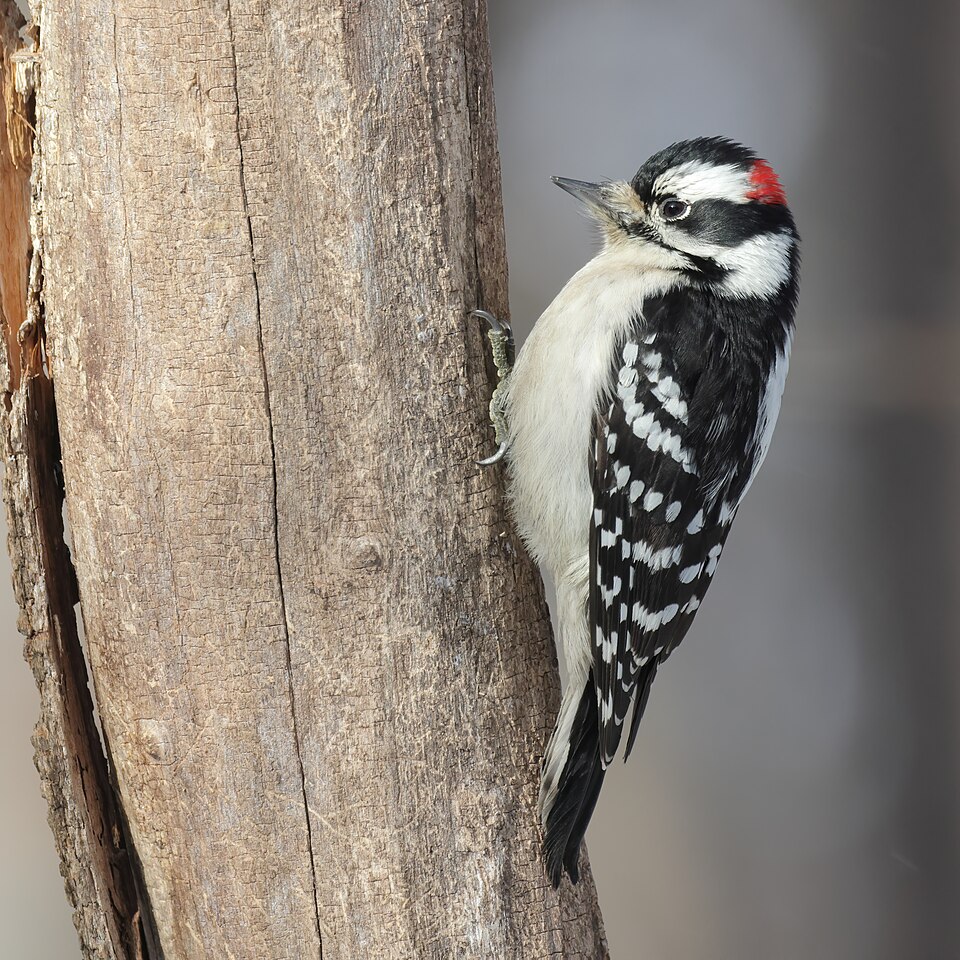
The Downy Woodpecker is the little black-and-white woodpecker that most North Americans meet first. About the size of a sparrow, it is the smallest woodpecker on the continent, and it has an easygoing, almost chickadee-like manner that makes it a regular and welcome visitor at backyard feeders. If you hang a suet cage or a peanut feeder almost anywhere from Alaska to Florida, a Downy will likely find it within days.
Beyond the yard, Downies are creatures of deciduous woods, river groves, orchards, parks, and weedy field edges. Their small size lets them forage where bigger woodpeckers cannot, clinging to slender twigs, goldenrod stems, and the seed heads of tall weeds. They often join mixed winter flocks of chickadees, nuthatches, and titmice, moving through the trees as part of the loose roving band that defines a quiet cold-weather woodland.
Look for a compact, big-headed little woodpecker with a short, stubby bill and a stiff, propped tail. The plumage is crisply pied: a black-and-white checkered pattern across the wings, a broad white stripe down the center of the back, and a boldly striped black-and-white face. The overall impression is small, neat, and busy.
| Size | Tiny for a woodpecker, roughly the bulk of a House Sparrow, with a rounded head |
| Bill | Short and stubby, noticeably shorter than the head is wide - the single best clue separating it from the Hairy Woodpecker |
| Back | Clean white stripe running down the center of the back, framed by black-and-white spotted wings |
| Face | Bold black-and-white stripes; black cap and a black line through and behind the eye |
| Outer tail | White outer tail feathers marked with small black bars or spots (the Hairy's are unmarked white) |
| Nape | Adult males show a small red patch on the back of the head; females lack it |
Male vs. female
The sexes look nearly identical except for one easy mark: the adult male has a small red patch at the back of the head (the nape), while the female has a plain black-and-white nape with no red at all. There is no red anywhere on the female's head. This makes Downies one of the simplest woodpeckers to sex at a feeder once you learn to glance at the back of the head.
Juveniles
Juvenile Downies look much like adults but often appear slightly scruffier and duller, with less crisp contrast. The key oddity is the head: young birds of both sexes frequently show some red, but it tends to be smudged across the crown (the top of the head) rather than confined to a neat patch on the nape as in adult males. This crown red fades as they molt into adult plumage in their first fall.
Downy Woodpeckers do not sing in the musical sense, but they are vocal and easy to learn. The signature sound is a sharp, bright pik note, softer and higher than the Hairy Woodpecker's louder, more emphatic peek. Their most distinctive call is a descending whinny - a rapid run of notes that tumbles down the scale, often written as ki-ki-ki-ki-ki-ki fading away at the end. This whinny helps keep pairs and flock members in contact.
In late winter and spring, both sexes drum on resonant dead limbs, gutters, and metal surfaces to claim territory and attract mates. The Downy's drum is a steady, fairly slow, even roll - distinctly less powerful and slower than the Hairy's. A drumming Downy on a downspout at dawn is a classic, and sometimes maddening, sound of early spring.
The Downy Woodpecker is one of the most widespread woodpeckers in North America, found across nearly all of the United States and most of Canada, from Alaska and the boreal forest south to Florida and the Gulf Coast. It is largely absent only from the arid Southwest deserts and the treeless far north.
It is a year-round resident throughout its range and does not truly migrate. Some birds in the far north may drift short distances south in harsh winters, and birds may shift to lower elevations in mountainous areas, but for most backyard birders the Downy is a reliable companion in every season.
Downies eat mostly insects - beetle larvae, ants, caterpillars, and the wood-boring grubs they pry from bark and dead wood - along with a good amount of plant food, especially in winter. Their small bill lets them probe places larger woodpeckers cannot, and they are often seen hammering into goldenrod galls to extract the fly larvae inside, or working over the seed heads of tall weeds and the stems of corn and sunflowers.
At feeders they readily take suet, peanut butter, shelled peanuts, and black-oil sunflower seeds. They also feed on berries and the sap at sapsucker wells. Watch how a Downy forages: it hitches along trunks and out onto surprisingly thin branches, frequently hanging upside down on twigs in a way the heavier Hairy rarely does.
Downy Woodpeckers are cavity nesters that excavate a fresh hole each year, usually in a dead tree or a dead limb of a living tree. Both the male and female chip out the cavity over one to three weeks, choosing soft, decaying wood that is easier to work. The entrance is small and round, and the cavity is often hidden under a fungus bracket or on the underside of a leaning dead stub, which helps conceal it.
The female typically lays 3 to 5 white eggs on a bare bed of wood chips at the bottom of the cavity. Both parents share incubation, with the male often taking the night shift, and both feed the nestlings. After the young fledge, the family may stay loosely together for a few weeks while the juveniles learn to forage. Downies raise a single brood in most of their range.
Yes - the Downy is one of the easiest woodpeckers to bring to a backyard, and it visits feeders year-round. A few simple offerings and a little habitat will reliably draw them in.
- Hang a suet feeder - this is the single most effective lure for Downy Woodpeckers, especially in fall and winter.
- Offer shelled peanuts, peanut butter, or black-oil sunflower seeds in a clinging-style or mesh feeder they can grip.
- Leave a dead tree or dead limb standing if it is safe to do so; snags provide nesting cavities and foraging grounds.
- Put up a nest box with a roughly 1.25-inch entrance hole packed with wood chips, which Downies will sometimes excavate and use.
- Skip the insecticides - the beetle larvae, ants, and caterpillars they eat are exactly what makes your yard attractive to them.
- Provide a water source such as a shallow birdbath, which woodpeckers will use to drink and bathe.
- Hairy Woodpecker: Nearly identical pattern but clearly larger, with a long bill about as long as the head is wide (the Downy's bill is short and stubby). Hairy's outer tail feathers are pure white and unmarked; the Downy's are barred with black.
- Ladder-backed Woodpecker: A small southwestern woodpecker, but it has a fully barred 'ladder' back rather than the Downy's solid white back stripe, and a more strongly patterned face.
- Nuttall's Woodpecker: A small barred-backed woodpecker of California; like the Ladder-backed it shows a ladder pattern across the back instead of the Downy's clean white central stripe.
How do I tell a Downy Woodpecker from a Hairy Woodpecker?
Look at the bill and the size. The Downy is small (sparrow-sized) with a short, stubby bill that looks too small for its head, while the Hairy is noticeably bigger with a long, chisel-like bill nearly as long as its head is wide. The Downy also has small black bars on its white outer tail feathers; the Hairy's are pure white.
Is that red spot on the head a sign it's a male?
Yes. Adult male Downy Woodpeckers have a small red patch on the back of the head (the nape), and females have none. If you see a Downy with a clean black-and-white head and no red, it's a female. Juveniles can show smudgy red on the top of the crown instead, which fades as they mature.
What is the best food to attract Downy Woodpeckers?
Suet is the top choice and works in every season. Downies also eagerly take shelled peanuts, peanut butter, and black-oil sunflower seeds. A clinging-style or caged feeder they can grip with their feet will hold them best.
Why is a woodpecker drumming on my house or gutter?
In late winter and spring, Downies (and other woodpeckers) drum on resonant surfaces - including metal gutters, downspouts, and siding - to advertise their territory and attract a mate, not to find food. It's loudest at dawn and usually tapers off after the breeding season. Covering the favored spot or hanging shiny deterrents can discourage it.
Do Downy Woodpeckers migrate?
No, Downy Woodpeckers are year-round residents across most of North America. A few far-northern birds may move short distances in severe winters, but in general the Downy at your feeder in summer is the same bird you'll see in January.