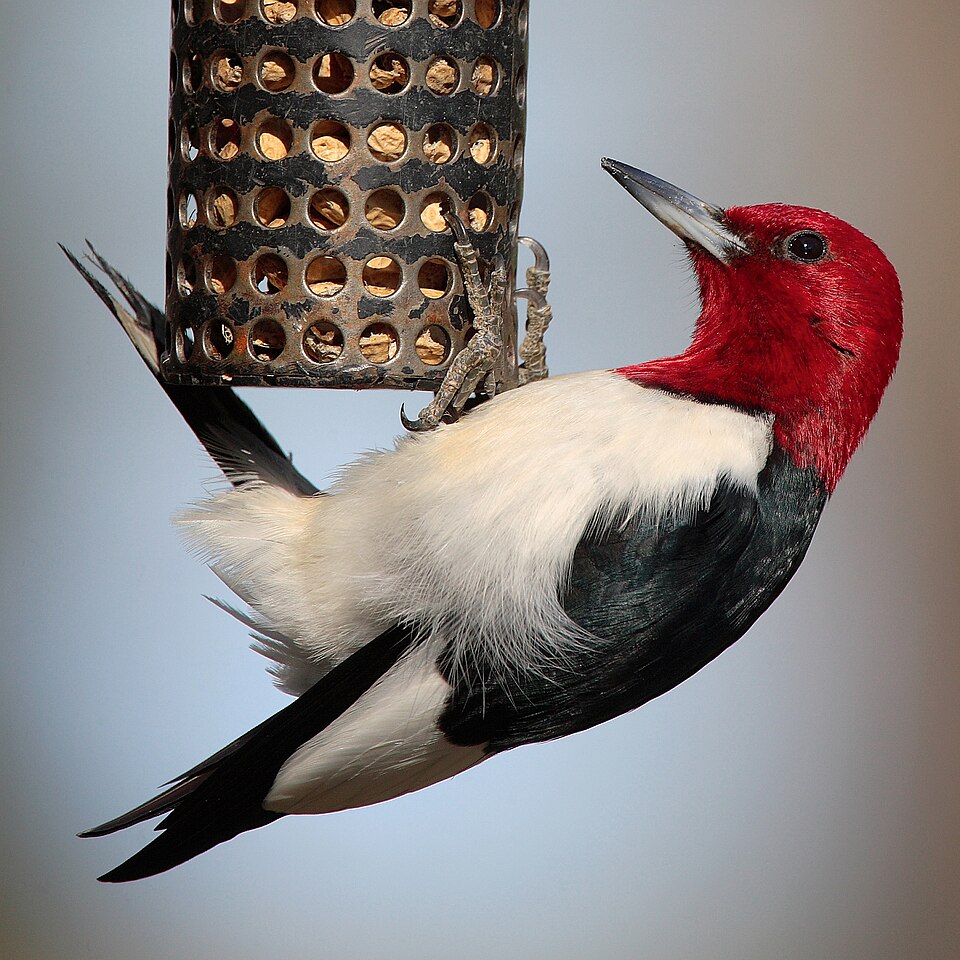
Few North American birds are as instantly recognizable as the Red-headed Woodpecker. While many woodpeckers carry just a dab of red on the head, this species wears the whole hood, a deep crimson that covers the entire head and throat and contrasts sharply with a snow-white belly and inky black back. In flight, big white wing patches flash against the dark wings and tail, earning it the old nickname "flying checkerboard." It is one of only a handful of truly tricolored birds on the continent, and once you see an adult, you never forget it.
This is a bird of open country with scattered big trees: oak savannas, beaver swamps with standing dead timber, pine plantations, parks, and rural roadsides. It is famous among birders for two unusual habits, it catches a remarkable share of its food in midair like a flycatcher, and it is one of very few woodpeckers that actively stores food, wedging acorns and insects into bark crevices and even shingling them over with chips of wood. Though still fairly widespread across the eastern and central United States, Red-headed Woodpecker numbers have fallen substantially over recent decades as dead snags are cleared and oak savannas disappear, making every sighting feel a little special.
The Red-headed Woodpecker is a medium-sized, stocky woodpecker with a fairly short, chisel-tipped bill and a sturdy, upright posture when clinging to a trunk. Adults are unmistakable, but the bold three-block color pattern, red, black, and white, is the key to a confident identification, and the large white patches on the trailing edge of the wing are obvious both at rest and in flight.
| Head | Entirely deep crimson-red, hood-like, covering head, neck, and throat with a clean border against the white breast |
| Back & wings | Glossy blue-black back; in flight the inner wing shows a large, square white patch |
| Underparts | Clean snowy white from breast to belly, sharply set off from the dark upperparts |
| Wing patches | Big white secondary patches make the lower back look white at rest; striking checkerboard flash in flight |
| Bill | Stout, straight, gray, chisel-tipped, typical woodpecker bill |
| Size | Roughly robin-sized to slightly larger; compact and big-headed |
Male vs. female
Males and females look identical to the human eye, both sexes share the full red head, black back, and white underparts and wing patches. There is no reliable plumage difference to separate them in the field, so you generally cannot sex a Red-headed Woodpecker by sight alone. (Males average very slightly larger with a marginally longer bill, but this is not usable in the field.) Behavior during the breeding season, such as which bird does most of the cavity excavation or roosts in the nest hole at night, typically the male, is often the only practical clue to which is which.
Juveniles
Juveniles look strikingly different from adults and routinely fool new birders. Instead of a red head, young birds have a dull grayish-brown head and neck, and their underparts are smudged with brown streaking. The wings show the same large white patches as adults, but those patches are usually crossed by a couple of dark bars early on. The brown head is gradually replaced by red through the first fall and winter, so birds in this transitional stage can show a patchy, mottled mix of brown and emerging crimson. By the following spring, young birds typically wear the full adult red hood.
Red-headed Woodpeckers do not really "sing" in the songbird sense; instead they communicate with a vocabulary of harsh, ringing calls. The most common is a loud, churring tchur or queer, shriller, higher, and rougher than the rolling call of a Red-bellied Woodpecker, and often repeated. They also give a sharp, chattering rattle and a variety of guttural notes around the nest and in territorial disputes.
Like all woodpeckers, they also "drum", a rapid burst of bill-strikes on a resonant dead limb or even a metal gutter or pole used to advertise territory and attract a mate. Their drumming tends to come in relatively short, evenly paced rolls. The combination of the strident queeah calls and a flash of black-and-white wings is often what first tips you off to a bird in the area.
The Red-headed Woodpecker is a bird of central and eastern North America. Its range stretches from the southern Canadian Prairies and the upper Midwest east to the Atlantic states and south through the Great Plains to Texas and the Gulf Coast and Florida. It is generally absent from the far Northeast's deep forests and from west of the Rockies. Within that range it is patchy and local, concentrated wherever the right mix of open ground and large dead or dying trees exists.
Movements are complex and tied to food rather than a fixed calendar. Birds in the northern part of the range are largely migratory, withdrawing southward in fall, while many southern birds are year-round residents. Crucially, winter distribution often hinges on the acorn and beechnut crop: in years with a heavy mast crop, birds may stay put and defend stores of nuts, while in poor-mast years they shift around in search of food. This makes the species famously unpredictable from winter to winter in any one spot.
This woodpecker is one of the most omnivorous and versatile of its family. A large share of its summer diet is insects, beetles, grasshoppers, ants, cicadas, and more, and it is an exceptional aerial hunter, launching from a perch to snatch flying insects on the wing the way a flycatcher does, or hovering to glean prey. It also forages on the ground, walks along fence rails and roadsides, and probes bark, but spends comparatively less time hammering deep into wood than many woodpeckers.
In fall and winter, plant food dominates: acorns, beechnuts, and other nuts, plus wild fruits and berries and waste corn. The species is one of the few woodpeckers known to cache food extensively, wedging acorns and even live grasshoppers into cracks, crevices, and under bark, sometimes hammering wood chips over the top to hide the larder. It will also raid other birds' nests for eggs and nestlings on occasion, a reminder that this handsome bird is also a resourceful opportunist.
Red-headed Woodpeckers are cavity nesters, excavating a hole in a dead tree, a dead limb of a live tree, a fence post, or a utility pole. They strongly favor exposed, sun-washed dead wood in open settings rather than deep woods, which is part of why the loss of standing dead snags has hurt the species. Both members of a pair help chisel out the cavity, and pairs will sometimes reuse the same tree or even the same hole in following years.
The female typically lays about 4 to 5 glossy white eggs, and both sexes share incubation, with the male commonly taking the night shift. After roughly two weeks of incubation the young hatch, and both parents feed them until they fledge a few weeks later. In the warmer southern parts of the range a pair may raise two broods in a season. Like other cavity nesters, they must contend with competition for nest holes, European Starlings in particular can be aggressive rivals for the cavities these woodpeckers work hard to dig.
Red-headed Woodpeckers are not reliable feeder regulars the way Downy or Red-bellied Woodpeckers are, but they do visit yards in the right setting, especially properties with big oaks, open ground, and standing dead wood. Patience and the right habitat matter more than any single feeder.
- Offer suet in a sturdy cage feeder; it is one of the most dependable ways to draw woodpeckers, especially in cold weather.
- Put out shelled or whole-kernel corn, peanuts, and acorns, this species caches nuts and is more nut-oriented than many feeder birds.
- Plant or protect oak and beech trees and shrubs with fall berries; natural mast is the foundation of their winter diet.
- Above all, leave dead trees and large dead limbs standing where safe, snags provide both nesting cavities and food-storage sites and are the single biggest draw.
- Keep feeders near the edge of open lawn or field rather than deep in dense cover, matching their open-country preference.
- Discourage European Starlings, which outcompete them for nest holes, and avoid removing every standing dead tree from your property.
- Red-bellied Woodpecker: Far more common at feeders; has a barred black-and-white 'zebra' back and red only on the crown and nape, not a full red hood. The all-red head is the giveaway for Red-headed.
- Acorn Woodpecker: A western bird with a clownish black, white, and red face pattern, not a solid red head, and a white rump. Ranges barely overlap.
- Pileated Woodpecker: Much larger and crow-sized, with a flaming red crest rather than a fully red head, and a mostly black body. Shape and size separate them at a glance.
- Downy Woodpecker: Tiny by comparison, with a white back stripe and only a small red nape patch on males. No red head and no big white wing patches.
What is the difference between a Red-headed Woodpecker and a Red-bellied Woodpecker?
Despite the confusing names, they are easy to separate. The Red-headed Woodpecker has an entirely red head, a solid black back, and clean white underparts. The Red-bellied Woodpecker, the one most people actually see at feeders, has a barred black-and-white 'zebra' back and red only on the back of its head, with just a faint reddish wash on the belly. If the whole head is red, it's a Red-headed.
Are Red-headed Woodpeckers rare?
They are still fairly widespread across central and eastern North America but are far less common than they once were, with significant long-term declines tied to the loss of dead trees and oak savanna habitat. They are also locally patchy, so they can be common in one area and absent nearby. Many birders consider finding one a treat.
Why don't the young ones have red heads?
Juvenile Red-headed Woodpeckers have a brownish-gray head instead of red, along with some brown streaking below. The red develops gradually through their first fall and winter, so you may see birds with a mottled brown-and-red head in between. By their first spring, most show the full adult red hood.
Will Red-headed Woodpeckers come to a backyard feeder?
Sometimes. They are not as feeder-dependent as Downy or Red-bellied Woodpeckers, but they will visit yards that offer suet, corn, peanuts, and acorns, especially properties with large oaks and standing dead trees nearby. Habitat with open ground and big trees matters as much as the feeder itself.
Do Red-headed Woodpeckers store food?
Yes, they are one of the few woodpeckers that actively cache food. They wedge acorns, nuts, and even live insects like grasshoppers into bark cracks and crevices, and may cover their stash with bits of wood or bark. These winter larders help them survive when fresh food is scarce.