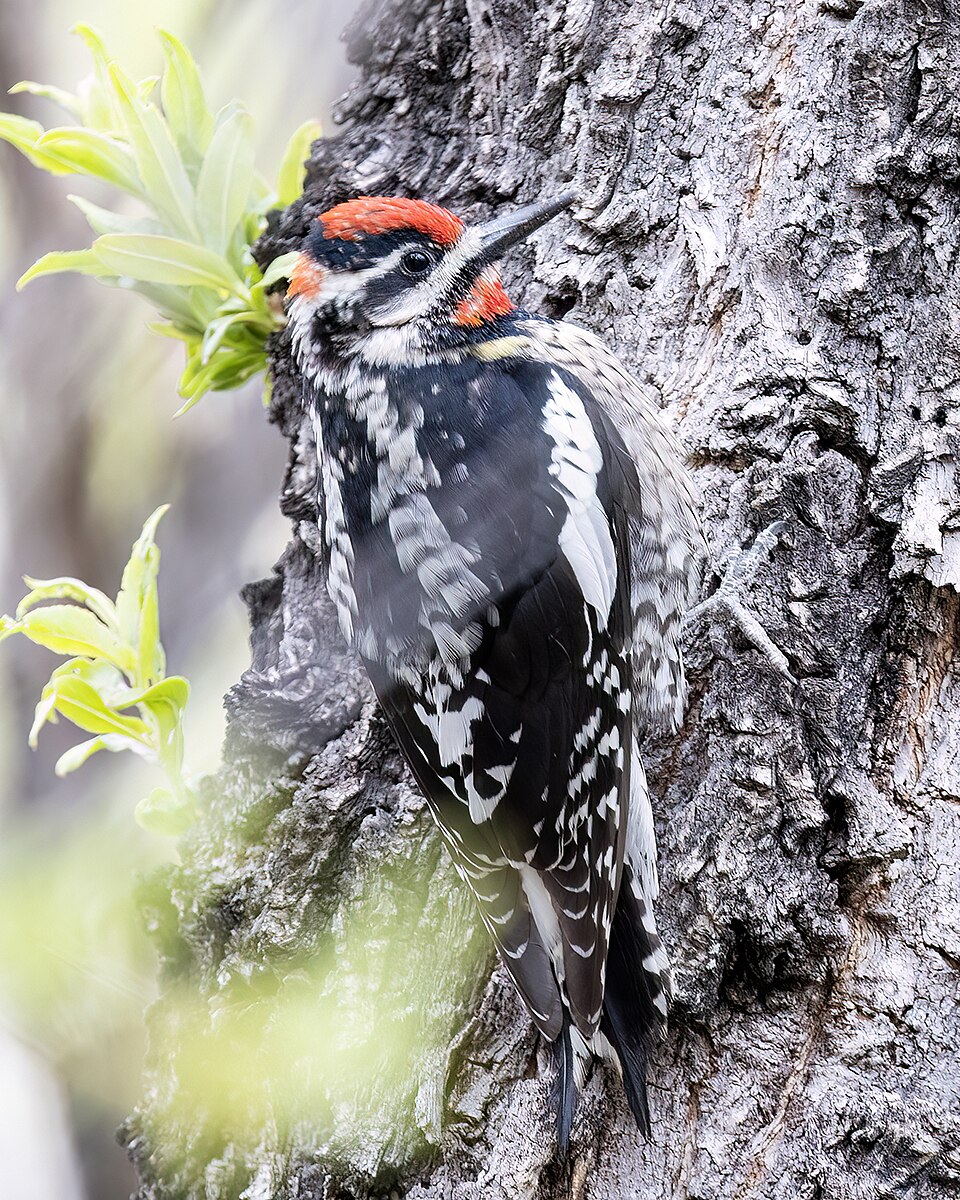
The Red-naped Sapsucker is the sap-drilling woodpecker of the interior West, a robin-sized bird that drums on aspens and orchard trees from the Rocky Mountains to the Great Basin. It earns its living in a way few other birds do: by chiseling neat rows of shallow holes into living trees, then returning again and again to lap up the sweet sap and the insects that get stuck in it. Those tidy "sap wells" are a giveaway that this bird is in the neighborhood, and they quietly feed a whole cast of other animals, from hummingbirds to warblers to squirrels.
Until the 1980s, ornithologists lumped this bird together with the Yellow-bellied and Red-breasted Sapsuckers as a single species. Today the three are recognized as separate but closely related, and they occasionally interbreed where their ranges overlap. The Red-naped is the western interior member of that trio, named for the small red patch on the back of its neck. It's a bird of aspen groves, mixed conifer-deciduous forest, and willow-lined mountain streams, and it's a true migrant, retreating south for winter rather than toughing it out in the snow.
This is a medium-small, boldly patterned woodpecker with an upright posture and a stiff tail it props against the trunk. At a distance it reads as a black-and-white bird with a long white wing stripe and a red cap; up close the red on the throat, forehead, and nape, plus a pale yellow wash on the belly, confirm the identification.
| Wing patch | A long, bold white stripe down the folded wing (the wing covert patch) is visible at rest and in flight on both sexes |
| Head pattern | Black-and-white striped face with a red forehead and crown bordered in black |
| Red nape | A small red patch on the back of the neck (the nuchal spot) that gives the bird its name; absent or minimal on Yellow-bellied Sapsucker |
| Throat | Red throat; in males the red extends down so the black border around it is broken at the bottom |
| Underparts | Pale, faintly yellow belly with messy black streaking along the sides |
| Back | Black back marbled with white in two irregular columns, not the clean ladder of a Hairy or Downy Woodpecker |
Male vs. female
The sexes look broadly similar, but the throat is the key. The male has an entirely red throat, and that red bleeds downward so it interrupts the black band at the lower edge of the chin. The female usually shows a white chin or upper throat with red only on the lower throat, leaving the black border more complete. Both sexes have the red crown and red nape, so don't rely on the cap alone, check the chin and throat. Females are, on average, a touch duller, but the difference is subtle in the field.
Juveniles
Juveniles are a muted, brownish version of the adults through their first summer and into fall. They lack the crisp red crown and throat, showing instead a dingy brown-and-buff head with only faint, smudgy color coming in, though the diagnostic white wing stripe is already present. Most molt into adult-like plumage by late autumn or early winter, so a sapsucker still looking "washed out" and brown in early fall is almost certainly a young bird of the year.
Red-naped Sapsuckers don't really sing; like other woodpeckers they communicate by voice and by drumming. The common call is a nasal, slightly whiny waah or mew, cat-like and falling in pitch, often given when a bird is disturbed or interacting with a mate. They also give a stuttering, churring series in close encounters.
The drum is the signature sound and the easiest way to tell a sapsucker from other woodpeckers. Instead of a steady machine-gun roll, it's an irregular, stuttering tattoo: a few quick taps followed by slower, spaced-out knocks, often rendered as a Morse-code-like brrrt... tap... tap-tap... tap. Sapsuckers will hammer this rhythm on resonant dead limbs, metal signs, chimney caps, and gutters to advertise territory in spring.
This is a bird of the interior West. It breeds through the Rocky Mountains and Great Basin ranges, from southern British Columbia and Alberta south through Idaho, Montana, Wyoming, Utah, Colorado, Nevada, and into the mountains of Arizona and New Mexico, with a foothold in the eastern Cascades and Sierra Nevada. Breeding habitat centers on aspen groves and mixed mountain forest, usually at moderate to high elevations.
It is a genuine migrant. In fall, birds move south and downslope to winter in the lower elevations and lowlands of the Southwest, much of Mexico, and into coastal and interior California, Texas, and northern Central America. Where its range edges meet those of the Red-breasted and Yellow-bellied Sapsuckers, hybrids turn up, which can make a lone bird at a range margin a genuine identification puzzle.
The Red-naped Sapsucker's diet is built around tree sap, and it engineers its own food supply. The bird drills two kinds of wells: round, deep holes that tap the tree's xylem (the sap rising from the roots, used heavily in early spring), and shallow, rectangular wells arranged in neat horizontal rows that tap the sugar-rich phloem later in the season. It tends these wells like a trapline, revisiting them to keep the sap flowing and to lap up the sticky liquid with its brush-tipped tongue.
Sap is only part of the story. The bird also eats the insects that get trapped in the oozing wells, gleans ants, beetles, and other arthropods from bark, flycatches in midair, and takes berries and fruit, especially in late summer and on the wintering grounds. Aspen, willow, birch, and various conifers and orchard trees are favored well-trees. Those wells become a shared resource: Rufous Hummingbirds, warblers, kinglets, squirrels, and even bats visit them, and some hummingbirds time their migration and nesting to coincide with active sapsucker wells.
Red-naped Sapsuckers are cavity nesters, and they strongly favor live aspens, often ones softened by a heartwood fungus that makes excavation easier while the outer trunk stays sound. The pair (or mostly the male) chisels a fresh cavity most years, typically 10 to 30 feet up, with a small round entrance leading to a gourd-shaped chamber. No lining is added; the eggs rest on a bed of wood chips.
The female lays a clutch of plain white eggs, and both parents share incubation, with the male typically taking the night shift. Eggs hatch in under two weeks, and both adults work hard to feed the noisy nestlings a mix of insects and sap. Young fledge a few weeks later but may follow the parents to sap wells for a while as they learn the trade. Old sapsucker cavities are valuable real estate, later used by chickadees, swallows, bluebirds, wrens, and even small owls.
The Red-naped Sapsucker is not a typical seed-feeder bird, so don't expect it at a sunflower tube. It's drawn to trees, not feeders, but there are real ways to make your property appealing if you live within its range.
- Keep aspens, willows, and birches on your property if you have them, these are prime sap-well and nesting trees, and mature live aspens are especially valued.
- Leave dead and dying limbs and snags standing where safe; sapsuckers use them for drumming and excavate nest cavities in soft-hearted wood.
- Offer suet in fall, winter, and migration, sapsuckers will sometimes visit suet cages, especially when insects are scarce.
- Put out fruit or jelly (orange halves, grape jelly) in late summer and migration, which can tempt them as it does orioles.
- Avoid insecticides on trees; the bird depends on the bugs that gather at its wells, and poisoned insects poison the bird.
- Tolerate the sap wells on your ornamental or orchard trees, they rarely kill a healthy tree, and the rows of holes are a sign you're hosting a fascinating bird.
- Yellow-bellied Sapsucker: The eastern counterpart; very similar but typically lacks the red nape patch, and males have an all-black border around a fully red throat. Ranges barely overlap except at migration.
- Red-breasted Sapsucker: Pacific coast and Cascades bird with an entirely red head and breast, lacking the black-and-white face stripes. Hybridizes with Red-naped where ranges meet.
- Williamson's Sapsucker: Shares western conifer forests but the male is glossy black with a red chin and yellow belly; females look totally different, barred brown with a brown head.
- Hairy Woodpecker: Similar size and black-and-white pattern but has a clean white back, a longer bill, no red throat, and a steady (not stuttering) drum.
What are the neat rows of holes in my tree?
Those are sapsucker wells. Red-naped Sapsuckers drill orderly horizontal rows of shallow holes to tap a tree's sap, then return to feed at them. On a healthy tree the holes are rarely fatal, though heavy, repeated drilling on a stressed or ornamental tree can occasionally cause damage. Wrapping a favored trunk in burlap or hardware cloth for a season can redirect the bird.
Do Red-naped Sapsuckers hurt trees?
Usually not seriously. Most established, healthy trees tolerate sap wells year after year. The risk rises if a tree is already weak or if the bird focuses heavily on one small ornamental, where ringing the trunk with holes can stress it. Native aspens and willows, the bird's preferred trees, are well adapted to it.
How do I tell a Red-naped from a Yellow-bellied Sapsucker?
Look for the red patch on the back of the neck, Red-naped usually has it and Yellow-bellied usually doesn't. Also check range: Red-naped is the interior western bird, Yellow-bellied the eastern one. On the male's throat, Red-naped has red that breaks through the lower black border, while Yellow-bellied keeps a complete black frame.
Will a sapsucker come to my bird feeder?
Not for seed. They're tree-feeding birds, but they will occasionally visit suet, and sometimes fruit or jelly during migration and winter. The best way to host one is to keep the trees, snags, and insects it actually relies on.
Where do Red-naped Sapsuckers go in winter?
They migrate south and downhill, leaving the mountain breeding grounds for the lowlands of the southwestern U.S., much of Mexico, lowland California and Texas, and into northern Central America. They're one of the few woodpeckers that are true long-distance migrants rather than year-round residents.