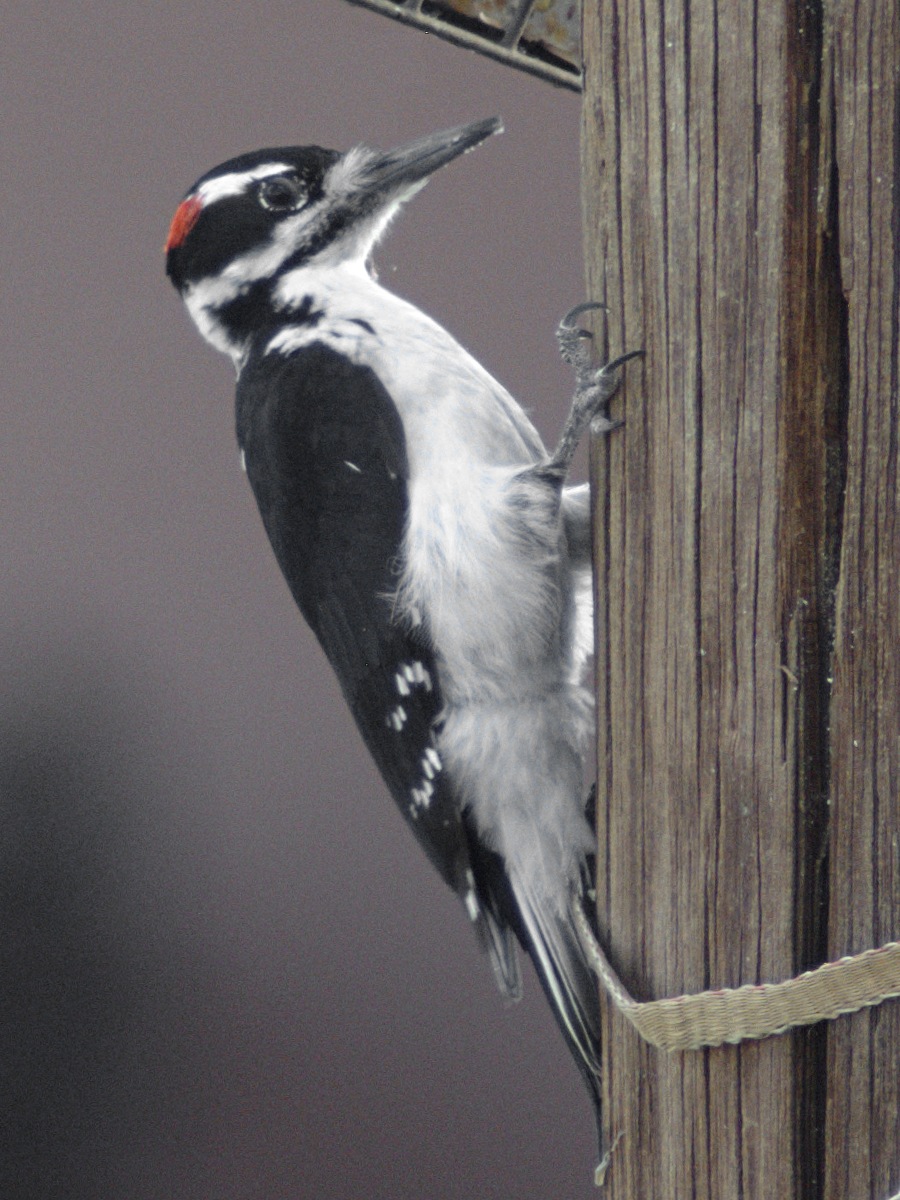
The Hairy Woodpecker is one of North America's most familiar woodland woodpeckers, a crisp black-and-white bird that turns up almost anywhere there are mature trees, from northern spruce forests to suburban shade trees and southern pine woods. To most people it looks like an oversized version of the tiny Downy Woodpecker, and the two are so similar that telling them apart is a rite of passage for new birders. The key difference is built into the bird's tools: the Hairy carries a noticeably longer, heavier, chisel-shaped bill suited to deeper excavation and hammering into solid wood.
Named for the long, soft, hair-like white feathers down the center of its back, the Hairy Woodpecker is a quiet but constant presence in healthy forests. It plays an important ecological role, drilling into wood after beetle larvae and helping control insect outbreaks, while its abandoned nest cavities later shelter chickadees, nuthatches, bluebirds, and small owls. It is a non-migratory resident across most of its enormous range, so the bird you meet in winter is very likely the same one nesting nearby in spring.
This is a medium-sized woodpecker with a clean black-and-white pattern, a fairly long, straight, pointed bill, and a relatively long neck and body that give it a more elongated, robust look than the dainty Downy. Roughly the size of an American Robin, it perches upright against trunks and large limbs, bracing with stiff tail feathers.
| Bill | Long and stout, roughly as long as the head is wide - the single best field mark separating it from the Downy |
| Back | Clean white stripe down the center of an otherwise black back |
| Wings | Black with bold white spotting (checkered) across the flight feathers |
| Underparts | Bright unmarked white from throat to belly |
| Outer tail feathers | Pure white with no black bars or spots (Downy has black-spotted outer tail feathers) |
| Head | Bold black-and-white striping; males show a small red patch on the back of the head |
Male vs. female
The sexes are nearly identical in size and pattern, and the only reliable difference is on the head. Adult males have a small red patch or band on the back of the crown (the nape), which females lack entirely - a female's head is simply black and white. In some western and northern populations the male's red may be split into two small spots rather than a single bar. Both sexes share the same long bill, white back stripe, and white underparts.
Juveniles
Recently fledged Hairy Woodpeckers look much like adults but slightly scruffier, and the head pattern can be confusing. Juveniles of both sexes often show a patch of red or reddish-orange on the crown (toward the front of the head, not the nape as in adult males), which they molt out before their first winter. Young birds may also look a bit duller and more loosely feathered overall.
The Hairy Woodpecker does not sing in the musical sense; instead it communicates with sharp calls and drumming. Its signature note is a loud, emphatic peek! - lower, sharper, and more forceful than the softer pik of a Downy. When agitated or in flight it gives a rattling, run-together call, often described as a whinny, but unlike the Downy's whinny the Hairy's rattle stays even in pitch rather than descending at the end.
Both sexes drum on resonant dead limbs, hollow trunks, and sometimes metal gutters or chimney caps in spring. The Hairy's drum is fast and steady, a long even roll that trails off, used to advertise territory and attract a mate rather than to find food. Learning the difference between the brisk peek and the gentle pik is often easier than judging bill length at a distance.
Few North American woodpeckers range as widely. The Hairy Woodpecker is found across nearly all of the United States and Canada, north to the limit of the boreal forest in Alaska and the Yukon, and south through the mountains of Mexico into Central America. It occupies an enormous variety of forest types - eastern deciduous woods, western conifer forests, oak woodlands, and even isolated stands in deserts and on the Bahamas.
It is essentially a year-round resident throughout its range and does not undertake true migration. Birds in the far north may drift somewhat southward or downslope in harsh winters, and high-elevation populations may move to lower ground, but most individuals defend the same territory all year. Geographic variation is considerable, with northern birds tending to be larger and whiter and Pacific and southwestern birds smaller and often dingier below.
Insects make up the bulk of the Hairy Woodpecker's diet, especially the wood-boring larvae of beetles and the larvae of moths tucked deep in wood. Its long, strong bill lets it chisel into solid trunks and limbs to reach prey that smaller woodpeckers cannot, and it uses a remarkably long, barbed tongue to extract grubs from their tunnels. It also takes ants, caterpillars, spiders, and adult beetles gleaned from bark crevices. In forests hit by bark beetle outbreaks or wildfires, Hairy Woodpeckers often concentrate to feast on the abundant larvae.
In addition to animal prey, it eats seeds, nuts, and some fruit and will drink sap from wells drilled by sapsuckers. Hairy Woodpeckers forage methodically, working up and around trunks and larger branches, tapping and listening, then hammering hard where they detect tunnels beneath the bark.
Hairy Woodpeckers are cavity nesters that excavate a fresh hole each year, usually in a dead trunk or a dead limb of a living tree. Both members of the pair share the work of chiseling out the cavity, which typically takes one to three weeks. The entrance is often placed on the underside of a leaning dead limb, which may help keep out rain and predators. The cavity is unlined except for a bed of wood chips.
The female lays a clutch of usually three to six glossy white eggs, and both parents take turns incubating, with the male typically sitting through the night. Eggs hatch in roughly two weeks, and both adults feed the nestlings until they leave the cavity at around a month old. Pairs generally raise a single brood per season. Old Hairy Woodpecker cavities become valuable real estate for many other birds and small mammals that cannot dig their own holes.
Yes - the Hairy Woodpecker is a genuine backyard and feeder bird, though it visits less reliably than the smaller Downy and prefers yards near mature trees or woodland edges. With the right food and some natural structure, it will become a regular caller.
- Offer suet in a sturdy cage feeder - it is the single most effective draw for Hairy Woodpeckers, especially in cold weather.
- Provide black-oil sunflower seeds and peanuts (in or out of the shell) on platform or hopper feeders; the Hairy's strong bill handles them easily.
- Mount feeders on or near tree trunks, or use a feeder that lets the bird brace its tail, mimicking its natural foraging posture.
- Leave dead trees and snags standing where it is safe to do so - they supply insect food and nesting and drumming sites.
- Avoid spraying for insects around your trees; wood-boring beetle larvae are this bird's preferred natural food.
- Put up a woodpecker-sized nest box packed with wood chips on a mature tree, though they more often excavate their own cavity.
- Downy Woodpecker: Much smaller with a stubby bill far shorter than its head; outer tail feathers have black spots or bars rather than being pure white; gives a softer pik call.
- Hairy Woodpecker (Pacific/western forms): In dry southwestern woods, check the Ladder-backed Woodpecker, which has a fully barred black-and-white back rather than a single clean white back stripe.
- Three-toed Woodpecker: Northern and montane conifer specialist with a barred 'ladder' back, barred flanks, and a yellow (not red) crown patch on males.
- Hairy vs Nuttall's: In California oak country, Nuttall's shows a heavily barred back and face stripes, unlike the Hairy's clean white back and white underparts.
How do I tell a Hairy Woodpecker from a Downy Woodpecker?
Look at the bill first: the Hairy's is long and stout, roughly as long as its head is wide, while the Downy's is short and stubby. The Hairy is also clearly larger (robin-sized versus sparrow-sized) and has pure white outer tail feathers, whereas the Downy's outer tail feathers are marked with black spots or bars. The calls differ too - a sharp peek for the Hairy, a gentler pik for the Downy.
Are Hairy Woodpeckers rare?
No. They are common and widespread across nearly all of North America and are listed as Least Concern. They are simply less conspicuous and visit feeders less often than the abundant Downy Woodpecker, so people often overlook them.
What do Hairy Woodpeckers eat at feeders?
They are especially fond of suet, and will also take black-oil sunflower seeds and peanuts from platform, hopper, and tail-prop feeders. In the wild, the bulk of their diet is wood-boring beetle larvae and other insects extracted from tree bark and trunks.
Do male and female Hairy Woodpeckers look different?
Only on the head. Adult males have a small red patch on the back of the crown; females have an all-black-and-white head with no red. Otherwise the sexes are identical in size, bill length, and plumage. Confusingly, juveniles of both sexes can show red toward the front of the crown before their first molt.
Why does a Hairy Woodpecker drum on my house or gutters?
Drumming is how woodpeckers advertise territory and attract mates in spring, and they choose the most resonant surface available - which can be metal flashing, gutters, or chimney caps. It is usually a seasonal display rather than damage-causing feeding. If it becomes a nuisance, you can deter it by covering or muffling the resonant surface or hanging reflective objects nearby.
Where do Hairy Woodpeckers nest?
They excavate a cavity in a dead tree or the dead limb of a living tree, often placing the entrance on the underside of a leaning limb. Both parents help dig the hole and raise a single brood of about three to six chicks each year. Their old cavities are later reused by chickadees, nuthatches, bluebirds, and other wildlife.