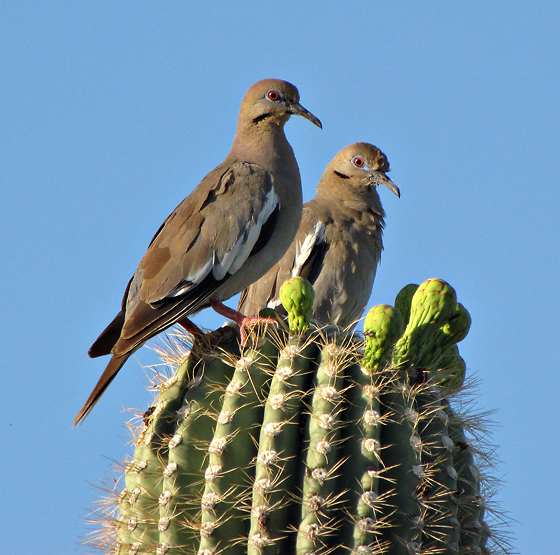
The White-winged Dove is a chunky, square-tailed dove of the American Southwest and the Gulf Coast, named for the bold white stripe that runs along the edge of each folded wing. At rest that stripe looks like a neat white slash on a soft gray-brown bird; in flight it explodes into a broad white flash that is the single best way to pick this species out at a distance. Where it lives, it tends to be conspicuous, sitting up on wires, fence posts, and bare branches and announcing itself with one of the most recognizable hooting calls in the desert.
Historically a bird of the Sonoran and Chihuahuan deserts, mesquite bosques, and citrus groves, the White-winged Dove has expanded dramatically over the past several decades. It has moved north and east, colonizing towns and cities far beyond its old strongholds, and is now a familiar yard bird across much of Texas and increasingly in places where it was once a rarity. Its close ties to saguaro cactus and desert wildflowers, and its willingness to take advantage of backyard feeders, make it both an ecologically important pollinator and seed disperser and a welcome, easy-to-watch visitor.
This is a medium-large, full-bodied dove with a rounded head, a fairly short and squared-off tail (not long and tapered like a Mourning Dove), and a long, slim dark bill. The overall color is a plain warm gray-brown, and the defining mark is the crisp white edge along the closed wing that becomes a bright crescent in flight.
| White wing stripe | A bold white band along the wing edge; appears as a thin white line when perched and a broad white flash across the wing in flight. |
| Tail | Short and squared, gray with a wide white tip and black band visible from below; not pointed like a Mourning Dove. |
| Eye | Bright orange-red iris ringed by bare bright blue skin, giving a distinctive 'made-up' look up close. |
| Face mark | A small black comma or dash below and behind the eye on the cheek. |
| Overall color | Plain warm grayish-brown body, slightly paler below, with a faint bronzy-purple sheen on the neck in good light. |
| Size and shape | Larger and bulkier than a Mourning Dove, with a rounder head and a long dark bill. |
Male vs. female
Males and females look essentially alike and cannot be reliably told apart in the field. Males average a touch larger and may show slightly brighter, more iridescent purple-bronze tones on the head and neck and a marginally bolder blue eye-ring, but these differences are subtle, overlap heavily, and are not dependable for identification. For practical backyard purposes, treat the sexes as identical.
Juveniles
Young White-winged Doves resemble washed-out adults. They are duller and grayer overall, lack the iridescent neck sheen, and show a darker, less vivid eye with little or no bright blue eye-ring. The white wing stripe is present from the start but can look slightly buffier or less crisp, and the plumage often appears scaly or freshly neat. Juveniles reach adult-like appearance within their first months.
The advertising call is a rhythmic, hooting series often written as who-cooks-for-you or hoo-hoo-hoo hoooo, a distinctly cooing, almost owl-like phrase that carries well across the desert and through suburban neighborhoods. Many listeners describe it as sounding like a question, with the cadence rising and falling, and on hot mornings dozens of birds may call at once.
White-winged Doves also give shorter, softer cooing notes and a low coo in close interactions. As with other doves, their wings can produce a fluttery, whistling sound on takeoff, though it is less pronounced than the sharp wing-whistle of a Mourning Dove.
The core range covers the southwestern United States, particularly Arizona, southern New Mexico, and much of Texas, southward through Mexico and into Central America and the Caribbean. In the Sonoran Desert, summer breeders pour in to exploit the saguaro bloom and fruit, then move south for winter, so in parts of Arizona the bird is strongly seasonal.
Over recent decades the species has expanded northward and eastward in a striking way, becoming established in cities well beyond its historic limits and turning up with growing frequency as a stray far to the north and east of its traditional range. Along the Gulf Coast and much of central and eastern Texas, many birds now remain year-round, helped along by backyard feeding and urban plantings. As a result, where you find them and whether they stay for winter depends heavily on the region.
White-winged Doves eat primarily seeds and grain, but they are notably tied to large desert plants. In the Sonoran Desert they are key visitors to saguaro cactus, drinking nectar from the flowers (and pollinating them in the process) and later feeding heavily on the sweet red fruit and its seeds. They also take seeds from grasses and weeds, cultivated grains like sorghum and corn, and a variety of fruits and berries.
Like other doves, they often feed on the ground, walking with a steady gait and pecking at fallen seed, then flying up to a perch to rest and digest. They readily come to platform and ground feeders for cracked corn, milo, sunflower, and other seed, and they need regular access to water, frequently visiting birdbaths, stock tanks, and puddles to drink.
White-winged Doves build the loose, flimsy stick nest typical of doves, a shallow platform of twigs placed in a shrub, tree, cactus, or sometimes a tangle of vines. In the desert they often nest in mesquite, palo verde, and citrus, and in towns they readily use ornamental trees. In some areas they nest in dense, noisy colonies; elsewhere pairs nest more solitarily.
A clutch is usually two creamy or buff eggs, and pairs commonly raise more than one brood per season where the season is long. Both parents incubate, and like all pigeons and doves they feed their young on "crop milk," a rich secretion from the lining of the crop, before transitioning the squabs to regurgitated seeds. Young grow quickly and fledge within a couple of weeks.
Yes, the White-winged Dove is a genuine backyard and feeder bird wherever its range overlaps with yours, and it is one of the easier doves to attract if you offer the right setup.
- Offer seed on a platform feeder or directly on the ground, these large doves prefer open, flat surfaces over small clinging perches.
- Stock cracked corn, milo, white millet, and black-oil sunflower seed, which they take readily.
- Provide a reliable water source such as a low birdbath or shallow basin; desert doves visit water daily and a dependable drink is a strong draw.
- Plant or preserve native desert vegetation like mesquite, palo verde, and especially saguaro where appropriate, which provide both food and nest sites.
- Keep open sightlines and a few exposed perches (wires, bare branches, fence posts) nearby, since these birds like to sit up in the open between feeding bouts.
- Expect them in small groups, once a few find your feeder, more usually follow.
- Mourning Dove: Slimmer with a long, pointed tail and no white wing stripe; shows black spots on the wing rather than a white band, and has a sharper wing-whistle in flight.
- Eurasian Collared-Dove: Pale sandy-gray with a black half-collar on the hindneck and a squared, white-cornered tail; lacks the bold white wing stripe and has a three-note koo-KOO-kook call.
- Common Ground Dove: Much smaller and stubbier with a short tail and rusty wing flashes (not a white stripe), and it forages low and unobtrusively on the ground.
- Inca Dove: Small and scaly-looking with a long tail and rufous wing patches in flight; far smaller and more delicate than the bulky White-winged Dove.
What does a White-winged Dove sound like?
Its signature call is a rhythmic, owl-like hooting often described as 'who-cooks-for-you,' a cooing question-like phrase that carries far. It also gives softer coos in close encounters, and many people first notice the bird by this distinctive call before spotting it.
How do I tell a White-winged Dove from a Mourning Dove?
Look for the bold white stripe along the wing edge, which becomes a bright white flash in flight, Mourning Doves lack this and instead show black wing spots. The White-winged Dove is also bulkier with a short, squared tail, while the Mourning Dove is slim with a long, pointed tail.
Do White-winged Doves come to bird feeders?
Yes. They readily visit platform feeders and feed on the ground, favoring cracked corn, milo, millet, and sunflower seed. A dependable shallow water source nearby greatly increases your chances of attracting them.
Why are White-winged Doves suddenly showing up where they never used to be?
The species has expanded its range substantially over recent decades, spreading north and east well beyond its historic desert and Gulf-Coast strongholds. Urban plantings, backyard feeding, and the bird's adaptability have helped it colonize new towns and cities.
Are White-winged Doves migratory?
It depends on the region. In parts of the Sonoran Desert they are strongly seasonal, arriving to breed in summer and moving south for winter, while along the Gulf Coast and much of Texas many birds now stay year-round, aided by backyard feeders and city habitat.