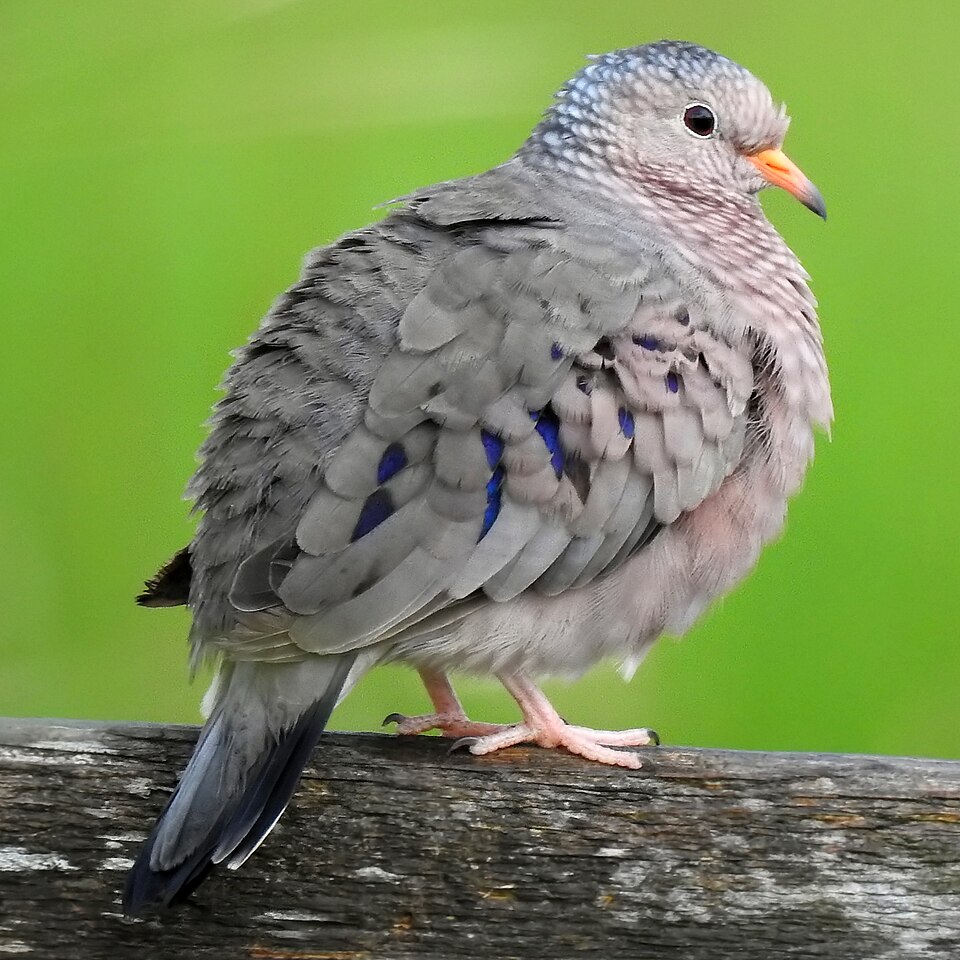
The Common Ground Dove is the smallest dove in North America, barely bigger than a House Sparrow and easy to overlook as it shuffles along bare ground and dusty roadsides. Where Mourning Doves look long and elegant, this little bird is round, short-tailed, and almost toy-like, with a scaly-looking head and breast and a habit of staying low. Birders in the southern United States often meet it first not by sight but by sound, when a soft, repeated coo drifts up from a hedgerow or a field edge on a warm morning.
It is a bird of warm, open country: the Deep South, Florida, the desert Southwest, southern California, and on south through Mexico and into South America. Common Ground Doves favor sandy soil, brushy pastures, orchards, suburban yards, and any open patch where weed seeds collect. Though small and unassuming, they are widespread and locally abundant across that range, and once you learn their shape and voice they become one of the more rewarding small birds to find.
Think small, round, and short-tailed. A Common Ground Dove is roughly sparrow-sized, with a stubby tail and a plump, hunched posture that makes it look more like a tiny quail than a typical dove. The single best clue is the burst of bright chestnut-rufous in the wings, flashed only when the bird flies.
| Size & shape | Tiny and stocky, only 6-7 inches long with a short tail; the smallest dove in North America, barely larger than a House Sparrow. |
| Scaly head & breast | The feathers of the head, neck, and chest have dark edges, giving a distinctly scaled or beaded look up close. |
| Rufous wing flash | In flight the wings show bright chestnut-rufous, a flash of warm color unlike any other small dove in its range. |
| Dark wing spots | At rest, scattered dark iridescent purple-to-black spots mark the folded wing coverts. |
| Bill color | A pinkish to reddish base tipped with black, often easier to see than on other doves. |
| Tail | Short and dark, with narrow white corners that show as the bird flushes. |
Male vs. female
The sexes look similar at a glance and many birds in the field cannot be confidently sexed, but with a good look there are differences. Males tend to be warmer and more colorful, with a soft pinkish or rosy wash across the breast and a pale bluish-gray cast to the crown and nape. Females are plainer and grayer overall, with a more uniform, drabber face and breast and less of the pink tone. Both sexes share the scaly pattern and the rufous wings, so the rufous is an identification mark for the species, not a way to tell the sexes apart.
Juveniles
Recently fledged Common Ground Doves are duller and more uniform than adults, lacking the crisp scaling on the head and breast. They show a grayer, scalier-fringed appearance overall, with pale feather edges across the upperparts giving a slightly mottled look, and the bright wing spots and rufous flash are present but more muted. The bill is also duller, without the clean pink-and-black contrast of an adult. Within a few months they molt toward the cleaner adult pattern.
The voice is a soft, gentle, monotonous cooing, often described as a repeated woo-oo or coo-oo with a rising inflection at the end of each note, as if the bird were asking a quiet question over and over. Some listeners hear it as a single soft hoop or wah-up repeated steadily many times, several notes per pair of seconds, for long stretches. It carries surprisingly far for such a small bird and is one of the most reliable ways to detect the species when it is hidden in low cover.
The cadence is even and unhurried, lacking the mournful, sliding quality of the Mourning Dove's song. When flushed, the bird's wings make a soft fluttering rustle rather than the sharp whistle of some other doves, and birds give few harsh calls beyond the cooing song.
In the United States, Common Ground Doves are residents of the warm southern tier: across Florida and the Gulf Coast, through the southern parts of Texas, the desert Southwest in Arizona and New Mexico, and into southern California. From there their range extends south through Mexico, Central America, the Caribbean, and into much of northern South America. They are largely non-migratory, staying on territory year-round wherever winters are mild.
Because they are tied to warm climates, they only rarely wander north of their normal range, and a sighting well outside the southern states is unusual. Within their range they can be local, common in one patch of sandy brush and absent from a nearby area that lacks the open, seed-rich ground they prefer.
Common Ground Doves are primarily seed-eaters, and they feed almost entirely on the ground. They walk slowly through open, sandy or dusty areas, picking up the small seeds of grasses, weeds, and many low plants, and will also take waste grain, small berries, and the occasional insect or snail, especially when feeding young. Like other doves they swallow grit to help grind seeds in the gizzard, which is part of why bare, gravelly ground appeals to them.
They forage in pairs or small loose groups, moving with a characteristic head-bobbing walk and pausing often to look around. When startled they flush low and fast, flashing the rufous wings, then drop back to cover or perch on a low fence wire or shrub. Much of their day is spent quietly working the ground for the tiny seeds that fuel such a small body.
The nest is a flimsy, shallow saucer of grasses, weed stems, and rootlets, sometimes so sparse it is little more than a pad. Pairs place it low: directly on the ground in a sheltered spot, on a stump, or in the fork of a shrub or low tree, usually not far off the ground. In the warm parts of their range the breeding season is long, and pairs often raise more than one brood in a year.
A typical clutch is two plain white eggs. Both the male and the female share incubation, and once the young hatch both parents feed them on crop milk, a rich secretion produced in the lining of the crop that all pigeons and doves provide to their nestlings. The young grow quickly and leave the nest while still looking dull and juvenile, before they have gained the clean adult plumage.
Common Ground Doves are not strong feeder birds in the way that Mourning Doves are, but if you live within their southern range you can absolutely encourage them, mostly by offering small seed on or near the ground and keeping part of the yard open and a little wild.
- Scatter small seeds such as white millet, cracked corn, and fine grains on the ground or on a low platform feeder rather than in hanging tube feeders.
- Keep an open, sandy or dusty patch in the yard; ground doves like bare earth for feeding and for picking up grit.
- Let a corner go weedy and brushy, since native grasses and weeds produce exactly the tiny seeds these doves seek.
- Provide a shallow water source or low birdbath at ground level, as small doves drink readily and prefer water they can reach without climbing.
- Avoid heavy use of herbicides and insecticides, which strip away the weed seeds and small invertebrates the birds depend on.
- Keep cats indoors; ground-feeding doves are especially vulnerable to predation while they forage low and out in the open.
- Mourning Dove: Much larger and slimmer with a long, pointed tail; lacks the scaly breast and the rufous wing flash, and gives a mournful sliding coo.
- Inca Dove: Similar tiny scaly dove of the Southwest, but its scaling is heavier and covers the whole body, and it has a longer tail with white edges; calls a clear two-note 'no-hope.'
- Ruddy Ground Dove: A rare visitor to the southern U.S.; males are much more uniformly rusty-red and lack the strong scaling on head and breast.
How small is a Common Ground Dove?
It is the smallest dove in North America, only about 6 to 7 inches long, barely larger than a House Sparrow. Its round body and very short tail make it look even smaller and more compact than that measurement suggests.
What is the difference between a Common Ground Dove and an Inca Dove?
Both are tiny scaly doves, but the Inca Dove has heavier scaling over its entire body and a noticeably longer tail with white edges, while the Common Ground Dove has scaling mostly on the head and breast and a short tail. Their voices differ too: the Inca Dove says a clear 'no-hope,' the ground dove gives a soft repeated coo.
Why does it flash reddish wings when it flies?
The bright chestnut-rufous in the wings is simply the color of the flight feathers, which is hidden when the wings are folded and revealed in flight. This rufous flash is one of the quickest ways to confirm a Common Ground Dove as it flushes.
Where do Common Ground Doves live in the United States?
They are year-round residents of the warm southern states, including Florida, the Gulf Coast, southern Texas, Arizona, New Mexico, and southern California, and they range on south through Mexico and into South America. They rarely wander north of this warm southern band.
Will Common Ground Doves come to a backyard feeder?
They can, especially within their southern range, but they prefer to feed on the ground rather than at hanging feeders. Scatter small seed like white millet or cracked corn on the ground or a low platform, keep an open dusty patch and some weedy cover nearby, and you stand a good chance of attracting them.