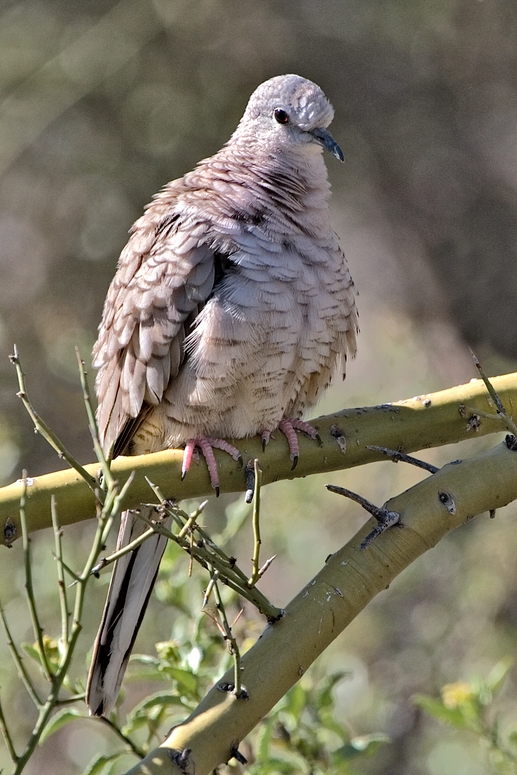
The Inca Dove is a slender, sparrow-sized dove of the American Southwest and Mexico, instantly recognizable by the fine, dark "scaled" pattern that covers nearly its whole body, as if it were dressed in tiny overlapping feathers like fish scales. Despite the name, it never lived in the historic range of the Inca Empire, an early naturalist simply misapplied the label, and it stuck. This is a bird of towns, ranch yards, city parks, and desert edges far more than wild country. Where there are people, water, and a little spilled grain, Inca Doves usually follow.
For backyard birders across Arizona, New Mexico, Texas, and parts of the Gulf Coast, the Inca Dove is a familiar and endearing companion. It walks the ground with a bobbing head, flushes with a startling rattle of wing feathers, and announces itself with one of the most quietly mournful calls in North America. Over the last century it has steadily expanded its range northward, riding the spread of irrigated towns and bird feeders into areas where it was once unknown.
Look for a small, long-tailed, ground-feeding dove that appears almost gray-brown at a distance but reveals a delicate scaly texture up close. The slim body and notably long, square tail edged in white give it a different shape from the chunkier doves people know best.
| Scaled plumage | Fine dark feather edges create an all-over scaly look on the head, breast, back, and wings, the single best field mark. |
| Rufous wing patches | In flight, bright chestnut-red flashes light up the primaries, often hidden when the bird is perched. |
| Long white-edged tail | A long, narrow tail with conspicuous white outer feathers, very noticeable as the bird flushes or lands. |
| Size and shape | Small and slender, barely bigger than a House Sparrow in body, much smaller than a Mourning Dove. |
| Color | Overall pale grayish-brown, a touch pinker on the underparts, with a dark eye and a thin dark bill. |
| Wing rattle | Takes off with a distinctive dry, fluttering rattle of the wings, almost a tiny whir. |
Male vs. female
Males and females look essentially alike, which makes them tricky to tell apart in the field. Males average slightly more pinkish or warmer on the breast and face, while females tend to be a shade grayer and plainer, but the overlap is wide and lighting easily erases the difference. There is no bold plumage badge separating the sexes, behavior during courtship, when a male puffs up, bows, and coos at a partner, is often the most reliable clue to who is who.
Juveniles
Juvenile Inca Doves are duller and more uniform than adults, with the scaly pattern muted or nearly absent on the head and underparts and a generally washed-out, grayish look. The rufous in the wing is present but subdued, and the feather edgings that give adults their crisp scaled appearance are softer and less defined. Young birds gain the full adult scaling as they molt over their first months.
The Inca Dove's signature call is a clear, two-note coo often rendered as "no hope" or "cool coo," repeated patiently for long stretches from a wire, rooftop, or bare branch. The mournful, slightly rising-then-falling quality has earned it the folk name "the no-hope dove," and once you learn it you'll hear it echoing through Southwest neighborhoods on warm mornings.
Besides the main song, Inca Doves give a softer rolling or churring note in close interactions, and a distinctly non-vocal sound: the dry, papery rattle their wings make on takeoff. That wing rattle is so consistent it can identify a flushing bird even when you don't get a good look.
The Inca Dove is mostly a resident of the southwestern United States and Mexico, ranging from southern Arizona, southern New Mexico, and much of Texas south through the Mexican highlands and Pacific slope into Central America. In the U.S. it is closely tied to towns, irrigated farmland, and developed desert, rather than untouched wilderness.
Over the past hundred-plus years it has pushed its range steadily northward and eastward, colonizing new towns as human settlement, watering, and feeding created suitable habitat. It is largely non-migratory, though individuals, especially young birds, may wander, and vagrants turn up well north and east of the normal range. Hard winters at the northern edge can knock back local populations, since the species is sensitive to prolonged cold.
Inca Doves are ground-foraging seed-eaters. The bulk of their diet is small seeds, grass and weed seeds, waste grain, and seeds from feeders, which they pick up while walking deliberately across lawns, gravel, sidewalks, and bare dirt. Like other doves they swallow seeds whole and grind them in a muscular gizzard, often swallowing grit to help.
They feed in a methodical, head-bobbing walk and frequently gather in loose flocks, especially in cooler months. In winter, Inca Doves are known for a curious behavior called pyramid roosting, where birds pile on top of one another in stacked layers to conserve heat, a vivid sign of how poorly this warm-climate dove tolerates cold.
Inca Doves build a small, flimsy platform nest of twigs, grass, and rootlets, typically placed in a shrub, tree, vine, or on a sheltered ledge, often surprisingly low and close to human activity. The nest is so thin that eggs are sometimes visible from below. In warm parts of the range the breeding season is long, and a pair may raise several broods in a single year.
The female usually lays two plain white eggs. Both parents share incubation, and like all pigeons and doves they feed their young "crop milk," a rich secretion produced in the crop, during the nestlings' first days before transitioning them to seeds. Pairs frequently reuse a successful nest site and can keep production going for much of the year in mild climates.
Yes, within its range, the Inca Dove is very much a backyard and feeder bird, and an easy one to invite in if you provide the right setup.
- Scatter small seeds on the ground or on a low platform feeder, millet, cracked corn, and milo are favorites; Inca Doves rarely use tube or clinging feeders.
- Provide a shallow, clean water source; doves drink frequently and are drawn to ground-level birdbaths and drips.
- Leave some open bare ground or short grass near cover where they can walk and forage in the methodical way they prefer.
- Offer dense shrubs, hedges, or small trees for nesting and for shelter from heat, cold, and predators.
- Keep a supply of fine grit or sand available nearby, which helps them digest the whole seeds they swallow.
- Be patient in colder northern areas, Inca Doves are warm-climate birds and may be scarce or absent during harsh winters.
- Common Ground Dove: Even smaller and stubbier with a short tail; shows scaling mainly on the head and breast (not all over) and has a noticeably shorter, more rounded tail.
- Mourning Dove: Much larger and plain-bodied with no scaly pattern, a pointed (not square white-edged) tail, and a slower whistling wing sound rather than a dry rattle.
- White-winged Dove: Bigger and grayer with a bold white wing stripe and a rounded tail; lacks the all-over scaling and the long white-edged tail of the Inca Dove.
Why is it called an Inca Dove if it doesn't live where the Incas did?
It's a historical misnomer. The species was named in the 1800s and the Inca label was applied in error, the bird's actual range never overlapped with the Inca Empire of South America. The name simply stuck.
What does the Inca Dove's call sound like?
A clear, mournful two-note coo often written as 'no hope' or 'cool coo,' repeated steadily. The melancholy tone has earned it the nickname 'the no-hope dove.'
How do I tell an Inca Dove from a Common Ground Dove?
Look at the tail and the scaling. The Inca Dove has a long tail with white outer edges and scaly feathers over its whole body. The Common Ground Dove is smaller and stubbier with a short tail and scaling mostly on the head and breast.
What do Inca Doves eat and how do I attract them?
They eat small seeds and waste grain off the ground. Offer millet, cracked corn, or milo on the ground or a low platform feeder, plus shallow water, and they'll often become regular visitors within their range.
Why do Inca Doves pile on top of each other in winter?
This is called pyramid roosting. As a warm-climate species, Inca Doves stack in layers to share body heat during cold weather, a behavior that highlights how sensitive they are to low temperatures.