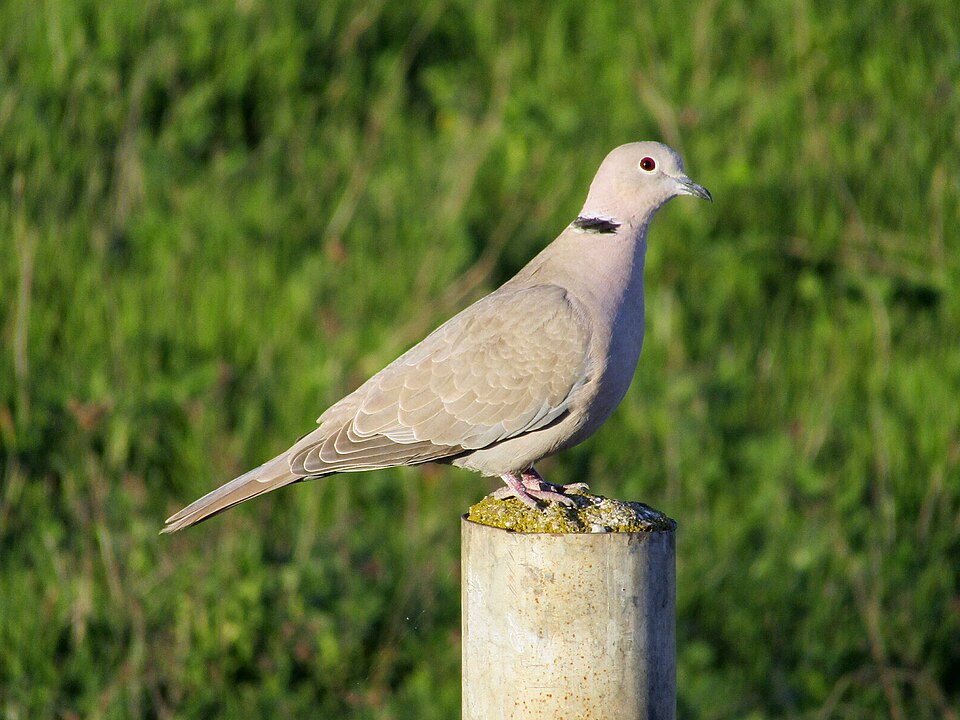
The Eurasian Collared-Dove is a chunky, pale gray dove best known for the thin black half-collar that wraps the back of its neck and for one of the most relentless expansions in modern bird history. A native of southern Asia, it spread across Europe through the 20th century, reached the Bahamas, and from there leapfrogged into Florida in the 1980s. In just a few decades it colonized most of the United States, southern Canada, and Mexico, turning up at backyard feeders, grain elevators, and small-town power lines almost everywhere except the dense forests and highest elevations.
For backyard birders it is a familiar and often welcome presence: larger and paler than a Mourning Dove, with a square-cut tail and a monotonous, far-carrying three-note song that becomes the soundtrack of suburban mornings. Because it is non-native and thrives alongside people, it stirs mixed feelings, but it remains a great bird for beginners to learn since it sits still on wires and rooftops and shows its key marks plainly.
Look for a medium-large, long-bodied dove that is uniformly sandy gray-buff, noticeably paler and bulkier than a Mourning Dove. The standout feature is the narrow black crescent edged in white across the back of the neck, and the broad, squared tail tip rather than a long point.
| Overall color | Pale, washed-out grayish-buff body, slightly darker on the wings; no bold spotting |
| Neck collar | Thin black half-ring bordered with white across the nape (absent in young birds) |
| Tail | Long but squared at the tip; broad white corners and band show as a fan from below in flight |
| Wingtips | Dark primary feathers contrast with the pale wing, obvious in flight |
| Bare parts | Black bill, deep reddish eye, and dull pinkish-red legs |
| Size & shape | Bigger and heavier-bodied than a Mourning Dove, with a more upright, blocky posture |
Male vs. female
Males and females look essentially alike and cannot be reliably told apart in the field. Both sexes share the same pale plumage, black neck collar, and dark eye. Males average a touch larger and are the ones that perform the persistent cooing song and the showy display flights, so behavior is often a better clue to sex than appearance.
Juveniles
Juveniles resemble adults but are duller and a bit browner, and they lack the diagnostic black neck collar, which develops as they molt into adult plumage during their first months. Young birds also show pale buff fringes on the wing feathers, giving them a slightly scaly look, and their bare parts are duller than the adult's reddish eye and pink legs.
The song is a low, hollow, three-syllable coo, usually written as coo-COO-coo or coo-COOO-cuk, with the middle note longest and emphasized. It is repeated steadily and monotonously, often for long stretches from a rooftop, wire, or treetop, and carries a surprising distance on calm mornings. With practice it is easy to separate from the soft, mournful, four-to-five-note lament of a Mourning Dove.
Listen also for a harsh, nasal flight call, a drawn-out hwaaah or kwurr, often given as the bird lands or flushes. During display, the male launches steeply upward with noisy wingbeats, then glides down in a spiral with wings and tail spread.
Native to the Indian subcontinent and the Middle East, the Eurasian Collared-Dove expanded across Europe in the 1900s and was introduced to the Bahamas, where escaped birds in the 1970s seeded an invasion of Florida by the early 1980s. From there it spread explosively north and west, and it is now established across most of the United States, southern Canada, and into Mexico, favoring towns, farmsteads, and suburbs over unbroken forest.
It is essentially non-migratory and present year-round wherever it occurs, though young birds disperse widely, which is how the range kept pushing outward so quickly. It remains scarcer or absent in the Northeast, the high mountains, and the wettest forested regions, while abounding in the agricultural interior and the Southwest.
The Eurasian Collared-Dove is primarily a seed and grain eater, foraging on the ground for cereal grains, weed seeds, and waste grain around farms, feedlots, grain elevators, and backyards. It readily takes cracked corn, millet, milo, sunflower, and other seed scattered on the ground or offered on platform feeders, and it will also eat some berries, small fruits, and the occasional insect.
Birds typically feed by walking and pecking on open ground, often in small loose groups, then fly up to a wire or perch to rest and digest. Like other doves and pigeons, they swallow grit to help grind food in the gizzard and can drink by sucking water continuously rather than tipping the head back.
Pairs build a flimsy, loosely woven platform of twigs and stems, often surprisingly thin, placed on a tree branch, in a dense conifer, or on a ledge, building, or other man-made structure. The female does most of the building while the male brings material, and a pair will frequently reuse and add to the same site.
The clutch is almost always two white eggs, incubated by both parents for roughly two weeks. The young are fed protein-rich crop milk produced by both adults, fledge in about two to three weeks, and the pair may raise several broods across a long breeding season. In mild climates they can nest nearly year-round, a key reason the species multiplies so fast.
Yes, this is very much a backyard and feeder bird, and in much of North America you may not need to do anything special to attract one. They favor open, suburban and rural settings with scattered trees and a reliable food source, and they take quickly to feeders.
- Scatter cracked corn, white millet, milo, or black-oil sunflower seed on the ground or a wide platform feeder - collared-doves prefer to feed in the open rather than cling to tube feeders.
- Provide a low, open water source such as a ground-level or pedestal birdbath; doves drink often and appreciate shallow water.
- Keep open lawn or gravel nearby - they like to walk and forage on bare or short ground where they can watch for danger.
- Offer a bit of grit or coarse sand, which doves swallow to help grind seed in the gizzard.
- Leave a few tall perches available - wires, dead branches, or rooftops - where males will sit and coo and where the flock can loaf safely.
- Be aware they are non-native and can dominate feeders; spreading seed in more than one spot helps smaller birds get a turn.
- Mourning Dove: Smaller and slimmer with a long pointed tail, warm brown tones, black spots on the wing, and no black neck collar; gives a soft mournful coo.
- Rock Pigeon: Bulkier and shorter-tailed with highly variable plumage, often a glossy green-purple neck and dark wing bars; lacks the slim black half-collar.
- African Collared-Dove: Very similar tame escapee (the 'Ringneck Dove'); paler and smaller with whitish undertail and a softer, rolling laughing coo rather than a strong three-note song.
- White-winged Dove: Similar size but shows a bold white stripe along the folded wing and a rounded tail; has a blue eye-ring and no black neck collar.
How do I tell a Eurasian Collared-Dove from a Mourning Dove?
The collared-dove is bigger, paler, and grayer, with a black half-collar on the back of the neck and a squared-off tail. A Mourning Dove is smaller and browner with black spots on the wing, no collar, and a long, pointed tail. Their voices differ too: a steady three-note coo-COO-coo versus the Mourning Dove's soft, mournful lament.
Are Eurasian Collared-Doves invasive or harmful?
They are non-native to North America and spread rapidly, so they are often called invasive. So far studies have not shown strong harm to native doves, but they can crowd feeders and compete for food and nest sites. Because they are non-native, they are not protected under the U.S. Migratory Bird Treaty Act in most states, unlike native doves.
Why do they coo so much, and what does the call mean?
The persistent three-note song is given mainly by males to defend territory and attract a mate. Because they breed over a very long season and often near houses, that monotonous cooing can seem nonstop in spring and summer. A harsher nasal note usually means a bird is landing or has been disturbed.
What do Eurasian Collared-Doves eat at feeders?
They are seed eaters and favor cracked corn, white millet, milo, and sunflower seed offered on the ground or a platform feeder. They feed by walking and pecking in the open rather than perching on tube feeders, so scattering seed low and wide is the best way to attract them.
Where did Eurasian Collared-Doves come from in the United States?
They trace back to birds that escaped or were released in the Bahamas in the 1970s. Those spread to Florida by the early 1980s, and from there the species expanded across nearly all of the U.S., southern Canada, and Mexico within a few decades, making it one of the fastest avian range expansions on record.
How long do Eurasian Collared-Doves live and how fast do they breed?
In the wild many live only a few years, though some reach a decade or more. Their success comes from rapid breeding: pairs lay two eggs per clutch and can raise multiple broods through a long season, sometimes nearly year-round in mild climates, which is why populations grow so quickly.