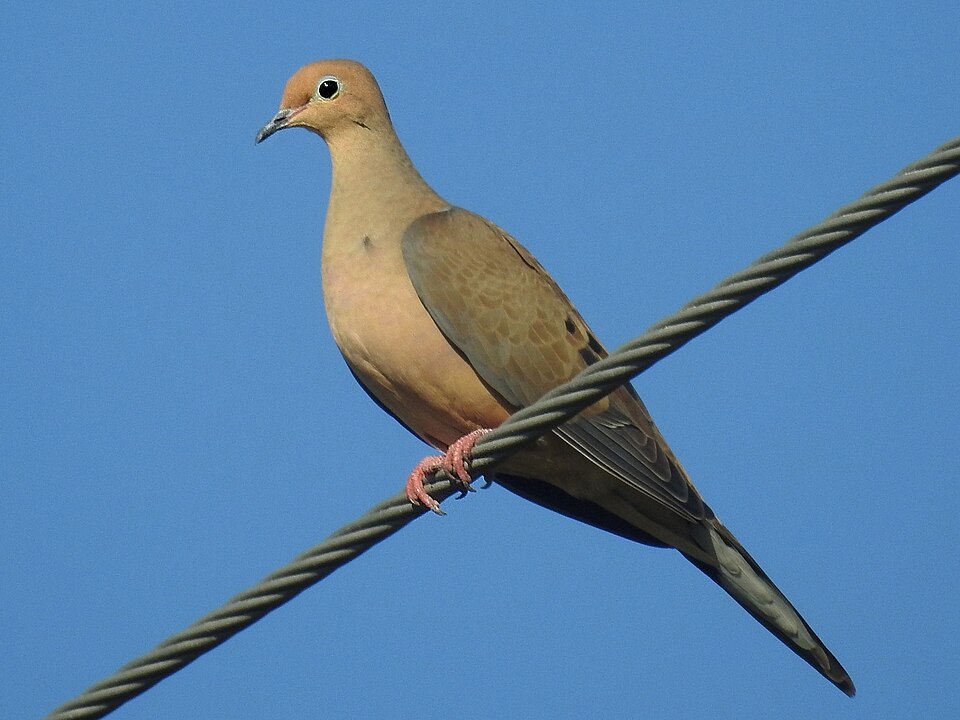
Few birds are as woven into the everyday soundscape of North America as the Mourning Dove. If you've ever heard a soft, sorrowful coo drifting across a quiet morning and mistaken it for an owl, chances are you were listening to this slim, long-tailed dove. Found from southern Canada to Panama, it thrives in suburbs, farms, open woods, deserts, and city parks alike, making it one of the most widespread and familiar birds on the continent.
The Mourning Dove is also one of the most numerous wild birds in North America, with a population estimated in the hundreds of millions. It is a prolific breeder, raising several broods a year, which helps it remain abundant even though it is among the most heavily hunted game birds in the United States. For backyard birders, it's a gentle, ground-feeding regular that adds soft color and a calming voice to the daily lineup at the feeder.
Look for a slender, pigeon-shaped bird about the size of a robin but longer, with a small rounded head, a plump body, and a distinctive long, pointed tail that tapers to a fine tip. In flight the silhouette is unmistakable: swift, direct, and streamlined, with the long tail trailing behind.
| Overall color | Soft grayish-brown to buff, paler and pinkish on the underparts |
| Tail | Long and pointed, edged with white spots that flash conspicuously in flight |
| Wing spots | Scattered black spots on the folded wing coverts |
| Head & eye | Small head with a dark spot below the eye and a thin pale eye-ring |
| Bill & legs | Slim dark bill; short reddish-pink legs |
| Neck sheen | Faint pinkish-iridescent patch on the sides of the neck, brighter in males |
Male vs. female
The sexes look very similar and are often impossible to tell apart at a glance. Males average slightly larger and more colorful: they show a faint bluish-gray crown, a rosy or pinkish wash across the breast, and a more vivid patch of pink-and-green iridescence on the sides of the neck. Females tend to be a touch browner and plainer overall, with a more uniformly tan head and breast. In mixed pairs the difference can be visible, but a lone bird usually can't be sexed with confidence.
Juveniles
Juveniles look scaly and rough compared with adults. Their feathers are edged with pale buff or whitish tips, giving the body and wings a distinctly spangled or scalloped appearance, and they lack the smooth pinkish tones and neck iridescence of the adults. The dark spot below the eye is fainter, and young birds often look slightly disheveled. This juvenile plumage fades within a couple of months as they molt into adult-like feathering.
The song is the source of the bird's name: a slow, mournful series usually rendered as coo-OO-oo-oo-oo, with the second note rising and the rest trailing off into a soft lament. It's a low, hollow sound that many people mistake for an owl. Males sing this "perch coo" repeatedly to advertise territory and attract a mate, often from a wire, bare branch, or rooftop.
The other classic Mourning Dove sound isn't a voice at all. When the bird takes off or lands, its wings produce a sharp, fluttering whistle or twittering, a mechanical sound made by the wing feathers, not the throat. This wing-whistle startles predators and alerts other doves to danger.
Mourning Doves breed across virtually all of the contiguous United States, southern Canada, Mexico, and into Central America and the Caribbean. They occupy an enormous variety of open and semi-open habitats and readily adapt to human-altered landscapes such as suburbs, agricultural fields, and roadsides.
Birds in the northern part of the range are migratory, withdrawing south in fall and returning in spring, while populations across the southern and central U.S. are largely year-round residents. Where winters are mild they remain present all year, which is why many backyard birders see them at feeders in every season.
Mourning Doves are almost exclusively seed-eaters, and seeds make up the great majority of their diet year-round. They forage primarily on the ground, walking and pecking as they pick up waste grain, grass and weed seeds, and the small seeds of cultivated plants. Favorites include millet, sunflower, cracked corn, sorghum, and wild seeds like pigweed and foxtail.
They feed quickly and efficiently, packing seeds into a crop, an expandable pouch in the throat, to digest later in a safer spot. Doves also need to drink regularly, and unlike most birds they can suck up water continuously without tilting the head back. To grind their seed diet, they swallow grit and small bits of gravel.
Mourning Doves build famously flimsy nests, a loose, shallow platform of twigs, grasses, and pine needles, often so thin you can see the eggs through the bottom. They nest in trees and shrubs, on building ledges, in gutters, and sometimes on the ground. The male gathers nesting material and passes it to the female, who arranges it into the modest cup.
The female typically lays two white eggs per clutch. Both parents share incubation, with the male often sitting by day and the female at night, and both feed the hatchlings "crop milk," a rich secretion produced in the crop. Because they nest so often, frequently raising several broods in a single season, and up to six in warm climates, Mourning Doves can have an exceptionally long breeding season.
The Mourning Dove is a very willing backyard bird and one of the easiest doves to attract. Because it prefers to feed on the ground, the key is offering seed where it likes to eat rather than only in hanging feeders.
- Scatter millet, cracked corn, or black-oil sunflower seed directly on the ground or on a low platform feeder, which suits their ground-feeding habit.
- Use a large platform or tray feeder rather than small perch feeders, doves are bulky and struggle to balance on tiny perches.
- Provide a ground-level or shallow birdbath; doves drink frequently and appreciate a reliable, open water source.
- Leave a patch of open ground or short grass nearby where they can forage and bask in the sun.
- Offer a little grit or coarse sand, which doves swallow to help grind seeds in the gizzard.
- Keep feeding areas open with clear sightlines so the wary birds can watch for cats and hawks.
- Eurasian Collared-Dove: Larger, paler gray, with a squared (not pointed) tail and a distinct black half-collar on the back of the neck.
- White-winged Dove: Stockier with a rounded tail and a bold white wing patch that shows as a stripe on the folded wing and a flash in flight.
- Common Ground Dove: Much smaller and stubbier with a short tail, scaly breast, and rufous wing flashes; stays low to the ground.
- Inca Dove: Small and slim with a heavily scaled, scalloped 'fish-scale' pattern over the whole body and rufous in the wings.
Is that mournful cooing a Mourning Dove or an owl?
Almost certainly a Mourning Dove. Their slow, sad coo-OO-oo-oo-oo is one of the most common bird sounds in North America and is very often mistaken for an owl, especially in the early morning. Owls are mostly heard at night, while doves coo through the day.
Why do Mourning Doves make a whistling sound when they fly?
That sharp twittering whistle comes from their wing feathers, not their voice. It's produced as air rushes through the outer wing feathers during takeoff and landing. The sound likely helps startle predators and warn other doves of danger.
What do Mourning Doves eat at feeders?
They are seed specialists and love millet, cracked corn, black-oil sunflower seed, and sorghum. Because they feed on the ground, they do best with seed scattered on the ground or on a wide platform or tray feeder rather than small hanging feeders.
How many babies do Mourning Doves have?
They almost always lay two eggs per nest. What makes them so abundant is how often they nest, frequently raising multiple broods in a season, and up to five or six in warm regions, thanks to a very long breeding season.
Why do Mourning Doves keep nesting in flimsy or odd spots?
Mourning Doves build minimal, loosely woven twig platforms by nature, and they readily use ledges, gutters, hanging planters, and other human structures. The nests look precarious, but the birds compensate by nesting frequently and quickly raising new broods.