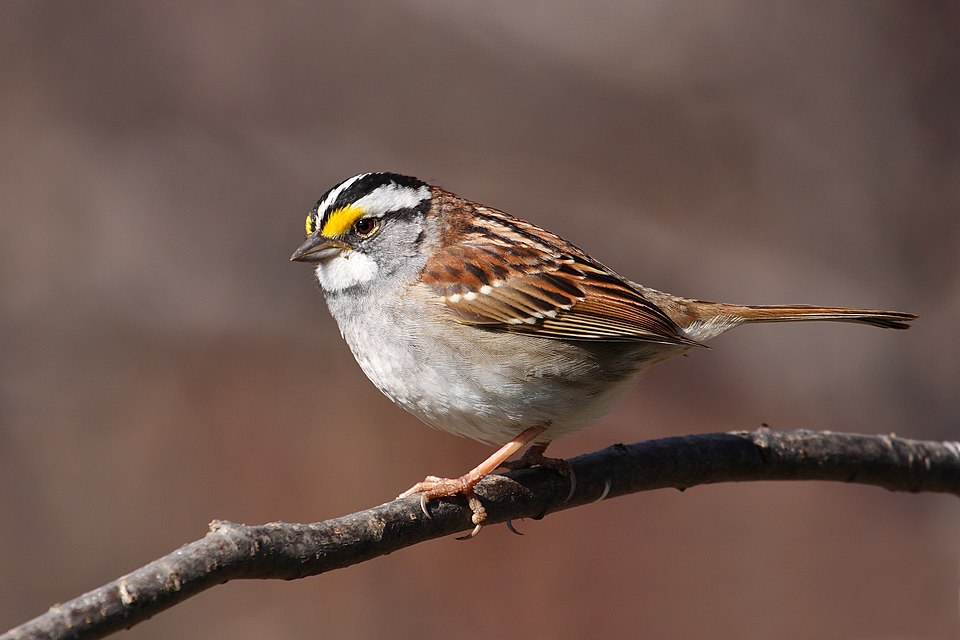
The White-throated Sparrow is one of the great signature birds of the eastern and northern woods, a plump, long-tailed sparrow with a crisp white bib, a boldly striped head, and a clear whistled song that birders learn to recognize before they ever clap eyes on the singer. In summer it belongs to the cool, brushy edges of the boreal forest and northern hardwoods, where its tune drifts out of spruce bogs and roadside thickets across Canada and the northern United States. Come fall, it pours southward in big numbers, and for much of the eastern half of the continent it becomes one of the most familiar winter visitors, scratching for seed under feeders and shrubbery from October into April.
What makes this sparrow especially fun to know is that it comes in two permanent color forms, or morphs: a sharp white-striped type and a softer tan-striped type. The two aren't males and females or adults and youngsters, they're genetically distinct and, remarkably, birds almost always pair with the opposite morph. That quirk, plus a song so memorable people put words to it, gives the White-throated Sparrow a personality that outsizes its modest brown plumage.
This is a fairly large, round-bodied sparrow with a longish notched tail, a rounded head, and a stout conical bill. On the ground it looks heavy-chested and a touch hunched, and it works the leaf litter with a two-footed backward scratch-hop. The combination of a clean white throat patch set off against a grayish breast, a striped crown, and a small patch of yellow in front of the eye is diagnostic once you learn it.
| Throat | Sharply defined white throat patch with a clean border against the gray breast, the field mark that names the bird |
| Crown stripes | Bold black-and-white (white morph) or black-and-tan (tan morph) stripes running fore-to-aft over the crown |
| Lores | A small but distinctive spot of yellow between the eye and the bill on each side |
| Underparts | Plain gray breast and grayish-white belly, usually unstreaked; sides washed with brown |
| Bill | Dark gray, conical, seed-cracking shape |
| Back & wings | Brown back streaked with black, two thin white wingbars on the folded wing |
Male vs. female
Males and females look essentially alike, and you cannot reliably sex one in the field by plumage. The far more useful distinction is morph rather than sex: the white-striped form has crisp black-and-white crown stripes and tends to look brighter overall, while the tan-striped form has muted brown-and-tan stripes, a duller throat, and often some faint streaking on the breast. Both morphs occur in both sexes. Interestingly, white-striped birds of both sexes tend to be more aggressive and sing more, while tan-striped birds invest more in parental care, and the species pairs almost exclusively across morphs, so a typical nest pairs a white-striped bird with a tan-striped mate.
Juveniles
Recently fledged juveniles are streaky and nondescript, with dingy, dark-streaked underparts and a far less obvious throat patch, so they can puzzle even experienced birders. By the first fall, immature birds resemble the dull tan-striped adults: muted head stripes, a less crisp throat, and only a hint of yellow at the lores. The yellow lore spot and the basic head pattern are usually enough to place them as White-throated Sparrows even before the markings sharpen up.
The song is one of the most beloved and easily remembered in North America: a few clear, wavering whistles often rendered as "Oh sweet Canada Canada Canada" in Canada and "Old Sam Peabody Peabody Peabody" in the United States. It typically opens with one or two steady notes followed by a series of triplets on a slightly different pitch, thin and slightly quavering. Birds sing not only on the breeding grounds but often on migration and on warm late-winter days, so southern listeners get to enjoy it too.
Calls include a sharp, hard "pink" or "chink" note, much like a stone being tapped, and a high, thin "seet" given in flight and as a contact note within wintering flocks. The hard chip is a reliable way to detect the species rustling in dense cover.
White-throated Sparrows breed across the boreal forest and northern hardwoods of Canada, from the Yukon and British Columbia east to Newfoundland, and dip south into the northern tier of the United States, including the upper Great Lakes, northern New England, and the higher Appalachians. They favor open coniferous and mixed woodland with brushy edges, regenerating clear-cuts, and bog margins.
In fall they migrate south and become one of the most numerous wintering birds of the eastern and central United States, common from the Midwest and Mid-Atlantic through the Southeast and into Texas, with smaller numbers reaching the Gulf Coast, the desert Southwest, and the Pacific states. Most arrive in October and depart by late April or early May. Migration is largely nocturnal, and wintering birds settle into loose, site-faithful flocks that often return to the same brushy yards year after year.
White-throated Sparrows are primarily seed-eaters in fall and winter, taking the seeds of grasses, weeds, sedges, and many wild plants, along with fruits and berries such as sumac, dogwood, blueberry, and grape. In the breeding season the diet shifts heavily toward insects and other invertebrates, caterpillars, beetles, ants, flies, spiders, which they feed almost exclusively to their nestlings.
They forage mostly on the ground, using a distinctive double-footed backward scratch-hop to kick aside leaves and expose food beneath. You'll usually find them low in dense cover or along its edge rather than out in the open, and they readily come to the ground under feeders, often in the company of juncos, Song Sparrows, and other winter sparrows.
Nesting takes place on or very near the ground, typically hidden in low vegetation, at the base of a shrub, beside a fallen log, or in a clump of grass at a woodland edge or clearing. The female builds the nest, a cup of grasses, twigs, pine needles, and moss lined with finer grasses, rootlets, and hair. Pairs sometimes site a second-attempt nest slightly above ground in a low shrub or conifer.
The female lays a clutch of about 3 to 5 pale, finely speckled eggs and does the incubating for roughly two weeks. Both parents feed the nestlings, which leave the nest in another week to ten days, often before they can fly well. In the cooler parts of the range a single brood is typical, while warmer or earlier-nesting pairs may attempt two. Brown-headed Cowbirds frequently parasitize their nests.
Yes, outside the breeding season the White-throated Sparrow is a genuine and welcome feeder bird, especially across the eastern and central United States in winter. It is a ground feeder by nature, so you attract it less with hanging tube feeders and more with the right food in the right place: low, near cover, with a brushy escape route close at hand.
- Scatter white millet, black-oil sunflower, and cracked corn directly on the ground or on a low platform feeder, which suits their natural ground-scratching habit
- Place feeding areas near shrubs, brush piles, or hedges so birds have instant cover to dart into, they avoid open, exposed lawns
- Build or keep a brush pile in a corner of the yard; it's one of the single best ways to hold a wintering flock
- Let a patch of yard go a little wild, native grasses, weedy seed heads, and berry shrubs like sumac and dogwood provide natural food
- Offer a ground-level birdbath or shallow water source, ideally with a dripper, as they will drink and bathe readily
- Expect them mainly from October through April in most of their winter range; they typically depart north to breed by May
- White-crowned Sparrow: Similar bold head stripes but lacks the clean white throat patch and yellow lores; has a pink or yellowish bill and a plain pale gray throat and breast
- Song Sparrow: Heavily streaked breast with a central spot and no white throat or striped crown; browner and more uniformly marked overall
- White-throated Sparrow tan morph vs. immature: Swamp Sparrows share damp brushy habitat but show a rusty cap and wings, gray face, and no crisp white throat or yellow lores
- American Tree Sparrow: Rusty cap and eyeline with a single dark breast spot and a bicolored bill; lacks the white throat and striped crown
What does a White-throated Sparrow look like?
It's a plump, long-tailed sparrow with a sharply defined white throat patch, a boldly striped crown (black-and-white or black-and-tan), a gray breast, and a small but distinctive spot of yellow between the eye and the bill. That yellow lore spot plus the clean white throat are the quickest way to clinch the ID.
What is the White-throated Sparrow's song?
A few clear, slightly wavering whistles, famously put into words as 'Oh sweet Canada Canada Canada' or 'Old Sam Peabody Peabody Peabody.' It usually starts with one or two steady notes followed by triplets on a different pitch. Its call is a hard, sharp 'pink' or 'chink' note and a high, thin 'seet.'
Why do some White-throated Sparrows have white head stripes and others tan?
The species has two permanent genetic color forms, or morphs, white-striped and tan-striped, that occur in both males and females. They're not age or sex differences. Remarkably, the birds almost always pair with the opposite morph, and white-striped birds tend to be more aggressive while tan-striped birds invest more in raising young.
How do I attract White-throated Sparrows to my yard?
Offer white millet, black-oil sunflower, and cracked corn on the ground or a low platform feeder, and place it near shrubs or a brush pile so the birds have cover close by. They're ground-feeders, so don't expect them at hanging tube feeders. In most of the U.S. they visit from October through April.
What's the difference between a White-throated and a White-crowned Sparrow?
Both have boldly striped heads, but the White-throated Sparrow has a clean white throat patch and a yellow spot in front of the eye, with a dark bill. The White-crowned Sparrow lacks the white throat and yellow lores, shows a plain pale gray face and breast, and has a pink or yellowish bill.