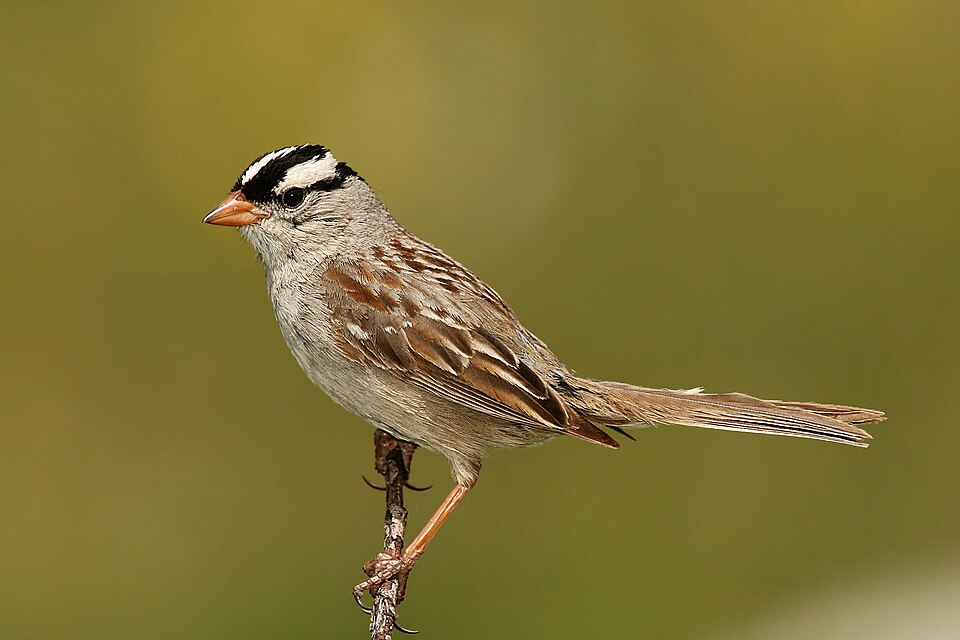
The White-crowned Sparrow is one of the easiest sparrows to learn, and once it clicks you will spot it everywhere in the cooler months. Look for a fairly large, upright sparrow with a plain pale-gray breast, a long tail, and that unmistakable bold head pattern: crisp black and white stripes running back over a peaked crown. It often perches in the open on top of a shrub or fence line, sitting tall as if posing, which is unusual for a group of birds that tends to skulk.
For much of the United States this is a classic winter visitor, arriving with the first cold fronts of fall and gathering in loose flocks along weedy field edges, hedgerows, and brush piles. Farther north and west it is a breeding bird of tundra, mountain meadows, and coastal scrub. Because it both winters widely and sings on territory in dramatically different habitats, it has become one of the most thoroughly studied songbirds in the world, famous among scientists for its regional song dialects.
This is a clean, long-tailed sparrow that holds itself noticeably upright. At a glance the body is fairly plain, so the head does the identifying work: a peaked crown striped boldly in black and white, set above an unstreaked, smooth gray breast and face.
| Crown | Bold black-and-white stripes over a peaked crown; the central crown stripe is white (immatures show tan-and-brown stripes instead) |
| Face & breast | Clean, plain pale gray with no streaking or central breast spot |
| Bill | Small, conical, pink to orange-yellow depending on subspecies |
| Back & wings | Brown with darker streaks above; two thin white wingbars |
| Size & shape | Larger than a House Sparrow, long-tailed, often sits tall and upright |
| Lores | Some western birds show pale lores; eastern 'Gambel's' birds show white lores between eye and bill |
Male vs. female
Males and females look alike. Both sexes share the same black-and-white striped crown, gray face and breast, and brown back, so you cannot reliably tell them apart in the field by plumage. Males do most of the singing, especially from an exposed perch on the breeding grounds, so a bird belting out the full song on territory is usually a male.
Juveniles
First-winter immatures are the source of most identification confusion. Instead of the adult's crisp black-and-white crown, young birds wear warm rusty-brown and pale tan stripes on the head, which can fool people into thinking they have a different species. The body shape, plain gray breast, long tail, and upright posture are all the same, though, so once you know to expect the brown-headed youngsters you will sort them out quickly. They gradually molt into the bold adult head pattern over their first year.
The song is a sweet, plaintive whistle that often starts with one or two clear notes and then tumbles into a buzzy or trilled jumble, frequently written as "see-see-pretty-pretty-me" or a thin "poor-wet-wetter-chee-zee." The opening whistle carries well across open country and is one of the more wistful sounds of northern and western summers. This species is famous for regional song dialects, so birds from different areas sing recognizably different versions, and young males learn their local tune by listening.
The common call is a sharp, metallic "pink" or "tsick," often given from inside a brush pile, plus a thin, high "seet" flight note. In winter flocks you will hear the hard pink notes constantly as birds keep contact in the underbrush.
White-crowned Sparrows breed across the far north and the western mountains: arctic and subarctic tundra and scrub from Alaska across northern Canada, plus high meadows and coastal thickets down the West Coast and through the Rocky Mountains. A nonmigratory subspecies lives year-round along the central California coast.
In fall, most birds migrate south, and from about October through April they are common to abundant winter residents across most of the United States and into northern Mexico, favoring weedy fields, desert washes, thickets, and suburban edges. They are among the more dependable winter sparrows for backyards in much of the country, then largely vanish northward each spring.
White-crowned Sparrows are primarily seed-eaters, especially outside the breeding season. They feed heavily on the seeds of grasses and weeds, along with waste grain, buds, and small fruits, and they readily take cracked corn, millet, and sunflower at and beneath feeders in winter. During the nesting season they shift to include far more insects and other small invertebrates, which provide the protein their fast-growing chicks need.
They forage mostly on the ground, hopping and scratching in leaf litter with a quick double-footed kick to uncover seeds and bugs. In winter you will often see a whole flock working a brushy edge together, dashing for cover the moment something alarms them.
The female builds the nest, an open cup of grass, twigs, moss, and bark lined with finer grasses, hair, and rootlets. Depending on habitat the nest may sit on the ground, sheltered under a clump of vegetation, or low in a shrub. Tundra and high-meadow pairs typically nest on or near the ground, while scrub-nesting birds may place the cup a few feet up.
A clutch is usually 3 to 5 pale, greenish or bluish, brown-speckled eggs. The female does the incubating, which takes roughly two weeks, and both parents feed the nestlings. Young leave the nest in about a week and a half, often before they can fly well, then continue to be fed nearby. In milder parts of the range pairs may raise two broods in a season.
Yes, this is a genuine backyard bird in winter across much of North America, though it feeds differently than the chickadees and finches at your hanging feeders. White-crowned Sparrows are ground foragers that want low cover nearby, so a few simple changes make a yard much more inviting.
- Scatter white millet or cracked corn on the ground or on a low platform feeder rather than in tube feeders, since these birds prefer to feed low and in the open beneath cover.
- Keep a brush pile or dense shrubs close to the feeding area; they will dash for it at the first sign of danger and won't linger in the open without nearby escape cover.
- Leave a weedy or unmowed edge with seed-bearing grasses and wildflowers standing through winter, which provides natural food they love.
- Offer a ground-level or low birdbath with fresh water, especially where natural water is scarce in winter.
- Expect them mainly from fall through early spring in most of the U.S.; they are far less likely at feeders during the summer breeding season.
- Rake leaf litter into a loose layer rather than bagging it all, giving them somewhere to scratch for seeds and insects.
- White-throated Sparrow: Also has a striped crown but shows a sharply defined white throat patch and yellow spots between the eye and bill; its breast looks duller and browner.
- Golden-crowned Sparrow: Same genus and size, but the crown center is dull yellow-gold bordered in black, and the head pattern is far less crisp; a western bird.
- Chipping Sparrow: Much smaller and slimmer with a rusty cap (not black-and-white stripes) and a dark eyeline; breeding birds are easy to separate by the clean rufous crown.
- Field Sparrow: Smaller and plainer with a bright pink bill, plain face with a white eyering, and a rusty cap rather than bold black-and-white head stripes.
How do I tell a White-crowned Sparrow from a White-throated Sparrow?
Both have striped crowns, but the White-throated Sparrow has a crisp white throat patch and yellow spots in front of the eye, plus a browner, duller body. The White-crowned has a clean gray face and breast with no throat patch and a pink to yellowish bill, and it tends to sit more upright.
Why does this sparrow have a brown-and-tan head instead of black-and-white?
That is a first-winter immature. Young White-crowned Sparrows wear rusty-brown and tan crown stripes through their first year before molting into the bold black-and-white adult pattern. The body shape, plain gray breast, and posture are the same.
When will I see White-crowned Sparrows in my yard?
In most of the United States they are winter visitors, showing up from about October and staying through April before heading north to breed. If you are in the western mountains or along the far north, you may see them in summer on the breeding grounds instead.
What do White-crowned Sparrows eat at feeders?
They favor seeds on or near the ground, especially white millet and cracked corn, and will also take sunflower. Offer food on a low platform or scattered on the ground rather than in hanging tube feeders, and keep cover nearby.
What does a White-crowned Sparrow sound like?
The song is a sweet, plaintive whistle followed by a buzzy trill, often paraphrased as 'poor-wet-wetter-chee-zee.' The common call is a sharp metallic 'pink' note you will hear coming from brush piles, along with a thin high 'seet' in flight.