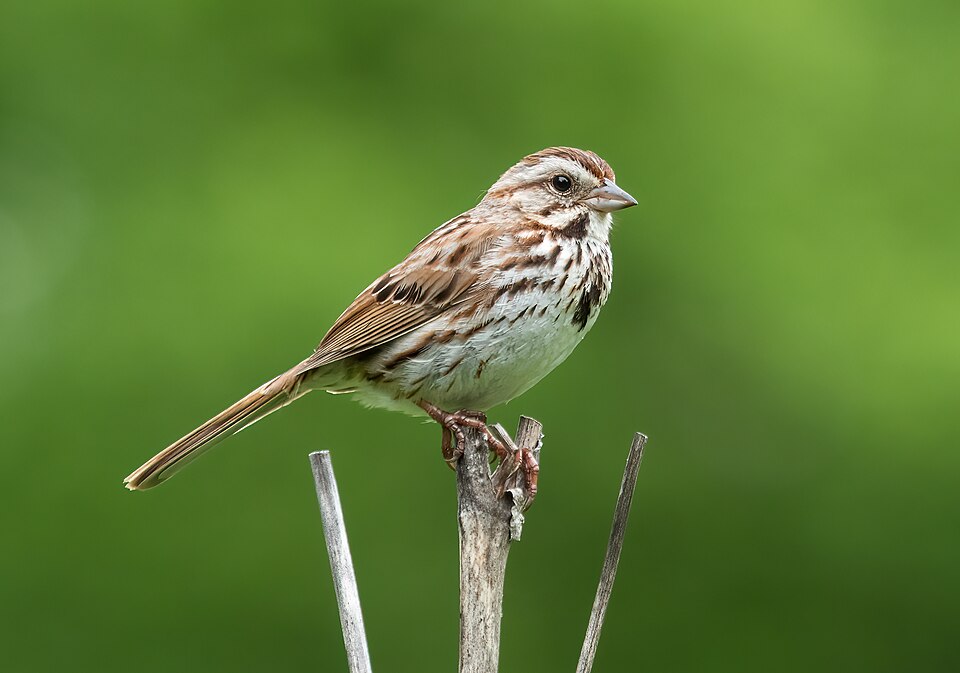
The Song Sparrow is one of the most widespread and familiar sparrows in North America, a brown-streaked bird that turns up in marsh edges, brushy fields, suburban hedges, and tangled backyard corners from coast to coast. It is the kind of bird that is easy to overlook as "just another little brown job," yet it rewards a closer look and an attentive ear. Males sing prolifically through spring and summer, often from an exposed perch, and that cheerful, sputtering melody is one of the first signs that the breeding season is underway.
What makes the Song Sparrow especially interesting to birders is its remarkable variation. Across its enormous range it has split into dozens of named subspecies, from small, pale birds of the southwestern deserts to large, sooty, dark forms in the rain-soaked Pacific Northwest and the giant subspecies on Alaska's Aleutian Islands. Wherever it lives, though, it stays true to its name, and learning its song and its trademark tail-pumping flight is one of the most useful skills a beginning birder can pick up.
This is a medium-sized, fairly chunky sparrow with a rounded head, a longish rounded tail that it often pumps in flight, and a relatively stout bill. The overall impression is of a heavily streaked brown bird with a streaked breast that usually converges into a bold central spot.
| Breast | Coarse brown streaks that typically merge into a dark central spot or 'stickpin' on the chest |
| Head | Gray face with a broad brown crown stripe and a strong dark stripe (malar) framing a pale throat |
| Back & wings | Warm brown to gray-brown, streaked; no bright wing bars |
| Tail | Long, rounded, and often pumped downward in low, fluttering flight |
| Bill | Short and conical, suited to seeds and insects |
| Variation | Plumage darkness and size vary widely by region, from pale desert birds to dark, sooty coastal forms |
Male vs. female
Male and female Song Sparrows look alike, so you cannot reliably tell the sexes apart in the field by plumage. Males tend to be slightly larger on average, but the difference is not something you can judge on a single bird. The most useful behavioral clue is song: it is the male who sings the loud, persistent territorial song from a conspicuous perch, while the female sings rarely. During courtship and nesting you may see the male singing while the female stays lower in the cover.
Juveniles
Juvenile Song Sparrows are buffier and more finely streaked than adults, and they often lack the clean central breast spot, which can make them tricky to identify. The streaking on a young bird tends to look softer and more diffuse, and the overall tone is warmer and more washed with buff. As they molt into their first winter plumage they begin to show the crisper streaking and the familiar breast spot of the adult, though shape, tail-pumping, and habitat are good clues even before the plumage settles.
The song is the bird's calling card: a bright, energetic phrase that classically begins with two or three clear, repeated introductory notes and then tumbles into a varied jumble of trills and buzzes. Many birders learn it with the mnemonic "maids-maids-maids, put-on-your-tea-kettle-ettle-ettle." Each male has a repertoire of several distinct song types and will repeat one many times before switching, so the song is both stereotyped and surprisingly variable from bird to bird and region to region.
Calls include a nasal, slightly metallic chimp or tchunk given as an alarm or contact note, and a high, thin tsst in flight. Once you have the husky chimp call in your ear, you will start noticing Song Sparrows scolding from brushy cover all year long, well outside the singing season.
Song Sparrows are found across nearly all of North America, breeding from Alaska and much of Canada south through the United States into central Mexico. Birds in the northern parts of the range are migratory, pulling south in fall and returning in spring, while many populations across the central and southern U.S. and along the milder coasts are year-round residents.
In winter, northern breeders join resident birds across the southern states and northern Mexico, so in much of the country the species is present every month of the year, just in shifting numbers. They are habitat generalists, favoring wet thickets, marsh and stream edges, weedy fields, forest openings, and shrubby suburban yards.
Song Sparrows have a mixed diet that shifts with the seasons. In spring and summer they eat large numbers of insects and other invertebrates, including beetles, caterpillars, grasshoppers, and spiders, which provide the protein needed to feed nestlings. In fall and winter they switch heavily to seeds, including the seeds of grasses and weeds, along with small fruits and berries.
They forage mostly on or near the ground, scratching and hopping through leaf litter and low vegetation, frequently along the edges of cover where they can dart back into the brush. Coastal birds will also pick at small crustaceans and other items along tidal margins. This adaptable, opportunistic feeding is a big reason the species thrives in so many habitats.
The female builds a cup-shaped nest of grasses, weed stems, and bark strips, lined with finer grasses and sometimes animal hair. Early nests are often placed on or near the ground, tucked into a grass clump or the base of a shrub, while later nests in the season are frequently built a few feet up in dense shrubs or vines, which may help avoid ground predators once vegetation has grown in.
A typical clutch is three to five pale blue-green eggs heavily marked with reddish-brown spots. The female incubates for roughly twelve to fourteen days, and both parents feed the young, which leave the nest about ten days after hatching. Pairs commonly raise two or three broods in a season. Song Sparrows are frequent hosts to Brown-headed Cowbirds, which lay their eggs in the sparrow's nest.
Yes, the Song Sparrow is a genuine backyard bird, especially if your yard offers a bit of brushy cover and ground-level feeding. It is more of an edge-and-thicket bird than a hang-on-the-tube-feeder bird, so the key is providing the kind of low, tangled habitat it loves along with seed it can reach near the ground.
- Scatter millet and other small seeds on the ground or on a low platform feeder rather than relying only on hanging tube feeders
- Leave a brushy corner, hedgerow, or unmowed edge where the birds can forage and dart to cover
- Plant native shrubs and grasses that produce seeds and provide dense low cover for nesting and shelter
- Provide a ground-level or low birdbath, ideally near shrubs, since they like water close to protective cover
- Avoid pesticides so insects remain available as breeding-season food for adults and nestlings
- Keep a tidy edge near messy cover: let leaf litter and weedy patches stay, since they forage by scratching through it
- Savannah Sparrow: Also streaky-breasted but slimmer with a shorter, notched tail, often a yellow wash before the eye, and prefers open grasslands rather than brushy cover
- Lincoln's Sparrow: Crisper, finer breast streaking over a buffy band, grayer face, and a more retiring, skulking manner; lacks the bold messy central spot
- Fox Sparrow: Larger and chunkier with bolder, more triangular breast spots; many forms are richly rufous, especially on the tail and rump
- Swamp Sparrow: Plainer gray breast with little streaking, rustier wings, and a stronger tie to marshes and wet edges
How can I tell a Song Sparrow from other brown sparrows?
Look for the heavy brown streaks on the breast that usually merge into a dark central spot, a longish rounded tail it pumps in flight, and a gray face with bold brown stripes. Habitat helps too: Song Sparrows favor brushy edges, thickets, and weedy yards rather than open grassland.
What does a Song Sparrow's song sound like?
It typically starts with two or three clear repeated notes and then breaks into a buzzy, trilling jumble. A classic memory aid is 'maids-maids-maids, put-on-your-tea-kettle-ettle-ettle.' Each male knows several song variations and repeats one before switching.
Do Song Sparrows come to bird feeders?
Yes, though they prefer feeding on or near the ground. Offer millet and small seeds on the ground or a low platform feeder, and keep some brushy cover nearby. They are less likely to cling to hanging tube feeders than finches or chickadees.
Are Song Sparrows year-round residents?
It depends on where you live. Birds in the far north migrate south for winter, but across much of the central and southern U.S. and the milder coasts they are present all year. In many areas you'll see them every month, just in changing numbers as northern birds move through.
Where do Song Sparrows build their nests?
Females build a grassy cup nest on or near the ground early in the season, often in a grass clump or shrub base, and frequently a bit higher in dense shrubs later on. They typically lay three to five spotted greenish eggs and may raise two or three broods a year.