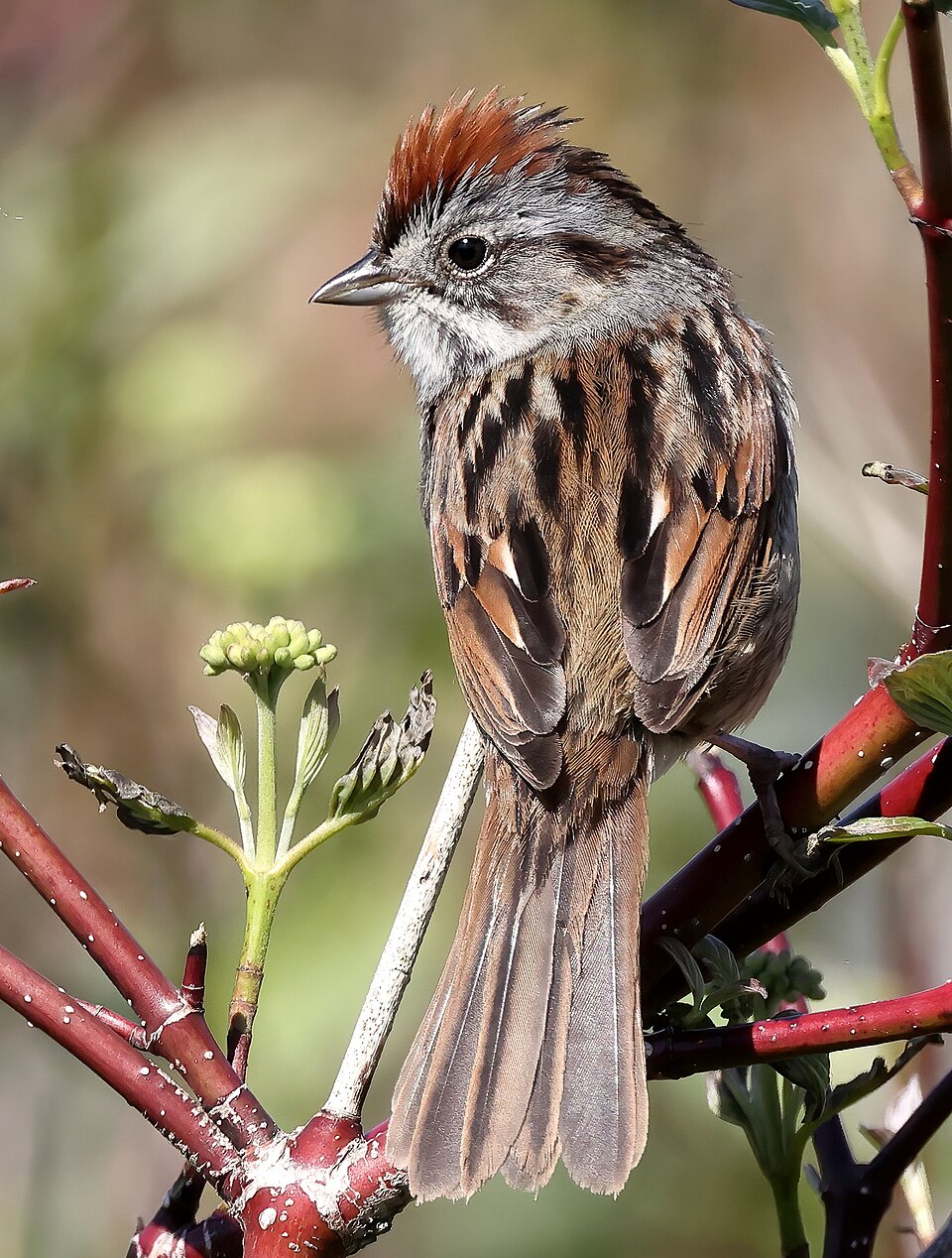
The Swamp Sparrow is one of North America's most handsome streaky sparrows, even if it spends most of its life hidden low in wet vegetation. As the name promises, this is a bird of marshes, bogs, sedge meadows, and the cattail-and-rush edges of ponds and slow rivers. Where many sparrows favor dry fields and brush, the Swamp Sparrow wades and clambers through standing water, often gripping a reed stem with both feet while it peers down for insects on the surface below.
It is a member of the genus Melospiza, which also includes the familiar Song Sparrow and the secretive Lincoln's Sparrow. Compared with those cousins, the Swamp Sparrow looks darker and more richly colored, with rusty wings, a gray face, and a clean unstreaked breast. Its loud, even-pitched trill is a classic summer sound of northern wetlands, and in migration and winter the species spreads across the eastern and central United States, turning up in any patch of wet weeds where a patient birder is willing to wait.
A small, round-bodied sparrow with a fairly long tail it often pumps or flicks. Swamp Sparrows look dark and richly toned overall, and they tend to stay low, flushing only short distances before dropping back into cover. The combination of a rusty cap, gray face and breast, and bright reddish wings is the quickest way to nail the ID.
| Crown | Rich rufous cap in breeding adults; in winter and on immatures it is duller and often divided by a faint gray central stripe. |
| Face | Plain gray face with a dark line behind the eye and a dark malar (whisker) stripe framing a whitish throat. |
| Wings | Bright rusty-red wings and back streaking, the warmest, reddest wings of the streaky 'little brown' sparrows. |
| Underparts | Smoky gray breast, usually unstreaked or only faintly marked, fading to a buffy-gray belly and flanks. |
| Bill & legs | Fairly stout dark bill (often with a paler lower mandible); pinkish to dull-yellow legs. |
| Size & shape | Compact, about Song Sparrow size, with a rounded head and a longish, often-flicked tail. |
Male vs. female
Males and females look essentially alike, and you cannot reliably sex a Swamp Sparrow in the field by plumage. Males average slightly larger and tend to do the singing, so a bird belting out a steady trill from an exposed reed in spring is almost always a male. Otherwise both sexes share the same rusty cap, gray face, and reddish wings.
Juveniles
Juveniles are noticeably browner and buffier than adults, with fine dark streaking across a warm-buff breast and a less distinct, browner crown, they can briefly recall a young Lincoln's or Song Sparrow. By their first fall, immatures take on the basic adult pattern but show a duller, often streaked or gray-divided crown rather than the solid bright rufous cap of a breeding adult. The rusty wings are a helpful constant across all ages.
The song is a loud, slow, musical trill on a single pitch, a steady weet-weet-weet-weet-weet or chip-chip-chip-chip run together. It is slower and sweeter than the dry buzz of a Chipping Sparrow and lacks the rich introductory phrases of a Song Sparrow. The notes carry well across open marsh, and on good mornings several males trill against one another from the cattails.
The common call is a sharp, hard chip, metallic and slightly explosive, often given from deep cover. In flight or when alarmed, birds may also give a higher, thinner seep. Learning the loud chip note is one of the best ways to detect Swamp Sparrows skulking in wet weeds, since you will often hear them long before you see them.
Swamp Sparrows breed across Canada and the northern United States, from the Maritimes and Great Lakes region west into the boreal wetlands of the prairie provinces, and south through the Northeast. A distinctive coastal subspecies (the 'Coastal Plain' Swamp Sparrow) breeds in tidal marshes along the mid-Atlantic and is grayer and longer-billed.
In winter they pull south, filling wet habitats across the eastern and central United States down to the Gulf Coast and into northeastern Mexico, with some lingering wherever marshes stay unfrozen. They are short- to medium-distance migrants, moving largely at night, and are most widespread and easiest to find during spring and fall passage when they show up in damp weedy fields and ditches well away from large marshes.
In the breeding season Swamp Sparrows are heavily insectivorous, gleaning beetles, caterpillars, dragonflies, damselflies, mayflies, and other aquatic and emergent invertebrates from reed stems, mud, and the water's surface. They are noted for wading in shallow water and even briefly submerging the head to snatch prey, unusual behavior for a sparrow, and their relatively long legs and feet suit this damp, clambering lifestyle.
In fall and winter the diet shifts toward seeds of sedges, grasses, smartweeds, and other wetland and weedy plants, supplemented by whatever insects remain available. They forage mostly on or near the ground, hopping along mucky edges and through dense low cover rather than feeding out in the open.
Nesting is tied closely to water. The female builds a bulky open cup of coarse grasses, sedges, and cattail leaves, lined with finer grass and hair, and places it low in dense emergent vegetation, typically just above standing water in cattails, tussock sedge, or shrubby marsh growth. The nest is often well hidden and surprisingly hard to find, sometimes with vegetation arched over it.
Clutches are usually 3-5 pale greenish or bluish eggs marked with brown blotches. The female does the incubating, which lasts roughly 12-13 days, and both parents feed the nestlings, which leave the nest after about 9-13 days, often before they can fly well, scrambling through the marsh vegetation while still being fed. Pairs frequently raise two broods in a season.
The Swamp Sparrow is not a typical feeder bird, and you are unlikely to coax one to a seed tray in the middle of a dry suburban yard. It is, however, very responsive to wet habitat, so the real way to "attract" one is to offer the marshy edges it needs, especially during migration when wandering birds will use surprisingly small patches of damp cover.
- If your property has a pond, ditch, or low wet corner, let native sedges, cattails, and weedy growth stand rather than mowing it down, that dense low cover is exactly what Swamp Sparrows seek.
- During spring and fall migration, watch brushy wet edges and weedy field margins; migrants turn up far from big marshes and will linger if there is cover and seed.
- Ground-level millet or mixed small seed scattered near a brushy wet edge is far more likely to draw them than an elevated feeder.
- Provide or preserve a shallow water feature with vegetated margins; they favor the interface of standing water and dense plants.
- Learn the sharp metallic chip call, playing detective with the call is often the only way you'll know one is skulking nearby.
- Avoid pesticides near wet areas, since the aquatic insects they depend on in summer are central to their diet.
- Song Sparrow: Heavily streaked breast with a central dark spot and bold streaking; lacks the clean gray breast and bright rusty wings of a Swamp Sparrow, and its song opens with clear notes before the trill.
- Lincoln's Sparrow: Finely streaked buffy breast band, buffy malar, and a more delicate look; crisper and paler than the dark, richly toned Swamp Sparrow, and prefers drier brushy edges.
- Chipping Sparrow: Also has a rusty cap but is slimmer and cleaner, with a bold white eyebrow and black eyeline, gray unstreaked underparts, and a dry mechanical trill; favors lawns and pines, not marshes.
- American Tree Sparrow: Rusty cap and gray face too, but shows a distinct dark central breast spot and a bicolored bill; a winter visitor of weedy fields rather than a marsh skulker.
How do I tell a Swamp Sparrow from a Song Sparrow?
Look at the breast and wings. A Song Sparrow has a heavily streaked breast with a dark central spot, while a Swamp Sparrow has a smooth gray, mostly unstreaked breast and noticeably brighter rusty-red wings. The Swamp Sparrow also looks darker and grayer-faced overall, and its song is a simple even trill rather than the Song Sparrow's musical phrases.
Where do Swamp Sparrows live?
They live in wetlands, cattail and sedge marshes, bogs, wet meadows, and the brushy edges of ponds and slow streams. They breed across Canada and the northern U.S. and winter through the eastern and central states down to the Gulf Coast. In migration they also turn up in damp weedy fields and ditches well away from big marshes.
What does a Swamp Sparrow sound like?
The song is a loud, slow, sweet trill on one pitch, like a run of evenly spaced 'weet-weet-weet' notes. Its most useful call is a sharp, hard, metallic 'chip,' usually given from inside dense cover, that note is often how birders first locate one.
Will Swamp Sparrows come to my bird feeder?
Rarely. They are marsh skulkers, not classic feeder birds. Your best chance is during migration if you have a wet, weedy, or brushy area; scattering small seed like millet at ground level near a wet edge is far more effective than an elevated feeder.
Are Swamp Sparrows rare?
No, they are common and their population is considered stable, with a conservation status of Least Concern. They simply go unnoticed because they stay low in dense wetland cover. Once you learn their trill and sharp chip call, you'll realize they're widespread in the right habitat.