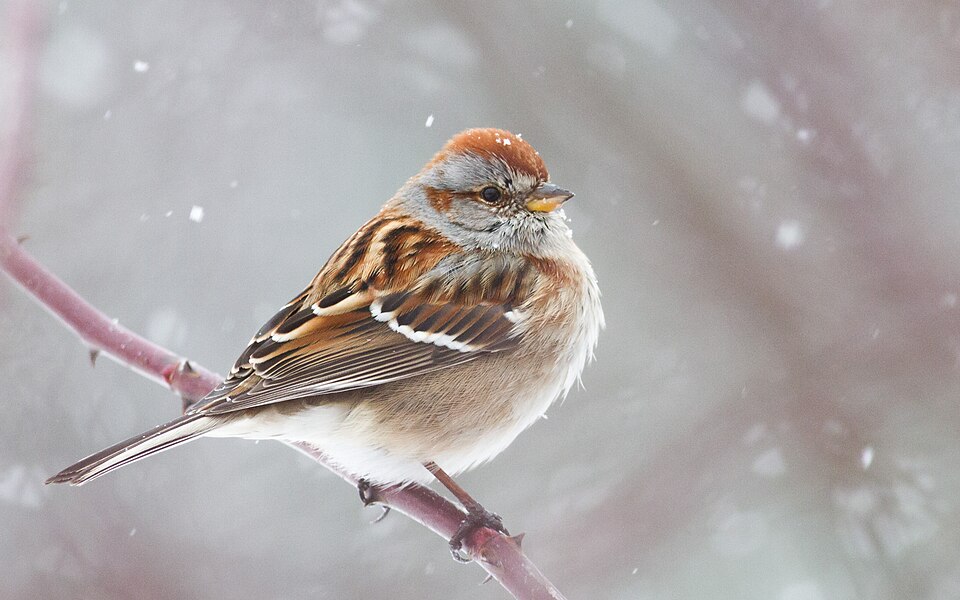
The American Tree Sparrow is one of winter's quiet pleasures across much of the United States and southern Canada. For all the "tree" in its name, it spends most of its life on the ground in open, brushy country, scratching for seeds in weedy fields, marsh edges, and hedgerows. Early European settlers thought it resembled the Eurasian Tree Sparrow and gave it the name, though the two birds are not closely related and ours rarely has much to do with trees at all.
What makes this bird special is its toughness. While many sparrows head far south for the cold months, the American Tree Sparrow flies the other way each fall, leaving its breeding grounds at the northern limit of the trees to winter across snowy fields where few other small birds can make a living. A plump, rusty-capped sparrow flushing from a frosted weed patch on a gray January morning is a reliable sign that this northern traveler has arrived.
This is a fairly large, round-bodied sparrow with a small head, a long notched tail, and a gentle, alert expression. Its overall look is clean and crisp compared to streakier sparrows, and a few standout marks make it one of the more identifiable winter sparrows once you know what to check.
| Crown | Solid rusty-red cap, usually unbroken, often with a thin gray central line |
| Breast spot | A single dark smudge or 'stickpin' spot on an otherwise plain gray breast |
| Bill | Distinctly bicolored: dark upper mandible, yellow lower mandible |
| Eyeline | Rusty stripe running back from the eye through an otherwise gray face |
| Wingbars | Two clean white wingbars on rusty-brown wings |
| Underparts | Pale gray to whitish below, washed buff on the flanks |
Male vs. female
Males and females look essentially identical in the field, and there is no reliable way to separate the sexes by plumage. Both show the rusty cap, gray face, bicolored bill, and the dark central breast spot year-round. On the breeding grounds, the singing bird is almost always the male, since females sing only rarely, so behavior is a better clue to sex than appearance.
Juveniles
Juveniles, seen only on the northern breeding grounds in summer, are noticeably streakier than adults, with heavy dark streaking on the crown, back, breast, and flanks, and they often lack the clean breast spot. By the time young birds reach their wintering areas in fall they have molted into a plumage much like the adults, so the streaky juveniles are rarely encountered by birders farther south.
The song is a sweet, musical warble, often beginning with one or two clear high whistles and tumbling into a varied, slightly jumbled series of notes. It has a sweet, almost wistful quality that carries well across open tundra and shrubby country in summer. In winter you are far more likely to hear the calls than the full song.
The most distinctive winter sound is a soft, musical tseet or tsee-dwit given by foraging flocks, and a thin, high seet contact note. Flocks also produce a gentle, tinkling chorus of these notes as they move through weedy fields, a sound some birders compare to tiny bells.
American Tree Sparrows breed across the far north, from Alaska eastward across northern Canada, in the scrubby transition zone between the boreal forest and the open tundra where stunted trees, willows, and dwarf birch dot the landscape. This is some of the most remote breeding habitat of any common North American songbird.
In fall they migrate south to winter across most of the United States and southern Canada, roughly from the northern Great Plains and Midwest through the Northeast, and west into the Rockies and Great Basin. They are most numerous in the northern half of the Lower 48 and grow scarcer toward the Gulf and the Southeast. They arrive in October and November and head back north in March and April, making them a true cold-season bird through most of their range.
In winter, American Tree Sparrows are almost entirely seed eaters, specializing in the small seeds of grasses, weeds, and wildflowers such as ragweed, foxtail, pigweed, and goldenrod. They forage in loose flocks on the ground, hopping and scratching beneath weedy growth and sometimes flying up to grab seeds directly from bent-over stalks. They will also beat seeds loose from standing plants by fluttering against the seed heads.
During the brief northern breeding season the diet shifts heavily toward insects and other small invertebrates, which provide the protein their nestlings need. This seasonal switch from animal to plant food is typical of many sparrows but is especially pronounced in a bird that must fuel itself through long Arctic days in summer and bitter cold in winter.
Nesting takes place on the northern breeding grounds in June and July. The female builds a bulky open cup of grasses, moss, bark, and fine rootlets, lining it with feathers (often ptarmigan feathers) and fine hair for insulation against the cold. Nests are placed on or very near the ground, frequently tucked against a tussock, at the base of a dwarf shrub, or sheltered by low willows.
The female does the building and incubation while the male sings nearby and helps feed the young once they hatch. Pairs typically raise a single brood per year, a constraint of the short Arctic summer that leaves little time for a second attempt.
Yes, in much of the northern United States the American Tree Sparrow is a welcome and reliable winter feeder visitor. It will not show up in summer (it is breeding in the Arctic then), but from late fall through early spring it readily joins the flocks of juncos and other sparrows working the ground beneath feeders.
- Scatter small seeds directly on the ground or on a low platform feeder, since this is a ground forager that rarely uses hanging tube feeders.
- Offer white millet, which is a clear favorite, along with finely cracked corn and black-oil sunflower seed.
- Leave a weedy, unmowed corner or a brush pile near the feeding area to provide natural seeds and quick cover.
- Feed most consistently from November through March, when these birds are present across the northern states.
- Provide open water with a heated birdbath in winter, which can draw them in along with other hardy seed eaters.
- Don't be discouraged if they're absent in mild southern winters, as they're far more common across the northern half of their range.
- Chipping Sparrow: Also has a rusty cap but is slimmer, has an all-dark bill, a bold black eyeline and white eyebrow, and lacks the central breast spot. It is mainly a summer bird where Tree Sparrows are winter birds.
- Field Sparrow: Smaller with a plain face, a white eyering, and an entirely pink bill (not bicolored), and it lacks the dark breast spot.
- Swamp Sparrow: Shows a rusty cap and rusty wings but has a grayer, more streaked overall look, a dark bill, and favors wetter, marshy habitat without the clean breast spot.
- Dark-eyed Junco: Often feeds in the same winter ground flocks but is plain slate-gray and white with no rusty cap, no breast spot, and a pale pinkish bill.
Why is it called a 'tree' sparrow if it lives on the ground?
The name is a bit of a misnomer. Early European colonists thought it looked like the Eurasian Tree Sparrow back home and borrowed the name. In reality, the American Tree Sparrow spends most of its time foraging on the ground in open, weedy country and rarely depends on trees.
When will I see American Tree Sparrows at my feeder?
They are winter birds across the United States, typically arriving in October or November and leaving by March or April. In summer they breed far to the north near the Arctic, so you won't see them at feeders during the warm months.
How do I tell an American Tree Sparrow from a Chipping Sparrow?
Both have rusty caps, but the Tree Sparrow has a bicolored bill (dark above, yellow below) and a dark spot in the center of its plain gray breast, which the Chipping Sparrow lacks. Timing also helps: Tree Sparrows visit in winter, while Chipping Sparrows are mostly present in the breeding season.
What do American Tree Sparrows eat in winter?
Almost entirely small seeds from grasses and weeds such as ragweed, foxtail, and pigweed. At feeders they favor white millet and cracked corn taken from the ground or a low platform rather than from hanging tube feeders.
Are American Tree Sparrow populations declining?
The species is still common and listed as Least Concern, but long-term surveys suggest its numbers have been gradually declining, likely tied to changes on its Arctic breeding grounds and loss of weedy winter habitat. It is not currently considered threatened.