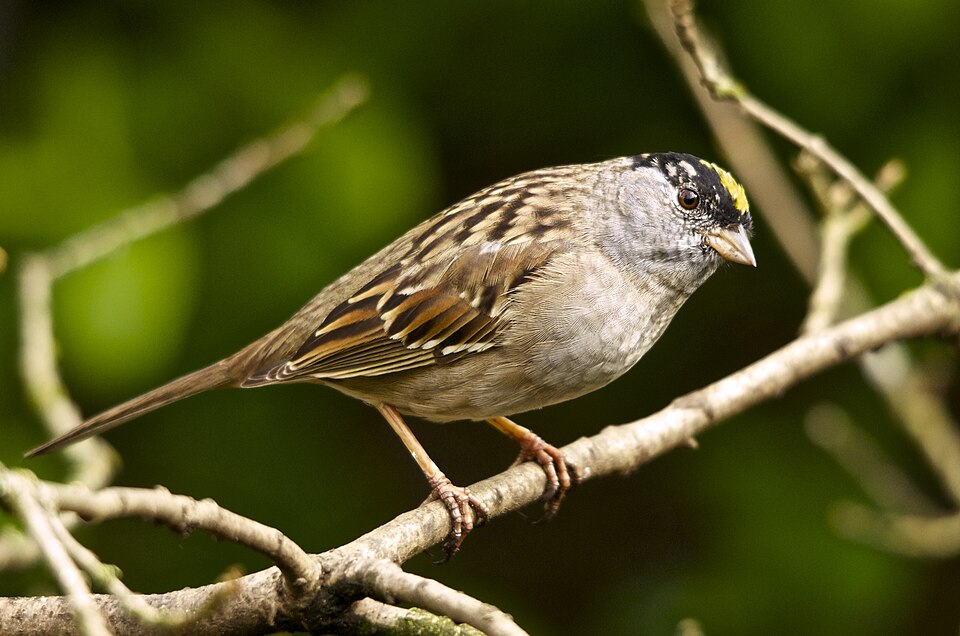
The Golden-crowned Sparrow is a large, handsome sparrow that breeds in the far Northwest and spends winters along the Pacific Coast, where it becomes one of the most familiar backyard birds from British Columbia down to Baja California. In breeding plumage, the adult wears a bold black crown split by a bright golden-yellow stripe, giving the bird its name and an unmistakable, almost regal look. For much of the year, though, birders meet it as a plainer, grayish-brown bird scratching quietly under shrubs and feeders.
What gives this sparrow its real personality is its voice. Its slow, descending three-note whistle has earned folk names like the "no-gold-here" bird among Gold Rush prospectors and "weary willie" among loggers. Hearing those plaintive, minor-key notes drift out of a chaparral thicket or a fog-soaked coastal garden is, for many West Coast birders, the true sound of winter. It is closely related to the White-crowned Sparrow and the two often forage together in mixed flocks.
This is a chunky, full-bodied sparrow with a relatively long tail, a rounded head, and a stout, conical bill. It is noticeably larger and bulkier than most backyard sparrows, roughly the size of a House Sparrow but longer-tailed and more elegant. The key is the head pattern, which changes dramatically with the seasons.
| Crown (breeding) | Bold black crown with a bright golden-yellow center stripe, fading to dull gold toward the back of the head |
| Crown (winter) | Much duller; dusky brownish crown with a smudgy yellow forehead patch and faint dark side borders |
| Face | Plain grayish face without a strong eyeline or eyering, giving a gentle, blank-faced expression |
| Underparts | Clean grayish-brown breast and belly with no streaking or central spot |
| Back & wings | Brown back streaked with darker brown; two thin whitish wingbars |
| Bill | Two-toned conical bill, dark upper mandible and paler pinkish-yellow lower mandible |
Male vs. female
Males and females look essentially identical, so you cannot reliably tell the sexes apart in the field. Both wear the same golden-and-black crown in breeding season and the same muted winter plumage. Males average very slightly larger, but the difference is not visible without a bird in the hand. On the breeding grounds, behavior offers the best clue: only the male sings from an exposed perch, so a singing bird is almost certainly a male.
Juveniles
Juveniles and first-winter birds are the source of much confusion. They lack the clean black crown borders of adults entirely, instead showing a plain brownish head with only a vague, dull yellowish wash on the forehead, and they may show faint streaking on the breast. Through their first fall and winter they look like a washed-out, blurry version of the adult. The combination of a large, plain-faced sparrow with even a hint of dingy yellow on the forecrown and an unstreaked breast is usually enough to clinch the identification.
The classic song is a series of three (sometimes more) clear, plaintive whistles that descend the scale, often rendered as oh-dear-me or I'm-so-tired. The minor-key, falling quality gives it a famously mournful sound, and unlike many songbirds it will sing on its wintering grounds and even during migration, so West Coast birders hear it for much of the year. Pitch and number of notes vary regionally.
The most common call is a sharp, flat chink or tsick, given as a contact and alarm note while birds forage in cover, plus a thin, high tseep used in flight. In a feeding flock you will often hear a steady undertone of these soft chips.
The Golden-crowned Sparrow breeds in the far Northwest, from Alaska and the Yukon south through coastal and mountainous British Columbia into the edges of Washington, favoring shrubby tundra, alpine thickets, and the brushy edges of stunted forest. It is a long-distance migrant with a remarkably narrow north-south range.
In winter it pours down the Pacific Coast, becoming abundant from southern British Columbia and Washington through Oregon and California and into northern Baja California, with smaller numbers reaching interior valleys and the Southwest deserts. It is largely absent from the eastern U.S., though a few wander east each year and turn up as prized rarities at feeders far outside the normal range.
Golden-crowned Sparrows are primarily seed and plant eaters, especially in fall and winter. They forage mostly on the ground, scratching backward with both feet in the leaf litter, double-scratch style, to uncover fallen seeds, grains, buds, and tender green shoots. They are well known for nibbling fresh sprouts, flowers, and garden greens, a habit that has occasionally put them at odds with vegetable gardeners.
During the breeding season they shift toward a richer protein diet, taking insects, spiders, and other small invertebrates to feed themselves and their nestlings. They also eat fruit and berries when available, and in winter flocks will readily exploit a reliable food source, returning to the same feeders and brush piles day after day.
Nesting takes place on the remote northern breeding grounds, so few birders ever see it. The female builds a bulky open cup of grasses, weeds, moss, and fine plant fibers, lined with finer material and sometimes animal hair. The nest is usually placed on or very near the ground, tucked under a low shrub, grass clump, or dwarf willow where it is well hidden from view.
She lays a typical clutch of about three to five eggs, pale greenish or bluish-white heavily marked with brown, and does the incubating herself for roughly two weeks. Both parents then feed the young, which leave the nest after a week and a half or so. In the short Arctic and subalpine summer, pairs generally manage just one brood per year.
If you live anywhere along the West Coast, the Golden-crowned Sparrow is very much a backyard and feeder bird in winter, and attracting it is mostly about offering the right food in the right place. It prefers to feed on the ground or low platforms rather than hanging feeders, and it wants cover close by.
- Scatter white millet, sunflower hearts, and cracked corn on the ground or on a low platform feeder, which suits its ground-foraging habits far better than tube feeders.
- Keep a brush pile or dense low shrubs within a quick hop of the feeding area; these sparrows dislike being far from protective cover.
- Provide a ground-level or low birdbath with clean water for drinking and bathing.
- Let part of the yard grow a little wild; weedy edges and unraked leaf litter give them seeds and a place to double-scratch.
- Be patient and consistent through the winter, since flocks learn reliable food sources and will return to the same yard year after year.
- Expect them October through April in most of their wintering range; they leave for the far north to breed in spring.
- White-crowned Sparrow: Very similar size and shape and often in the same flocks, but shows bold black-and-white head stripes and a clean pale crown stripe, never yellow, plus a pinkish or yellowish unmarked bill.
- White-throated Sparrow: Has a sharply defined white throat patch, a yellow spot between the eye and bill, and bolder head striping; mainly an eastern bird, scarce on the West Coast.
- House Sparrow: Similar bulk but an unrelated Old World species; males show a gray cap and black bib, and it favors buildings and pavement rather than brushy ground cover.
How do I tell a Golden-crowned Sparrow from a White-crowned Sparrow?
Look at the crown. The Golden-crowned has a black cap with a yellow center stripe (bright in summer, dull yellow on the forehead in winter), a plain face, and a darkish bill. The White-crowned has crisp black-and-white head stripes, no yellow, and a bright pink, orange, or yellowish bill. They often forage together, so compare directly.
Why does the Golden-crowned Sparrow sound so sad?
Its song is three clear whistles that descend the scale in a minor key, often described as oh-dear-me or I'm-so-tired. That falling, mournful quality is just the natural structure of the song. Gold Rush miners nicknamed it the no-gold-here bird because the tune sounded so discouraged.
When and where will I see Golden-crowned Sparrows?
They are winter visitors to the Pacific Coast, roughly October through April, from British Columbia to Baja California and into the Southwest deserts. They breed far to the north in Alaska, the Yukon, and British Columbia, so most people only see them in the non-breeding season.
What do Golden-crowned Sparrows eat at feeders?
They favor white millet, sunflower hearts, and cracked corn offered on the ground or a low platform. They are ground foragers that double-scratch through leaf litter, so they rarely use hanging tube feeders. Keep cover nearby and they will visit reliably all winter.
Are Golden-crowned Sparrows rare?
No, they are common and listed as Least Concern. Within their West Coast wintering range they can be abundant. They are genuinely rare only outside that range, so a Golden-crowned turning up at an eastern feeder is a notable find for local birders.