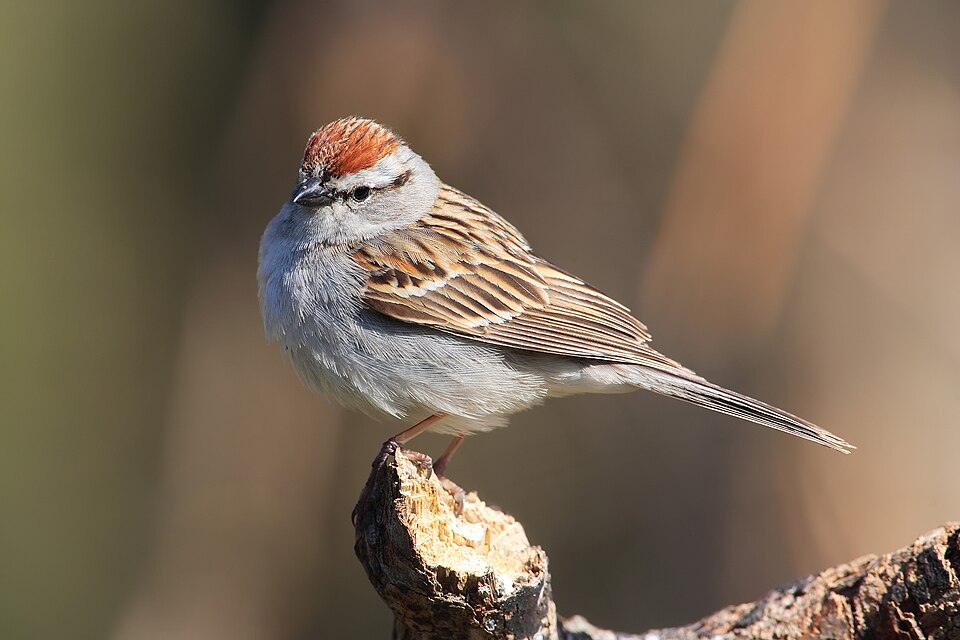
The Chipping Sparrow is one of the most common and approachable sparrows across North America, a slim, neatly marked little bird that turns up on suburban lawns, in city parks, at the edges of pine woods, and around open conifers almost everywhere on the continent. In breeding plumage it is genuinely sharp-looking for a "little brown job", a bright rufous cap, a clean gray face and underside, and a crisp black line running back through the eye. Its long, mechanical trill is one of the classic background sounds of a North American spring morning, often coming from a high perch in an evergreen.
Because it tolerates people and readily feeds on the ground beneath bird feeders, the Chipping Sparrow is a bird many backyard watchers see daily without ever learning its name. It is also a tidy example of how a sparrow changes through the year: the dapper breeding adult molts into a much plainer, browner winter bird that confuses even experienced birders. Learning this species well is one of the best on-ramps into the rewarding (and humbling) world of sparrow identification.
This is a small, slender, long-tailed sparrow, clearly more delicate and "pencil-thin" than a chunky House Sparrow or Song Sparrow. The clean, unstreaked gray breast and the contrast between a rusty crown and a pale eyebrow are the quickest things to lock onto in spring and summer.
| Crown | Bright rufous-chestnut cap in breeding adults; streaky brown and duller in winter and on young birds |
| Face | Crisp black line through the eye, set off by a white-to-gray eyebrow stripe above it |
| Underparts | Clean, unstreaked pale gray breast and belly, no central breast spot, no streaking |
| Rump | Gray rump (not rusty or brown), a useful mark to separate it from similar sparrows |
| Bill | Small and conical; blackish in breeding season, often pinkish or pale in winter |
| Shape | Slim body with a relatively long, notched tail and a flat-crowned look when relaxed |
Male vs. female
Males and females look essentially identical, there is no reliable plumage difference visible in the field. Both sexes wear the same rufous cap, black eye-line, and gray underparts in breeding season. The male does nearly all of the singing, so a Chipping Sparrow delivering a long trill from a treetop in spring is almost always a male defending territory, but you cannot sex a silent bird by sight alone.
Juveniles
Juveniles look quite different and trip up a lot of birders. Fresh young birds are heavily streaked below, with a dull brownish, streaky crown rather than a clean rufous cap, and they can resemble several other young sparrows. As they molt into their first winter, the breast streaking fades to clean gray and the head pattern becomes more sparrow-typical, though the cap stays dull and brown-streaked until the following spring. Winter adults also lose the bright cap, showing a brown, finely streaked crown, a buffier face, and a dark line through the eye, a much plainer bird than the spring version.
The song is a long, even, mechanical trill on a single pitch, a dry rattle that can run for a couple of seconds and is often written as a rapid chip-chip-chip-chip-chip-chip run together into a buzz. The pace and dryness are the key: it lacks the musical sweetness of a warbler and the rich phrases of a Song Sparrow. The main confusion is with the trill of a Dark-eyed Junco (more musical and tinkling) or a Pine Warbler (slower, more liquid and rolling); the Chipping Sparrow's trill is typically faster, flatter, and drier than the warbler's.
Away from the song, the most familiar call is the namesake sharp, hard chip note, given singly or in a stuttering series. In flight and at dawn the birds also give thin, high seep or tsip notes. Listen for the dry trill from elevated perches in conifers and shade trees from early spring through midsummer.
The Chipping Sparrow breeds across an enormous range, from Alaska and central Canada south through nearly all of the lower 48 states and down into the mountains of Mexico and Central America. It favors semi-open habitats with scattered trees, especially conifers, including suburbs, orchards, parks, woodland edges, and pine-oak forests.
It is strongly migratory in the north: birds that breed across Canada and the northern United States pull out in fall and winter across the southern U.S. and Mexico, often gathering into loose flocks in weedy fields and open woodland. In the southern tier of states, Chipping Sparrows can be present year-round. Spring migration brings a noticeable return of singing males to northern yards, typically from March into May depending on latitude.
Chipping Sparrows eat mostly small seeds for much of the year, grass and weed seeds gleaned from the ground are a staple, and they switch heavily to insects and other small invertebrates during the breeding season, when the high-protein food is fed to nestlings. You'll often see them hopping and pecking across short grass, lawns, and bare ground, picking up fallen seeds and small bugs.
At feeders and feeding stations they forage primarily on the ground or on low platforms, taking millet, cracked corn, and small seeds, and they readily clean up spilled seed beneath hanging feeders. In late summer and fall they frequently feed in small flocks, sometimes mixing with other sparrows and juncos in weedy edges and grassy openings.
Nesting is closely tied to conifers and dense shrubs. The female builds a small, loose cup of grasses and fine rootlets, characteristically lining it with hair, historically horsehair, which gave the bird the old nickname "hairbird." Nests are typically placed a few feet up in an evergreen, vine tangle, or shrub, though height varies.
A clutch is usually 3 to 4 pale blue-green eggs lightly spotted with dark markings, and pairs often raise two or more broods in a season where the climate allows. The female does the incubating, while both parents feed the young. Chipping Sparrows are also frequent hosts to Brown-headed Cowbirds, which lay their eggs in the sparrow's nest; cowbird parasitism can be a meaningful drain on a pair's nesting success.
Yes, the Chipping Sparrow is a genuine backyard bird and one of the easier sparrows to draw in, especially if you have open lawn near some evergreens and you offer the right food at the right height.
- Offer white proso millet and other small seeds, plus cracked corn, these are far more attractive to Chipping Sparrows than large sunflower seeds.
- Feed on or near the ground: use a low platform feeder or simply scatter seed on a clean patch, since these birds prefer to forage at ground level.
- Keep some conifers or dense shrubs nearby for nesting cover and song perches, evergreens are a big draw in spring and summer.
- Provide a shallow birdbath with fresh water; ground-feeding sparrows visit water readily, especially in dry weather.
- Let part of the yard stay a little weedy or plant native grasses so natural seed heads are available in late summer and fall.
- Avoid lawn insecticides where you can, Chipping Sparrows rely on insects to feed their nestlings through the breeding season.
- American Tree Sparrow: Also has a rusty cap, but shows a dark central spot on a plain gray breast and a two-toned bill (dark above, yellow below); a winter bird in the north where Chippings are usually absent.
- Field Sparrow: Plain face with a bold white eye-ring and a bright pink bill, lacking the black eye-line; gives a sweet accelerating 'bouncing-ball' song rather than a dry trill.
- Clay-colored Sparrow: Browner overall with a pale crown stripe, a clean buffy face framed by a dark border, and a brown rump; song is an insect-like buzz, not a trill.
- Swamp Sparrow: Rusty cap in breeding plumage too, but much darker and richer overall with a gray face and rusty wings, tied to wetlands rather than lawns.
What does a Chipping Sparrow look like?
In spring and summer it's a slim gray sparrow with a bright rusty-red cap, a clean white eyebrow, a sharp black line through the eye, and an unstreaked pale gray breast. In winter and as a juvenile it's much plainer and browner, with a dull streaky crown instead of the rufous cap.
What is the difference between a Chipping Sparrow and an American Tree Sparrow?
Both have rusty caps, but the American Tree Sparrow has a dark spot in the middle of its plain breast and a two-toned bill (dark upper, yellow lower), while the Chipping Sparrow has a clean unmarked breast and, in breeding season, an all-dark bill. They also separate by season and range in much of the country: Tree Sparrows are northern winter birds, Chippings are mostly breeding-season birds in the north.
What sound does a Chipping Sparrow make?
Its signature song is a long, dry, mechanical trill on one pitch, a rapid 'chip-chip-chip' run together into a buzzy rattle. Its everyday call is a sharp, hard 'chip' note, which is where the name comes from.
Do Chipping Sparrows come to bird feeders?
Yes. They readily visit feeders, especially low platform feeders or seed scattered on the ground, where they prefer small seeds like white millet and cracked corn over big sunflower seeds. They also clean up seed that falls beneath hanging feeders.
Where do Chipping Sparrows go in winter?
Birds that breed in Canada and the northern U.S. migrate south for winter, gathering in flocks across the southern United States and Mexico. In the southern states, Chipping Sparrows can be present all year, so whether you see them in winter depends on where you live.