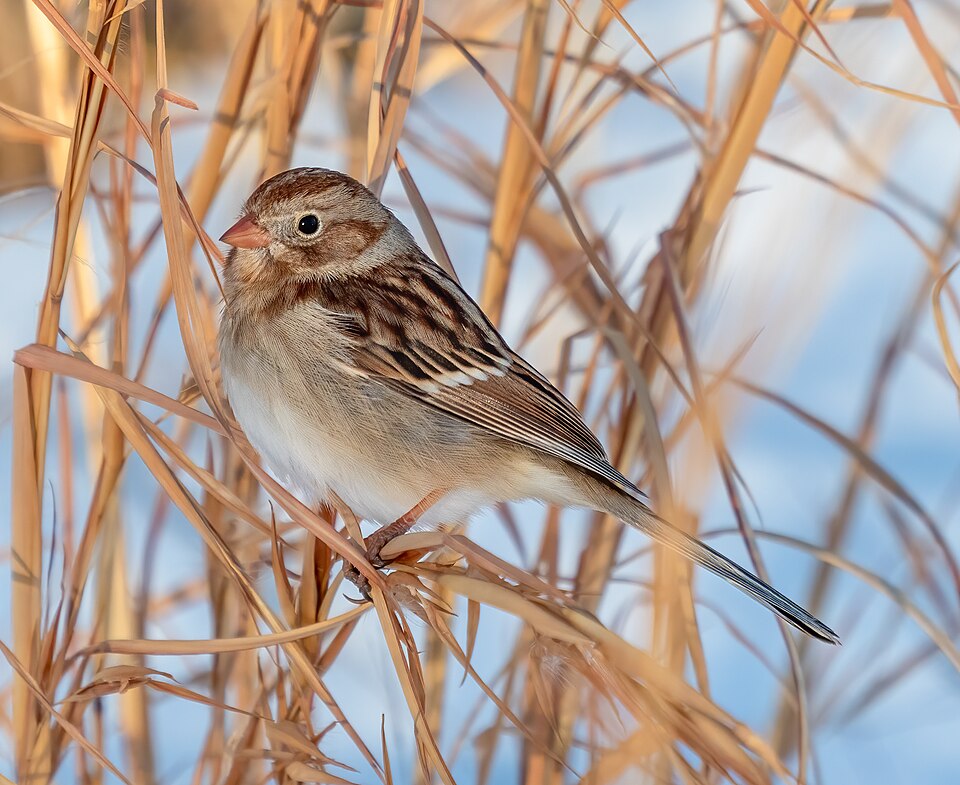
The Field Sparrow is one of the easiest little brown sparrows to fall for, even though it spends most of its life keeping a low profile in scrubby, overgrown fields. It is a slim, long-tailed sparrow of weedy pastures, old farm fields growing back to brush, powerline cuts, and the brushy edges where grassland meets young trees. What gives it away is less the plumage than the personality: a clear, plain face with a bold white eye-ring, a bright pink bill, and a sweet, far-carrying song that sounds like a ball bouncing to a stop.
Despite the name, Field Sparrows do not love wide-open mowed fields. They want structure - clumps of grass, scattered shrubs, briar tangles, and small saplings to sing from and hide in. As America has tidied up its farmland and let old fields grow into mature forest, this sparrow has quietly lost ground across much of its range. It is still common in the right habitat, but its long-term decline makes it a bird worth knowing and appreciating.
Look for a small, slender sparrow with a noticeably long, slightly notched tail and a small rounded head that can look slightly peaked. It often appears plainer and "cleaner" in the face than the busy-faced sparrows around it, and the combination of a pink bill plus a white eye-ring on an otherwise blank face is the quickest way to clinch it.
| Bill | Bright pink to orange-pink, small and conical - the single best field mark |
| Face | Plain grayish face with a bold white eye-ring and a soft rusty line behind the eye; lacks heavy facial streaking |
| Crown | Rusty or rufous cap, often split by a faint gray central area |
| Underparts | Clean, unstreaked buffy-gray breast (no central spot) |
| Upperparts | Warm brown back streaked with black; two thin pale wing bars |
| Tail | Long and narrow for a sparrow, frequently flicked, with a slight notch |
Male vs. female
Male and female Field Sparrows look alike. There is no reliable plumage difference you can pick out in the field - both sexes show the same pink bill, rusty cap, plain face, and white eye-ring. In spring and summer, the bird belting out the bouncing-ball song from a shrub top is almost always the male, since males do the singing to defend territory and attract mates, but you cannot sex a silent perched bird by appearance alone.
Juveniles
Juvenile Field Sparrows are streakier than adults, with fine dark streaking across the breast and a less obvious rusty cap, which can briefly cause confusion with other young sparrows. They still show the pink bill and the pale eye-ring, though, and within a few weeks they molt into the cleaner, unstreaked adult-like body plumage. By their first fall, young birds look much like the adults.
The song is the showstopper and the reason many birders learn this species by ear first. It is a series of clear, sweet, downslurred whistles that start slow and deliberate, then accelerate into a rapid trill - the classic description is a ping-pong ball or marble dropped on a hard floor, bouncing faster and faster until it blurs into a buzz: tew... tew... tew tew tew-tew-tetetetetete. Some males sing a more even, flat-pitched version, but the accelerating-bouncing-ball quality is the signature.
Calls are less distinctive: a soft, high tsip or chip given by foraging and alarmed birds, and various thin notes among family groups. Field Sparrows often sing well into the heat of the day and even through summer afternoons when most other songbirds have gone quiet.
Field Sparrows breed across the eastern and central United States and just into southern Canada, roughly from the Great Plains east to the Atlantic and from the Gulf states north to the upper Midwest and New England. They favor early-successional habitat throughout this range.
They are short-distance migrants. Birds breeding in the northern part of the range pull south in fall to spend winter across the southern and south-central U.S., while populations in the milder mid-Atlantic and southern states are largely year-round residents. In winter they often gather in loose flocks in weedy fields and brushy edges, sometimes mixing with other sparrows.
Field Sparrows shift their diet with the seasons. Through fall and winter they are primarily seed eaters, foraging on the ground and on bent-over grass and weed stems for the small seeds of grasses, sedges, and weedy plants like ragweed and foxtail. They have a charming habit of fluttering up to ride a seed-head down to the ground or picking seeds directly from drooping stems.
In the breeding season the menu swings toward protein. Adults and especially nestlings eat large numbers of insects and other small invertebrates - grasshoppers, beetles, caterpillars, true bugs, and spiders - gleaned from grass and low vegetation. This seasonal switch to insects is typical of seed-eating sparrows and is what makes a brushy field full of bugs such valuable nesting habitat.
Field Sparrows are open-cup nesters that build low in their grassy, shrubby habitat. Early in the season, before much green-up, nests are often placed right on or near the ground in a clump of grass; as the season progresses and vegetation grows, pairs tend to nest a bit higher, in the fork of a small shrub or briar tangle. The female does most or all of the building, weaving a cup of grasses and weed stems lined with finer grasses and animal hair.
A typical clutch is about three to four pale eggs, finely spotted and speckled with brown, and the female does the incubating. Pairs frequently raise two or three broods over a long breeding season, often building a fresh nest for each attempt - which they need to, because ground and low nests are heavily preyed upon and are a common target for Brown-headed Cowbird parasitism.
Field Sparrows are not classic feeder birds, but you can attract them under the right conditions - it is mostly about habitat, not feeders. They are far more likely to visit yards that border brushy fields, hedgerows, or overgrown lots than a tidy suburban lawn in the middle of town.
- Scatter seed on or near the ground. Field Sparrows are ground foragers and prefer low platform or tray feeders, or seed sprinkled near brushy cover, over hanging tube feeders.
- Offer small seeds. White millet and other small grass-like seeds suit their bills far better than large sunflower or mixed-bird blends.
- Leave a wild, weedy corner. Letting part of the yard grow into native grasses and weeds that go to seed is the single best thing you can do for them.
- Keep brushy cover nearby. A hedgerow, briar patch, or shrub thicket gives them a place to retreat and makes them feel safe enough to forage in the open.
- Skip the pesticides. Insects are essential summer food, especially for nestlings, so a chemical-free yard supports them best.
- Expect them mostly in winter. If you do get Field Sparrows at a feeding area, it is most often as part of a loose winter sparrow flock.
- Chipping Sparrow: Also has a rusty cap, but shows a dark bill, a crisp black eye-line, and a bold white eyebrow stripe - the face is patterned, not plain, and the song is a flat mechanical trill rather than an accelerating bounce.
- American Tree Sparrow: A winter visitor with a rusty cap and a dark central breast spot, plus a distinctive bicolored bill (dark above, yellow below) rather than the Field Sparrow's all-pink bill.
- Swamp Sparrow: Shares a rusty cap and plainish look but is darker and grayer-faced, has a dark bill, prefers wet marshy habitat, and gives a slow musical trill instead of a bouncing song.
- Vesper Sparrow: A streakier, chunkier grassland sparrow with a white eye-ring like Field Sparrow's, but it has a streaked breast, white outer tail feathers, and a chestnut shoulder patch.
What does a Field Sparrow look like?
It is a small, slim, long-tailed sparrow with a plain grayish face, a bold white eye-ring, a rusty cap, and a clean unstreaked buffy breast. The standout feature is its bright pink bill - no other common sparrow in its range combines a plain face with a pink bill quite like this.
What does the Field Sparrow's song sound like?
It sounds like a ball bouncing on a hard floor: clear sweet whistles that start slow and then speed up into a fast trill, often written as 'tew... tew... tew-tew-tetetetete.' That accelerating, bouncing-ball quality is the easiest way to identify the bird by ear.
How is a Field Sparrow different from a Chipping Sparrow?
Both have rusty caps, but a Chipping Sparrow has a dark bill, a sharp black line through the eye, and a white eyebrow, giving it a patterned face. A Field Sparrow has a pink bill and a plain face with just a white eye-ring. Their songs differ too - the Chipping Sparrow gives a flat, even trill, while the Field Sparrow's song bounces and accelerates.
Do Field Sparrows come to bird feeders?
Not often, and only under the right conditions. They are ground-foraging seed eaters that prefer brushy, weedy habitat over tidy yards. You are most likely to see them at low tray feeders or seed scattered near cover, especially in winter, if your property borders overgrown fields or hedgerows. Small seeds like white millet work best.
Where do Field Sparrows live and are they migratory?
They live in weedy, brushy fields and shrubby edges across the eastern and central United States and into southern Canada. They are short-distance migrants - northern breeders move south for winter, while birds in the milder southern and mid-Atlantic states often stay put year-round.