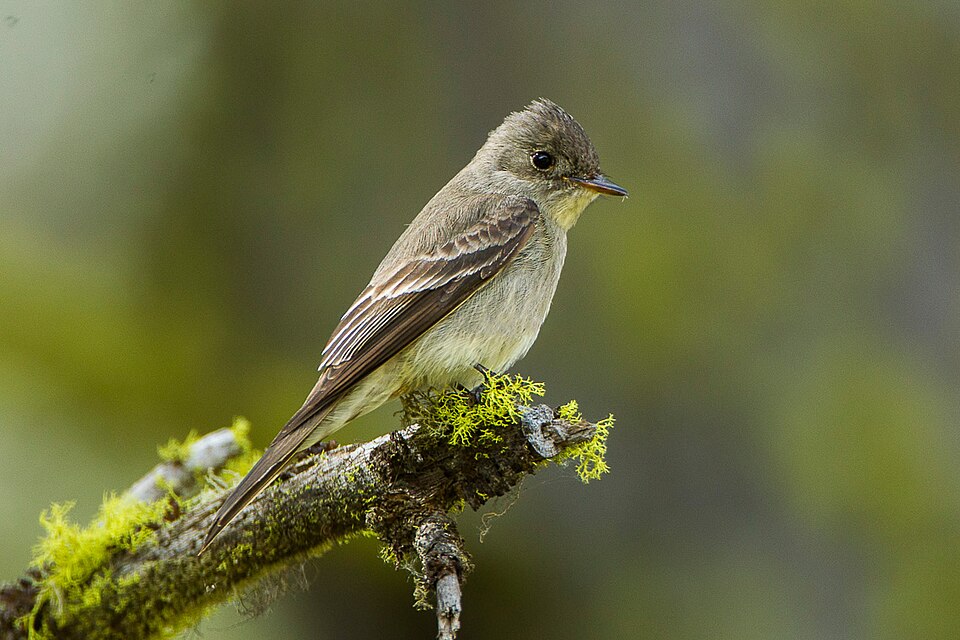
The Western Wood-Pewee is one of those birds you hear long before you learn to see it. Across the open woodlands, riverside cottonwoods, and pine forests of the American West, its rough, descending peeer drifts down from a bare snag on summer afternoons, a sound so woven into the season that many westerners know it without ever knowing the bird that makes it. Visually it is the definition of plain: a small, gray-brown flycatcher with no bold field marks to speak of. But its upright posture, its habit of sallying out after insects and returning to the same perch, and above all its distinctive voice give it away once you know what to look for.
This is a long-distance migrant that spends only the warmer months in North America, breeding from Alaska and western Canada south through the mountains and lowlands of the western United States into Mexico, then retreating to South America for the winter. It belongs to the genus Contopus, the pewees, and is the western counterpart to the nearly identical Eastern Wood-Pewee, two birds so alike in appearance that voice is often the only reliable way to separate them. For backyard birders in the West, the pewee is less a feeder visitor than a familiar summer presence, a small gray sentinel of the woodland edge.
Look for a small, slender flycatcher that sits bolt upright on an exposed perch, often a dead branch partway up a tree. The Western Wood-Pewee has a relatively large head with a slightly peaked crown, a fairly long tail, and long wings that reach well down the tail when folded, a key structural clue that separates pewees from the smaller, rounder Empidonax flycatchers. There is little color to work with, so shape, posture, and behavior carry most of the weight.
| Overall color | Grayish to brownish olive above, paler and dingy gray-white below with a dusky wash across the breast that often forms a faint, vest-like look |
| Wing bars | Two pale wing bars, but typically dull and grayish rather than the crisp white bars of Empidonax flycatchers |
| Eye ring | Little to none, lacks the bold, clean eye ring shown by most Empidonax flycatchers, an important distinction |
| Crown shape | Slightly peaked or crested at the rear, giving the head a slightly triangular profile |
| Wings and tail | Long wings (long primary projection) and a longish tail; the bird looks lanky and attenuated rather than compact |
| Bill | Fairly broad and flat; upper mandible dark, lower mandible mostly dull orange-yellow toward the base |
Male vs. female
Males and females look alike. There is no difference in plumage color, pattern, or size that a birder can reliably use in the field, both sexes show the same drab gray-brown coloring, dull wing bars, and peaked crown. In the hand, breeding females develop a brood patch and males do not, but for backyard observers the sexes are effectively identical. Behavior offers the only hint: the persistent singing from a high perch is done by the male defending his territory.
Juveniles
Freshly fledged juveniles look much like adults but a touch browner and softer overall, with buffy or cinnamon-tinged wing bars rather than the grayish bars of worn adults. Their fresh feather edges can make the bird look slightly cleaner and more contrasty than a faded summer adult. These differences are subtle and fade quickly as the bird matures, so by the time pewees are migrating south, young and old are hard to tell apart in the field.
The voice is the single best way to identify this bird. The signature call is a harsh, burry, descending peeer or tswee-er, a nasal, slightly buzzy whistle that slides downward and sounds almost mournful. Many birders describe it as rough or "burry," and it is noticeably less sweet and clear than the plaintive, rising-and-falling pee-a-wee of the Eastern Wood-Pewee. That harsh, downslurred quality is the giveaway.
The Western Wood-Pewee also gives a clearer dawn song, a repeated three-part phrase often rendered as tswee-tee-teet, delivered persistently in the half-light before sunrise. Through the day, males call from exposed perches at a steady, unhurried pace, and pewees are famous for singing well into the heat of midday when most other birds have gone quiet.
This is a bird of the western half of the continent. It breeds from central Alaska and the Yukon south through British Columbia and across the western United States, through the Rocky Mountains, the Great Basin, the Pacific states, and the Southwest, and on into the highlands of Mexico and Central America. It favors open woodland with scattered tall trees and clearings: cottonwood-lined rivers, aspen groves, pine and pine-oak forest, burned or logged forest edges, and wooded canyons.
The Western Wood-Pewee is a true long-distance migrant. It arrives on western breeding grounds relatively late in spring, often not until May, and departs again by late summer and early fall, wintering in the forests and forest edges of northern and western South America. Because it travels at night and is quiet on migration, it passes through much of its range almost unnoticed except by birders watching for it.
The Western Wood-Pewee is an insect specialist and a classic aerial flycatcher. It hunts by "sallying", perching upright on an exposed branch, scanning the air, then darting out to snatch a flying insect and, very often, looping back to the same perch or one nearby. You can frequently hear the audible snap of its bill as it captures prey. Its diet is dominated by flying insects: flies, wasps, bees, flying ants, beetles, moths, and other small bugs taken on the wing.
This perch-and-sally style, repeated from the same favored snags hour after hour, is one of the most useful behavioral clues for identifying the bird at a distance. Unlike warblers that glean among leaves or swallows that course continuously through the air, the pewee works from a fixed station, making short, purposeful flights and returning to a lookout.
The female builds a compact, shallow open cup nest, usually saddled on a horizontal branch or set in a fork well out from the trunk, often at a considerable height in a tree. She constructs it from grasses, plant fibers, and weed stems, binds it together with spider silk, and camouflages the outside with lichen, bark flakes, and plant down so that it blends remarkably well with the limb it sits on, an easy nest to walk right past.
A typical clutch is three eggs, sometimes two or four, creamy white with a wreath of darker spots concentrated toward the larger end. The female does the incubating, and once the young hatch both parents bring a steady supply of insects. Pewees generally raise a single brood per season, fitting the whole nesting cycle into their relatively short stay on the breeding grounds before the southbound migration begins.
The Western Wood-Pewee is not a feeder bird, and no amount of seed, suet, or nectar will draw it in, it eats flying insects almost exclusively and catches them on the wing. That said, you can absolutely make a western yard or property pewee-friendly if it sits near the right habitat. The goal is to provide open hunting perches and a healthy insect supply rather than food at a station.
- Leave some dead snags and bare branches standing where it's safe to do so, pewees need exposed perches to sally from, and a yard with open lookouts over a clearing is far more attractive than dense, closed canopy.
- Avoid spraying insecticides. A pewee's entire diet is flying insects, so a chemical-free yard with abundant flies, wasps, moths, and flying ants is the single best way to support them.
- Encourage native trees and a woodland edge, especially cottonwoods, aspens, oaks, and pines, which mimic the open woodland and riparian habitat the species prefers.
- Provide water, such as a clean birdbath or a small moving-water feature, which draws the flying insects pewees hunt and gives the birds a place to drink and bathe.
- Keep some open airspace, a clearing or gap in the canopy, since pewees hunt by darting out into open air and returning, and a cluttered yard gives them no room to work.
- Eastern Wood-Pewee: Nearly identical in appearance; ranges barely overlap. Best told apart by voice, Eastern gives a clear, sweet, rising-then-falling pee-a-wee, while Western gives a harsh, burry, descending peeer.
- Olive-sided Flycatcher: Larger and bulkier with a big head, dark 'vest' on the sides of the breast leaving a white center stripe, and a loud quick-three-beers song. Perches even higher and more conspicuously.
- Willow Flycatcher: An Empidonax flycatcher, smaller, rounder-headed, with crisper wing bars and a sneezy fitz-bew call. Lacks the pewee's long-winged, peak-crowned, upright look.
- Western Kingbird: Much larger, with a gray head, lemon-yellow belly, and black tail edged in white. Shares the sit-and-sally habit but is far bolder, brighter, and noisier.
How do I tell a Western Wood-Pewee from an Eastern Wood-Pewee?
By voice, almost always. The two look nearly identical, so plumage won't help. The Western gives a harsh, burry, descending peeer, while the Eastern sings a clear, sweet pee-a-wee that rises and falls. Their breeding ranges also barely overlap, Western in the West, Eastern in the East, so location is a strong clue too.
What does a Western Wood-Pewee sound like?
Its most common call is a rough, nasal, downslurred peeer or tswee-er that slides downward and sounds slightly mournful. At dawn it also gives a repeated three-part tswee-tee-teet song. The harsh, burry quality is the key, it's noticeably less musical than the Eastern Wood-Pewee.
Will Western Wood-Pewees come to a bird feeder?
No. They eat flying insects caught in mid-air and have no use for seed, suet, or nectar. To support them, skip the insecticides, keep open hunting perches like dead branches, and encourage a healthy insect population near woodland edge.
How can I separate a pewee from an Empidonax flycatcher?
Pewees are larger and lankier, with long wings (long primary projection), a slightly peaked crown, and dull grayish wing bars. Crucially, they lack the bold, clean eye ring that most Empidonax flycatchers show. Pewees also don't flick their wings and tail as nervously as Empids do.
Where and when can I see a Western Wood-Pewee?
Look in open western woodlands, cottonwood river bottoms, aspen groves, pine and pine-oak forest, and burned or logged edges, from late spring through late summer. They're long-distance migrants that arrive in May and head to South America by fall, so they're a warm-season bird only.
What does a Western Wood-Pewee eat?
Almost entirely flying insects: flies, wasps, bees, flying ants, beetles, and moths. It hunts by perching upright on an exposed branch, sallying out to grab prey on the wing, often with an audible snap of the bill, and returning to the same perch to watch again.