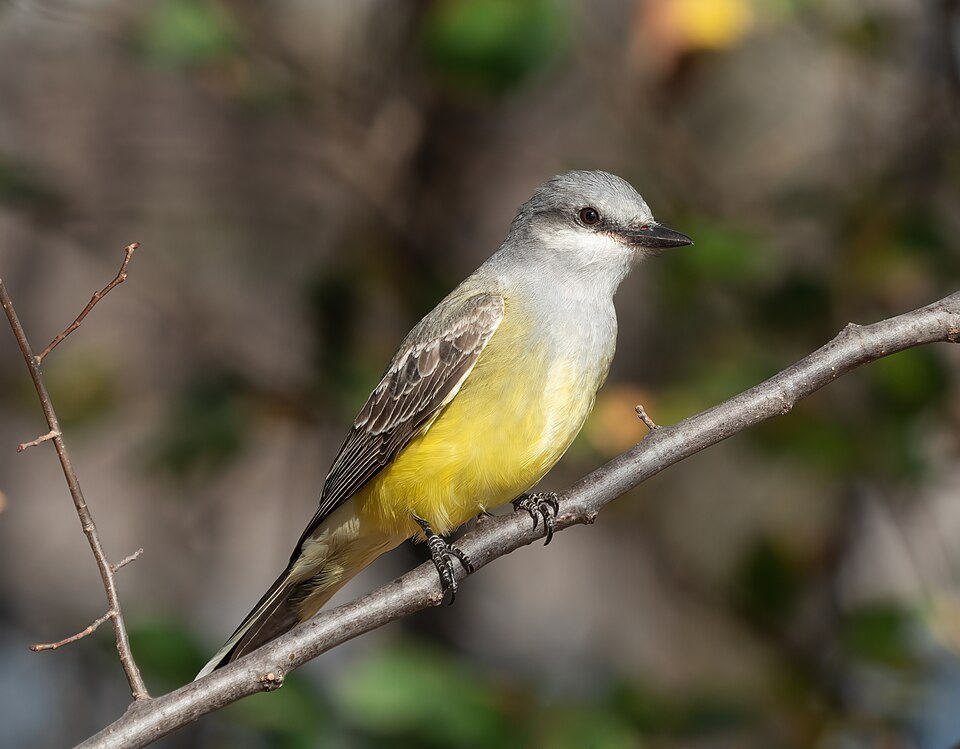
The Western Kingbird is one of the signature birds of summer across the open country of the American West. Perched upright on a fence wire, a roadside power line, or a bare snag, it shows a clean pale gray head and chest that melts into a bright lemon-yellow belly. It is a flycatcher with attitude, sallying out after passing insects with quick, fluttering flights and returning to the same exposed perch again and again. Where there is open ground, scattered trees, and a good vantage point, you can count on finding one in the warm months.
Its name fits its personality. Like other kingbirds, the Western is fearless far beyond its size, readily chasing off hawks, ravens, and even much larger raptors that drift too near its nest. This combination of a tidy, easy-to-see appearance, a loud bickering voice, and a willingness to nest right alongside people on utility poles and yard trees makes it a familiar and well-loved bird throughout the prairies, farmlands, deserts edges, and small towns of western North America.
This is a medium-sized, sturdy flycatcher with a large head, broad shoulders, and an upright posture when perched. At a glance it reads as a gray-headed bird with a yellow belly and a dark tail; the clean two-tone look and habit of perching out in the open are usually enough to clinch the identification within its range.
| Head & chest | Pale ash-gray, with a slightly darker mask through the eye and a whitish throat |
| Belly | Bright lemon-yellow, sharply set off from the gray chest |
| Back | Grayish-olive, blending into the gray of the head and the yellow underparts |
| Tail | Black with crisp white outer edges (the white sides are a key field mark) |
| Bill | Short, straight, and black, a typical flycatcher bill |
| Crown patch | A concealed orange-red crown stripe, rarely seen except in display or in the hand |
Male vs. female
Males and females look essentially alike and cannot be reliably told apart in the field. Both show the gray head, yellow belly, and white-edged black tail. The hidden orange-red crown patch is present in both sexes but is normally kept covered; it shows only in moments of excitement or aggression, and even then it is hard to see. Males average very slightly larger, but the difference is not useful for everyday birding.
Juveniles
Juveniles resemble adults but look softer and less crisp. Their yellow belly is paler and more washed-out, the gray of the head and chest is duller, and there is often a faint buffy or cinnamon edging on the wing coverts, giving the folded wing a slightly scaly look. Young birds also lack the concealed crown patch. By the time they head south on migration in late summer they are largely adult-like, with the white tail edges already showing clearly.
The Western Kingbird is a noisy, talkative bird. Its common call is a sharp, squeaky kit or whit, often run together into bickering, sputtering chatters that sound like a handful of squeaky toys, kit-kit-keeler-keeler. Birds give these calls constantly while chasing insects, defending territory, or scolding intruders.
At dawn, males deliver a more structured song from a high perch or during fluttering flight: a series of stuttering, twittering notes building to an emphatic ending, often described as pidik-pidik-PEEKaroo. The overall effect is busy and excitable rather than musical, and once learned it is an easy way to detect the bird before you see it.
The Western Kingbird breeds across the western and central parts of North America, from the southern Canadian prairie provinces south through the Great Plains, Rocky Mountain basins, Southwest, and into Mexico. It favors open and semi-open country, grasslands, farm fields, sagebrush flats, desert edges, ranchland, and the open margins of towns, anywhere with scattered trees, fence lines, or wires to perch on. Its breeding range has expanded eastward over the past century as land was cleared and as utility poles spread across the landscape.
It is a long-distance migrant. Most birds winter in western Mexico and Central America, with some reaching as far as Costa Rica. A small but regular number turn up along the southeastern U.S. coast, especially in Florida, during fall and winter. Spring arrival on the breeding grounds is typically April into May, with southbound migration concentrated in late summer and early fall.
Western Kingbirds are primarily insect hunters. They feed mainly by "hawking", watching from an exposed perch, then darting out to snatch flying insects in midair before returning to the same or a nearby perch. Bees, wasps, beetles, grasshoppers, flies, true bugs, and dragonflies all feature heavily in the diet, and the birds will also drop to the ground to grab larger prey like grasshoppers and crickets.
In late summer and on migration they supplement insects with small fruits and berries, including those of elderberry, hawthorn, and other shrubs. This flexibility helps fuel their long journey south. Their reliance on open perches near insect-rich ground is exactly why fences, wires, and isolated trees in farm country are such reliable places to find them.
Western Kingbirds build a bulky, somewhat untidy cup nest of grasses, weed stems, twigs, plant fibers, and string, often lined with softer material like plant down, feathers, hair, or cotton. They readily nest on human structures, utility poles and crossbars, transformers, building ledges, and other supports, as well as in the forks of trees, frequently choosing surprisingly exposed sites. The female does most of the nest building.
A typical clutch is 3 to 4 eggs, creamy white and boldly marked with brown and lavender blotches. The female incubates for about two weeks, and both parents feed the young, which leave the nest roughly 16 to 17 days after hatching. Pairs are fierce defenders, aggressively driving off hawks, crows, ravens, and other potential threats that approach the nest area.
The Western Kingbird is not a feeder bird, it eats flying insects, not seed or suet, so it will ignore conventional bird feeders. That said, if you live within its range and have the right kind of open habitat, there are ways to make your property appealing.
- Provide open perches. Fence lines, dead snags, wires, and isolated tall shrubs give kingbirds the hunting vantage points they depend on.
- Keep some open ground. Lawns, pastures, gardens, and weedy edges produce the flying and ground insects they hunt.
- Go easy on pesticides. Insecticides remove the bees, beetles, and grasshoppers that make up the bulk of their diet.
- Offer nesting structure. A utility pole, tall fence post, or open-fork tree near open country can serve as a nest site.
- Plant native fruiting shrubs. Elderberry and similar berry producers offer late-summer food before migration.
- Add a water source. A birdbath or shallow water feature near open habitat can draw them in to drink and bathe.
- Cassin's Kingbird: Darker gray head and chest with a more contrasting white chin, and a dusky tail tipped pale (not edged white on the sides). Voice is a lower, burry chi-bew.
- Tropical Kingbird: Larger bill, more greenish back, notched brownish tail without white edges, and a distinctive twittering call; mostly along the southern border and coasts.
- Western Wood-Pewee: Smaller and drabber overall, lacking bright yellow belly and white tail edges; shows wing bars and a peaked crown, with a burry descending pee-er call.
- Great Crested Flycatcher: Eastern bird with rufous in the wings and tail, a bushy crest, and a louder wheep call; overlaps little with the Western Kingbird's open western range.
What does a Western Kingbird look like?
It is a medium-sized flycatcher with a pale gray head and chest, a bright lemon-yellow belly, a grayish back, and a black tail with crisp white outer edges. It perches upright in the open on fences, wires, and bare branches.
Where do Western Kingbirds live?
They breed across open and semi-open country in western and central North America, from the southern Canadian prairies through the Great Plains and Southwest into Mexico. They winter in western Mexico and Central America, with a few showing up in the southeastern U.S.
What is the difference between a Western Kingbird and a Cassin's Kingbird?
Western Kingbirds have a paler gray head and a black tail with white outer edges. Cassin's Kingbirds are darker gray, especially on the chest, show a sharper white chin, and have a dusky tail with a pale tip rather than white sides. Their calls also differ, Cassin's gives a burrier chi-bew.
Will Western Kingbirds come to a bird feeder?
No. They are aerial insect hunters and do not eat seed or suet. To attract them, provide open perches, keep some open insect-rich ground, avoid pesticides, and offer water and native fruiting shrubs.
Why is the Western Kingbird so aggressive?
Like other kingbirds, it is highly territorial and will fearlessly attack much larger birds such as hawks, crows, and ravens that approach its nest. This bold defense helps protect its eggs and young from predators.
Do Western Kingbirds migrate?
Yes. They are long-distance migrants, arriving on their breeding grounds in April and May and heading south in late summer and early fall to winter in western Mexico and Central America.