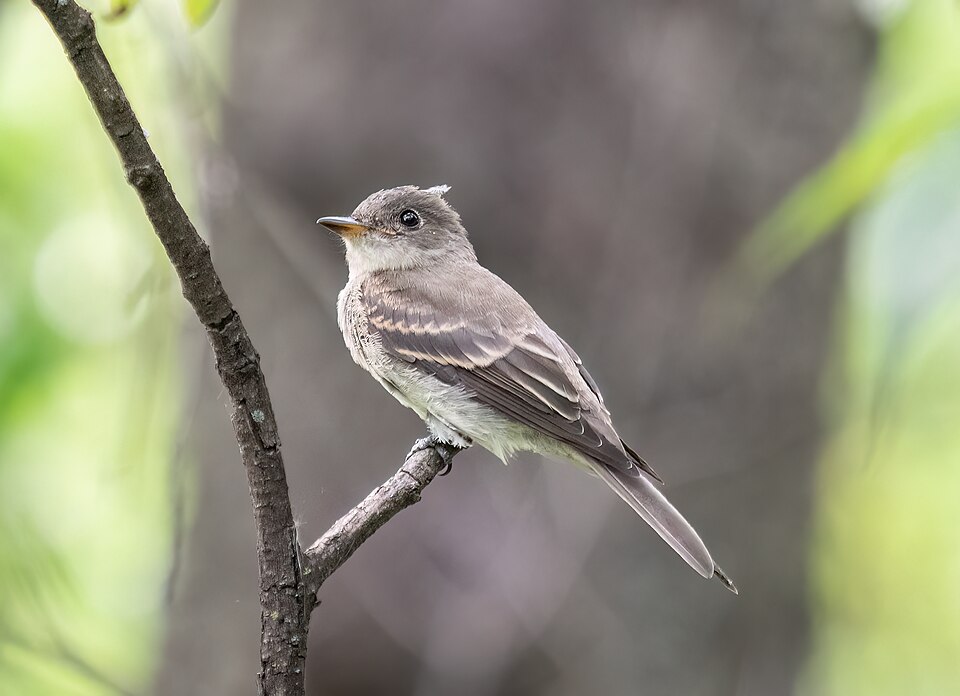
The Eastern Wood-Pewee is one of those birds you almost always hear before you see. A small, plain gray-olive flycatcher of the forest canopy and woodland edges, it spends its summers perched quietly on a bare dead branch, sallying out to snap up flying insects and returning to nearly the same spot. What gives it away is its voice: a slow, sweet, slightly mournful pee-a-wee that drifts through the trees on hot June afternoons when most other birds have fallen silent.
It is an unassuming bird in every way, which is exactly why so many people overlook it. There are no bright colors, no flashy markings, and it rarely visits feeders or yards. But the Eastern Wood-Pewee is a true long-distance migrant that winters in South America, and its drawn-out whistle is one of the signature sounds of eastern deciduous forests in summer. Like many aerial-insect-eaters, its numbers have been slipping over recent decades, making it a quiet barometer of forest and insect health.
This is a small, slim flycatcher with an upright posture, a peaked or slightly crested head, a fairly long-winged look, and a longish tail. At rest the wingtips reach noticeably down the tail, giving it a long, attenuated profile that helps separate it from chunkier flycatchers. Overall it is grayish-olive above and paler below, with no bold field marks, so shape, behavior, and voice do most of the identification work.
| Overall color | Grayish-olive above, dingy white to pale gray below, with a slightly darker 'vest' smudged across the breast |
| Wing bars | Two whitish wing bars, the lower one often crisper; pale edges to the inner flight feathers |
| Eye ring | At most a faint, indistinct pale eye ring, never the bold, complete eye ring of an Empidonax flycatcher |
| Bill | Broad-based and flat; upper mandible dark, lower mandible mostly dull yellow-orange at the base |
| Wing/tail shape | Long primary projection (wingtips extend well down the tail), giving a slim, long-tailed silhouette |
| Posture/behavior | Sits bolt upright on exposed dead branches, sallies out for insects, and usually does not pump or wag its tail |
Male vs. female
Males and females look essentially identical in the field, there is no reliable plumage difference you can pick out with binoculars. Both sexes are the same plain gray-olive with the same two wing bars and the same shape. The male does almost all of the singing, so a bird delivering the full pee-a-wee song from a high perch is statistically likely to be a male, but you cannot sex a silent perched bird by sight alone.
Juveniles
Freshly fledged juveniles look much like adults but tend to be a touch browner overall, with buffy or cinnamon-tinged wing bars rather than clean white ones, and the feathers of the upperparts can show faint pale edges that give a slightly scaly look. These warm tones fade as the feathers wear, and by the time young birds head south in fall they are very close to adult appearance. The yellow-orange base to the lower bill is usually obvious in young birds.
The song is the best way to know this bird: a clear, plaintive, slurred whistle usually written as pee-a-wee, the first note rising and the last note sliding up, followed after a pause by a downslurred pee-yur or pee-oo. It is unhurried and slightly melancholy, often repeated lazily through the heat of midday and into the evening when few other birds are vocal. Birders sometimes describe the overall effect as wistful or questioning.
Calls include a softer chip and a clear, even pee-yur given on its own. Around dawn, males sometimes work the phrases into a more excited, jumbled twilight song. The name itself is onomatopoeic, say "pee-a-wee" slowly with a little sad lilt and you've got it.
The Eastern Wood-Pewee breeds across the eastern United States and southern Canada, from the Great Plains east to the Atlantic and from the Gulf states north into southern Canada. It favors deciduous and mixed woodlands, woodland edges, clearings, and open forest with a fairly clear understory and good perches in the mid-to-upper canopy.
It is a complete, long-distance migrant. Birds leave the breeding grounds in late summer and fall and winter in northwestern and central South America, in countries such as Colombia, Ecuador, Peru, and Venezuela. Spring migrants are notably late, with many not arriving on northern breeding grounds until well into May, one reason the pewee's song is so tied to early summer rather than spring.
The Eastern Wood-Pewee is an aerial insectivore, and it is a classic "sit-and-wait" hunter. It perches upright on an exposed dead twig, scans for passing insects, then darts out in a quick sally to seize prey in midair before looping back, often to the very same perch. This hawking behavior, repeated over and over from a favorite snag, is one of the most reliable ways to pick the bird out.
Its diet is made up almost entirely of flying insects: flies, small wasps and bees, beetles, moths, true bugs, and winged ants, with some small amounts of other arthropods and the occasional berry. Because it depends so heavily on flying insects caught on the wing, it is sensitive to declines in insect abundance, which researchers think may be one factor behind its long-term population slide.
The female builds a small, shallow, neatly made cup nest saddled onto a horizontal branch, often well out from the trunk and fairly high in a deciduous tree. She constructs it from grasses, plant fibers, and fine rootlets, binds it with spider silk, and decorates the outside with lichen so that it blends into the limb and looks like a natural bump or knot, surprisingly hard to spot even when you know roughly where it is.
A typical clutch is about three eggs, creamy white with a wreath of darker spots near the larger end. The female does the incubating for roughly two weeks, and both parents feed the nestlings, which fledge a couple of weeks after hatching. Pairs usually raise a single brood each season, fitting their nesting into the relatively short window between their late spring arrival and the start of fall migration.
The Eastern Wood-Pewee is not a feeder bird and won't be tempted by seed, suet, or nectar, since it eats only flying insects. But if you have wooded property or live near a forest edge, you can absolutely encourage it as a summer resident by managing habitat rather than putting out food.
- Keep mature deciduous and mixed trees with an open, uncluttered understory, pewees like room to launch their aerial sallies.
- Leave dead branches and snags standing where it's safe to do so; bare exposed twigs are the hunting perches pewees depend on.
- Avoid pesticides on your property, a healthy population of flying insects is the entire menu for this bird.
- Favor native trees and plants that support robust insect life, which in turn feeds aerial insectivores like the pewee.
- Protect woodland edges and clearings rather than mowing or developing them, since these transition zones are prime pewee territory.
- Listen at midday in June and July, when the pewee sings while most other birds rest, that's your cue one is nearby.
- Eastern Phoebe: Similar size and plain look, but the phoebe persistently pumps and wags its tail, lacks obvious wing bars, has an all-dark bill, and says its own name, a raspy 'fee-bee.'
- Western Wood-Pewee: Nearly identical in appearance and best separated by range and voice; the western gives a harsh, burry, descending 'breeer' rather than the eastern's sweet 'pee-a-wee.'
- Least Flycatcher: A small Empidonax that shows a bold, complete white eye ring and shorter wingtips; it gives a sharp, dry 'che-bec' instead of a slurred whistle.
- Olive-sided Flycatcher: Larger and bulkier with a big head, dark side patches that look like an unbuttoned vest, and a loud, emphatic 'quick-three-beers' whistle.
What bird makes a slow, sad 'pee-a-wee' whistle in the summer woods?
That's almost certainly an Eastern Wood-Pewee. Its clear, plaintive, slightly mournful 'pee-a-wee', often followed by a downslurred 'pee-yur', is a signature sound of eastern deciduous forests, and the bird frequently sings it through the heat of midday when most other birds are quiet.
How do I tell an Eastern Wood-Pewee from an Eastern Phoebe?
Behavior is the quickest tell. The phoebe constantly pumps and wags its tail and has an all-dark bill with no real wing bars. The pewee sits still and upright, shows two whitish wing bars, has a yellow-orange base to its lower bill, and doesn't wag its tail. Their songs are different too: the phoebe says a raspy 'fee-bee,' the pewee a sweet 'pee-a-wee.'
Will Eastern Wood-Pewees come to my bird feeder?
No. Pewees are aerial insectivores that catch flying insects on the wing, so they have no interest in seed, suet, or nectar. The best way to host them is to maintain wooded habitat with mature trees, open understory, and dead perching branches, and to avoid pesticides so flying insects remain abundant.
Where do Eastern Wood-Pewees go in winter?
They are long-distance migrants that leave North America entirely in fall and winter in northwestern and central South America, countries like Colombia, Ecuador, Peru, and Venezuela. They are also famously late spring migrants, often not returning to northern breeding areas until well into May.
Why don't I see Eastern Wood-Pewees even though I hear them?
They are plain gray birds that perch quietly in the mid-to-upper canopy and woodland edges, so they blend in and stay relatively still between hunting sallies. Their carrying whistle travels much farther than the bird is visible. Scan exposed dead branches in the direction of the song and watch for a small bird that darts out and returns to the same perch.
Are Eastern Wood-Pewees declining?
Yes. Although still common across their range, long-term surveys show a steady decline over recent decades. As aerial insectivores, they're vulnerable to drops in flying-insect abundance, as well as to forest fragmentation and changes on their wintering grounds, which is why birders treat them as a quiet indicator of forest health.