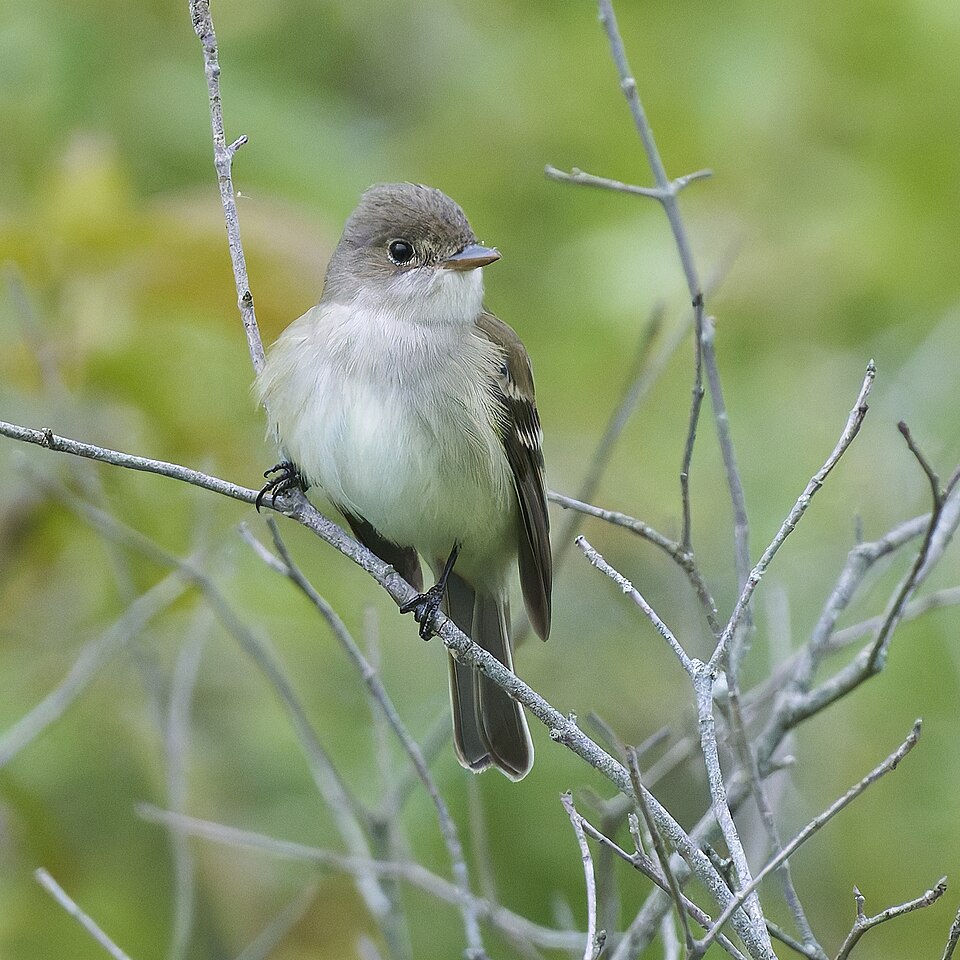
The Willow Flycatcher is a small, plain, brownish-olive songbird that birders learn to identify with their ears long before their eyes. It belongs to the genus Empidonax, a notoriously confusing group of look-alike flycatchers, and in the field it is nearly impossible to separate from several close relatives by appearance alone. What gives it away is its voice: a sneezy, buzzy "fitz-bew" that rings out from the tops of willows, dogwoods, and other shrubby tangles in damp lowlands and meadow edges across much of North America.
For decades the Willow Flycatcher and the Alder Flycatcher were lumped together as a single species called "Traill's Flycatcher," and only their distinct songs eventually convinced ornithologists they were two. That history tells you everything about this bird: it is a creature of subtle field marks and loud opinions. While most of the species is common and widespread, the Southwestern Willow Flycatcher subspecies, which nests in the disappearing riparian willow and cottonwood thickets of the desert Southwest, is listed as federally endangered, making this humble little flycatcher an important symbol of streamside habitat conservation.
Expect a small, slender flycatcher with an upright posture, a fairly large head, a square-tipped tail, and the long-winged, peaked-crown look typical of Empidonax. Overall it appears drab and washed out, lacking any bold colors, and crucially it shows only a faint, thin eyering, often so weak it seems absent entirely. It perches at mid-height in shrubs, flicks its tail and wings, and sallies out to snap up flying insects.
| Overall color | Brownish-olive to grayish above, pale below with a dusky wash across the breast and a faint yellow tinge on the belly |
| Eyering | Very faint and thin, often nearly absent, a key trait separating it from most other Empidonax, which show bolder eyerings |
| Wingbars | Two whitish to pale buff wingbars, usually moderately distinct against dark wings |
| Bill | Fairly broad and flat; lower mandible mostly pale yellowish-orange, upper mandible dark |
| Tail | Square-tipped, frequently flicked; medium length for the genus |
| Posture | Upright and alert, often perched at the top of a shrub from which it sings and forages |
Male vs. female
Male and female Willow Flycatchers look alike. The sexes are identical in plumage and very similar in size, so there is no reliable way to tell them apart in the field by appearance. Behavior offers the best clue: the singing bird advertising a territory from an exposed perch is almost always the male, while the female does the bulk of the nest building and incubation and tends to stay lower and more hidden in the vegetation.
Juveniles
Freshly fledged juveniles look much like adults but are typically a touch browner and warmer-toned overall, with buffier, more contrasting wingbars and slightly looser, fluffier body feathers. The faint eyering and the pale lower mandible are present from early on. Because juvenile Empidonax flycatchers are even harder to separate by sight than adults, fall identification of silent young birds is often left as an unidentified "Traill's-type" flycatcher.
The song is the single best identification mark. The male delivers an emphatic, burry, sneeze-like "fitz-bew" (sometimes written "FITZ-bew" or "ritz-bew"), with the accent on the first syllable and a buzzy, downslurred quality at the end. He repeats it steadily through the breeding season from prominent perches. This sound cleanly separates it from the Alder Flycatcher, whose song is a rougher, three-syllable "fee-bee-o" or "rree-be-a."
The most frequent call note is a soft, liquid "whit", a flat, dry note given by both sexes throughout the day and useful for detecting birds that aren't singing. You may also hear a sputtering series of "whit" notes and various churring sounds around the nest. Because plumage is so unreliable, many birders simply will not count a silent Willow Flycatcher and instead wait for it to sing or call.
The Willow Flycatcher breeds across a broad swath of the United States and the southernmost edge of Canada, from the Pacific states eastward through the northern and central interior to the Northeast and mid-Atlantic. It favors shrubby, moist habitats: willow and alder thickets along streams and ponds, wet meadow edges, brushy old fields, and riparian corridors. The endangered Southwestern subspecies clings to dense native riparian growth along desert rivers in Arizona, New Mexico, southern California, and neighboring areas.
It is a long-distance, fully migratory songbird that winters from Mexico south through Central America into northern South America, in shrubby clearings and forest edges. Willow Flycatchers are notably late spring migrants, often not arriving on breeding grounds until mid-to-late May, and they depart relatively early in late summer, so the window to find one singing on territory is fairly short.
Like other flycatchers, the Willow Flycatcher is almost entirely insectivorous. It feeds on a wide variety of flying and crawling insects, including flies, bees, wasps, beetles, caterpillars, true bugs, leafhoppers, and small moths, along with spiders and the occasional bit of fruit or berry, especially later in the season.
Its main foraging style is "sallying": it perches alertly on an exposed branch, watches for passing prey, then darts out to snatch an insect from the air or glean one off foliage before returning, often to the same perch. You may hear the audible snap of its bill closing on prey. It typically hunts in and around the shrubby thickets it calls home rather than venturing into open country or up into tall canopy.
The female builds a compact, open cup nest, usually placed in the upright fork of a willow, dogwood, or other shrub a few feet off the ground. She weaves it from grasses, bark strips, and plant fibers, lines it with soft material such as plant down and fine fibers, and often leaves loose ends dangling below, a look reminiscent of an American Goldfinch nest. Construction can take roughly a week.
A typical clutch is three to four eggs, pale buff or whitish and lightly marked with brown spots concentrated toward the larger end. The female does the incubating, which lasts on the order of two weeks, and the young fledge roughly two weeks after hatching. Most pairs raise a single brood per season, though they will renest if an early attempt fails. Willow Flycatchers are frequent hosts to Brown-headed Cowbird parasitism, and cowbird pressure is one of the threats facing the endangered Southwestern population.
The Willow Flycatcher is not a feeder bird and won't be tempted by seed, suet, or nectar, it eats live insects caught on the wing and ignores feeders entirely. The way to host one is to offer the wet, shrubby habitat it needs. If your property includes or borders a stream, pond, marsh edge, or damp low spot, you can make it appealing.
- Protect wet, shrubby habitat. Leave or plant dense stands of native willow, dogwood, and alder along streams, ponds, and damp meadow edges, this is exactly the cover Willow Flycatchers nest in.
- Skip the manicured look near water. Resist mowing and clearing brushy, tangled growth at the water's edge; that messy thicket is prime real estate.
- Avoid pesticides. Insecticides remove the flying insects that are this bird's entire diet, so a chemical-free yard supports far more flycatchers.
- Maintain native riparian plants. Removing invasive shrubs and restoring native streamside vegetation benefits this species, especially in the arid West where habitat is scarce.
- Listen in late May and June. Learn the sneezy fitz-bew song so you can detect one on territory even when it stays hidden in the foliage.
- Alder Flycatcher: Essentially identical in plumage; separated reliably only by song, Alder gives a rough, three-syllable 'fee-bee-o' versus the Willow's emphatic two-part 'fitz-bew.'
- Least Flycatcher: Smaller and grayer with a much bolder, more obvious white eyering, and a sharp, dry, repeated 'che-bec' song rather than a buzzy 'fitz-bew.'
- Eastern Wood-Pewee: Larger and longer-winged with no eyering and longer primary projection; lacks tail-flicking and sings a plaintive, slurred 'pee-a-wee.'
- Eastern Phoebe: Lacks distinct wingbars, has an all-dark bill, and persistently wags its tail down-and-up; says its own name, 'fee-bee,' in a raspy voice.
How do you tell a Willow Flycatcher from an Alder Flycatcher?
By song, almost exclusively. The two were once considered one species ('Traill's Flycatcher') because they look virtually identical. A Willow Flycatcher sings a sneezy, two-part 'fitz-bew,' while an Alder Flycatcher gives a rougher, three-syllable 'fee-bee-o.' Silent birds usually can't be safely separated in the field.
What does a Willow Flycatcher sound like?
Its song is a buzzy, sneeze-like 'fitz-bew' with the accent on the first syllable. Its common call is a soft, flat 'whit' note given throughout the day, which helps you locate birds that aren't singing.
Where do Willow Flycatchers live?
They breed in shrubby, moist habitats, willow and alder thickets along streams and ponds, wet meadow edges, and brushy old fields, across much of the U.S. and southern Canada. They migrate to Mexico, Central America, and northern South America for the winter.
Is the Willow Flycatcher endangered?
The species as a whole is common and listed as Least Concern. However, the Southwestern Willow Flycatcher, a distinct subspecies that nests in riparian thickets of the desert Southwest, is federally listed as endangered due to habitat loss and cowbird parasitism.
Will Willow Flycatchers come to bird feeders?
No. They eat live insects caught in flight and won't visit seed, suet, or nectar feeders. The best way to attract one is to maintain wet, shrubby native habitat free of pesticides near a stream, pond, or marsh edge.