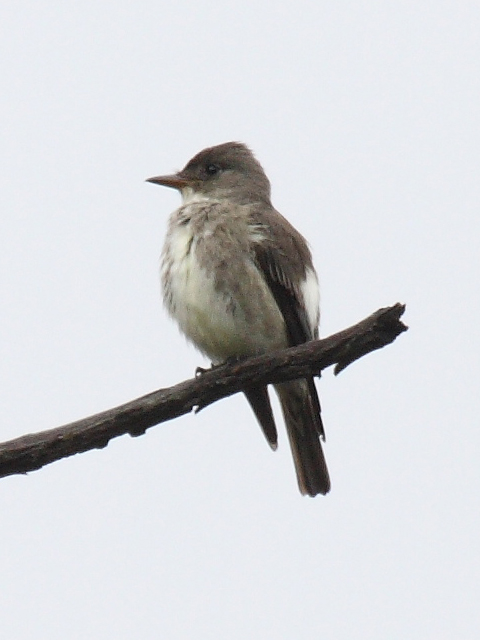
The Olive-sided Flycatcher is a stocky, big-headed bird of cool northern and mountain forests, far more often heard than seen. It famously perches bolt upright on the very tip of a dead snag or the highest bare branch of a conifer, scanning the open air for passing insects. From that lookout it launches long, swooping sallies, snaps up a bee or beetle, and circles right back to the same perch. If you learn one thing about this bird, learn its voice: a ringing, beer-commercial whistle that carries across an entire valley.
Once considered fairly common, the Olive-sided Flycatcher has suffered one of the steeper long-term declines of any North American songbird, and it now carries a Near Threatened conservation label. The reasons are tangled together, from changes on its tropical wintering grounds to shifting forest structure across its breeding range. For backyard birders it is mostly a treat of travel and migration rather than a feeder visitor, but its distinctive song makes it one of the most satisfying boreal and montane birds to add to a list.
This is a large flycatcher with a noticeably big head, short tail, and a "no-neck," top-heavy shape that helps separate it from its smaller cousins even at a distance. The classic silhouette is a broad-shouldered bird sitting straight up on an exposed dead tip, often the tallest point around.
| Sides / flanks | Dark olive-gray streaking down each side of the breast, leaving a pale stripe up the center, like an unbuttoned dark vest over a white shirt |
| Head & throat | Grayish-olive head with a white throat and pale central belly that contrast with the darker sides |
| Shape | Big-headed, short-tailed, broad-chested; sits very upright on exposed perches |
| Wings | Long, pointed wings; faint pale wingbars at best (much weaker than on pewees); often shows white tufts of feathers poking out behind the wing near the rump |
| Bill | Fairly stout for a flycatcher, dark above with a dull orange-yellow lower mandible |
| Size | Clearly larger and chunkier than a wood-pewee or Empidonax flycatcher |
Male vs. female
Males and females look essentially alike, there is no reliable plumage difference you can spot in the field. Both sexes show the same vested sides, white throat, and dark olive upperparts. Males do the singing from the highest, most conspicuous perches, so a bird belting out the full song from a treetop is almost certainly a male, but you cannot sex a silent bird by appearance.
Juveniles
Juveniles and fresh fall immatures resemble adults but are a touch browner overall, with buffy or cinnamon-tinged edges to the wing feathers that can create slightly more obvious wingbars than adults show. The vested pattern on the sides is still present but a bit softer and more diffuse. By the time they reach the wintering grounds the overall look is much like an adult.
The song is unmistakable and is the single best way to find this bird: a clear, ringing three-note whistle most people memorize as "quick, THREE BEERS!" The first note is short and abrupt, the second rises high and emphatic, and the third drops away. It carries an astonishing distance across open forest and is often the first clue a bird is present.
The common call is an evenly spaced, pip-like "pip-pip-pip", three quick, dry, whistled notes that the bird gives between songs and when agitated. Together the loud song and the staccato pip notes make the Olive-sided Flycatcher one of the easier flycatchers to identify by ear, even when it is just a speck on a distant snag.
Olive-sided Flycatchers breed across the boreal forest of Alaska and Canada and southward down the western mountains of the United States, through the Cascades, Sierra Nevada, and Rockies, wherever there are coniferous or mixed forests with openings, burns, bogs, or beaver ponds that provide tall dead snags for perching. They favor the edges of clearings rather than dense unbroken forest.
This is one of the longest-distance migrants among North American flycatchers. Most of the population winters in the Andes and foothills of South America, especially Colombia, Ecuador, Peru, and Panama. Because they arrive late in spring and leave relatively early in fall, the window to find migrants in much of the lower 48 is fairly brief, late spring and again in late summer through early fall, when one may turn up on a tall dead branch in a park, woodlot, or along a wooded edge well outside the breeding range.
The Olive-sided Flycatcher is almost entirely insectivorous and a specialist on flying insects, with a particular fondness for bees, wasps, and other flying Hymenoptera, along with beetles, flying ants, moths, and dragonflies. It is a classic "sit-and-wait" hunter, also called a sallying forager.
From a high, exposed perch it watches the airspace, then launches out on a long, looping flight to snap up prey in midair, often with an audible bill-snap, before returning to the same lookout or a nearby one. These flights can be surprisingly long and acrobatic for such a chunky bird. Because it depends on open air above clearings and water, it concentrates around forest openings, burns, and pond edges where flying insects are abundant.
Nesting takes place in conifers, where the female builds a fairly flat, shallow cup of twigs, lichens, and rootlets, often well out on a horizontal branch and frequently quite high in the tree. The nest is loosely built and can look almost flimsy from below.
A typical clutch is three eggs, sometimes four, pale and lightly speckled with browns toward the larger end. The female does the incubating, which lasts roughly a couple of weeks, while the male defends the territory and stands sentinel from his favorite snags. Both parents feed the young. The pair raises a single brood per season, fitting their entire breeding effort into the short northern and montane summer before the long journey back to South America.
This is not a backyard or feeder bird in any practical sense, it eats only flying insects and never visits seed, suet, or nectar feeders. You attract it by habitat and by going to it, not by stocking a feeder.
- Skip the feeders entirely, it takes only flying insects caught on the wing and will never come to seed, suet, or sugar water.
- If you own forested or edge property in its range, leave dead snags and tall bare branches standing; these exposed perches are exactly what it needs to hunt.
- Look for it around forest openings, burns, bogs, and beaver ponds where flying insects gather, scan the very tops of dead trees.
- Learn the "quick-three-beers" song and listen on late-spring and late-summer mornings; your ears will find it long before your eyes.
- Avoid pesticides on wooded land, reducing flying insects directly removes its food supply.
- During migration, check tall dead branches in parks and along wooded edges, where a lone migrant may pause to hunt.
- Western Wood-Pewee: Smaller and slimmer with a longer tail, more uniform gray sides without the bold vested look, and a burry, descending nasal call rather than the ringing 'quick-three-beers.'
- Eastern Wood-Pewee: Also smaller and longer-tailed with obvious wingbars and plainer sides; its plaintive 'pee-a-wee' whistle is nothing like the three-note beer song.
- Eastern Phoebe: Lacks wingbars and pumps its tail constantly; plainer-faced, gives a raspy 'fee-bee' and lacks the dark vested sides and snag-top hunting style.
- Greater Pewee: A southwestern bird of similar size but grayer overall with a crest and a peaked head; lacks the strong dark-and-white vested sides and gives a very different 'jose-maria' song.
What does the Olive-sided Flycatcher's song sound like?
A loud, clear three-note whistle most birders remember as 'quick, THREE BEERS!' The middle note is the highest and most emphatic, and the song carries a remarkable distance across open forest. Its other common sound is a dry, evenly spaced 'pip-pip-pip.'
How do I tell an Olive-sided Flycatcher from a wood-pewee?
The Olive-sided is bigger, chunkier, and bigger-headed with a short tail and a distinctive 'vested' look, dark olive sides framing a pale center stripe up the breast. Pewees are smaller and slimmer with longer tails, more uniform gray underparts, and obvious wingbars. The songs are completely different, which is the surest way to separate them.
Where can I see an Olive-sided Flycatcher?
In summer, look in boreal and western mountain conifer forests near openings, burns, bogs, and beaver ponds, especially scanning the tops of dead snags. During spring and fall migration, a single bird may pause on a tall dead branch in parks or wooded edges well outside the breeding range.
Why is the Olive-sided Flycatcher declining?
It has shown one of the steeper long-term declines of any North American songbird and is now listed as Near Threatened. The causes are not fully understood but likely include habitat loss on its South American wintering grounds, changes in forest structure on the breeding range, and possibly declines in the flying insects it depends on.
Will an Olive-sided Flycatcher come to my bird feeder?
No. It eats only flying insects caught in midair and will never visit seed, suet, or nectar feeders. The best way to help it on wooded property is to leave dead snags standing as hunting perches and avoid pesticides that reduce flying insects.