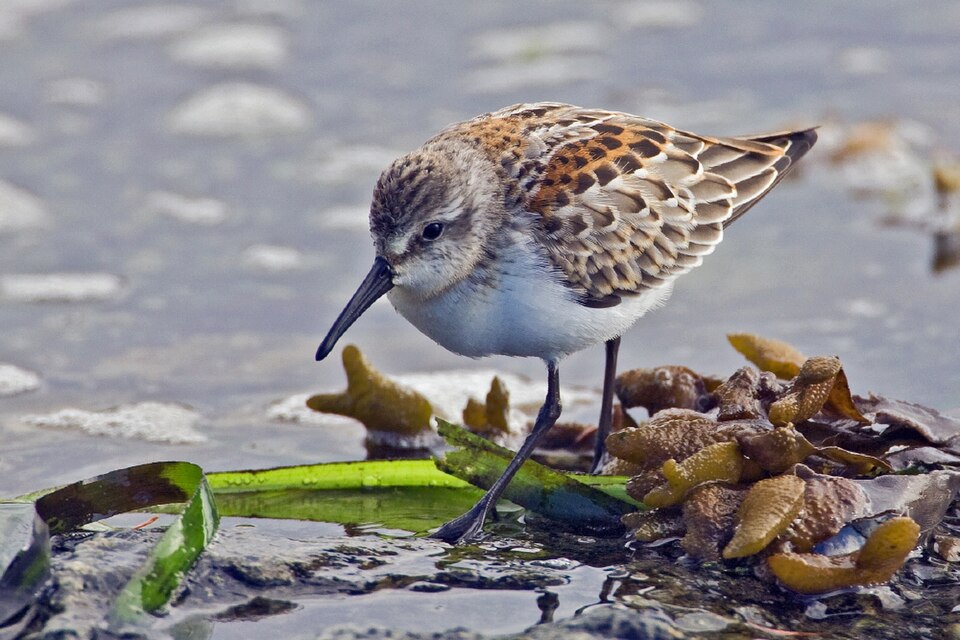
The Western Sandpiper is one of the smallest and most numerous shorebirds in North America, a member of the confusing group of tiny sandpipers collectively nicknamed "peeps." Despite its modest size, this is a heavyweight in sheer numbers: millions funnel along the Pacific coast each spring and fall, and at peak migration a single mudflat or estuary can hold tens of thousands of them swirling in tight, glittering flocks. For many coastal birders, especially in the West, it is the default small sandpiper picking at the wet edge of the tide.
What makes the Western Sandpiper worth a closer look is the puzzle it presents. It looks so much like the Semipalmated Sandpiper and the wintering Dunlin that telling them apart is a rite of passage for shorebird watchers. Learn its slightly drooped bill, its rusty shoulder patches in spring, and its thin, high call, and a wall of anonymous gray birds suddenly resolves into something you can name with confidence. Add in its remarkable migrations from Alaskan tundra to tropical shores, and this little bird becomes a window into one of the great spectacles of the Western Hemisphere.
This is a small, compact sandpiper with a rounded body, short neck, and medium-length black legs. The single most useful structural clue is the bill: it is relatively long for a peep, fairly thick at the base, and droops slightly toward the tip rather than being perfectly straight. Females average longer-billed than males. Size alone won't carry you far in the field, so focus on bill shape, leg color, and plumage details.
| Bill | Black, longish for a peep, thick-based and gently drooping toward the tip |
| Legs | Black (never yellow or greenish), of medium length |
| Breeding plumage | Bright rufous patches on the crown, cheek, and especially the scapulars (shoulders); dark arrow-shaped spots down the flanks |
| Winter plumage | Plain pale gray above, clean white below, a subtle gray smudge on the side of the breast |
| Size | Tiny, sparrow-sized; one of the smallest North American shorebirds |
| Toes | Slight webbing between the toes (partially palmated), shared with Semipalmated Sandpiper |
Male vs. female
Males and females look essentially alike in plumage, and you cannot reliably sex a lone bird in the field by color. The one consistent difference is bill length: females have noticeably longer bills than males, an adaptation that lets paired birds probe at slightly different depths and reduce competition. In a mixed flock you may notice this range of bill lengths, but it takes side-by-side comparison and experience to use it well.
Juveniles
Juveniles, seen mostly in late summer and fall, are the cleanest and freshest-looking of all. They show neatly scalloped upperparts with bright rufous edges to the upper scapulars, contrasting with grayer lower scapulars, creating a distinctive two-toned "split" shoulder. The breast is washed faintly buff or gray with fine streaking confined to the sides, and the underparts are crisp white. This tidy, brightly fringed look helps separate young Westerns from the warmer, more uniformly buff juvenile Semipalmated Sandpipers.
The Western Sandpiper's flight call is a thin, high, slightly buzzy cheet or jeet, higher and finer than the lower, rolling chrup of a Semipalmated Sandpiper. In big flocks these calls combine into a soft, twittering wash of sound as birds lift, wheel, and resettle on the flats.
On the breeding grounds males give a fuller display song during a fluttering, hovering flight over their tundra territory, a buzzy, trilling, churring series often rendered as a repeated zree-zree-zree that rises and falls. Most birders, though, encounter this species only on migration or in winter, where the simple high cheet is what you'll hear and the one to commit to memory.
Western Sandpipers breed in the far north, on tundra in western and northern Alaska and across the Bering Strait into the easternmost reaches of Siberia. After nesting, they undertake one of the most concentrated migrations of any New World shorebird, with the bulk of the population streaming down the Pacific Flyway. The Copper River Delta and other Alaskan staging sites can host astonishing numbers in spring, and famous stopovers like the Fraser River estuary in British Columbia and San Francisco Bay swell with the birds at the peaks of passage.
In winter they spread widely along both coasts of the Americas, from the southern United States south through Mexico, Central America, the Caribbean, and well into South America. They are abundant on the Pacific coast, common along the Gulf and Atlantic coasts, and far scarcer inland, where they turn up at lake edges, flooded fields, and sewage ponds mainly as migrants. In the eastern U.S. they are outnumbered by Semipalmated Sandpipers, which adds to the identification challenge there.
Western Sandpipers feed mainly on small invertebrates pulled from soft mud and shallow water: tiny crustaceans, marine worms, insect larvae, small clams and snails, and the rich films of microscopic life that coat estuarine mudflats. They are versatile foragers, switching between rapid pecking at the surface and probing with that slightly downcurved bill, sewing-machine style, into the wet sediment.
One of their more remarkable feeding habits is grazing on "biofilm", the thin, nutrient-packed layer of diatoms, bacteria, and mucus on the mud surface. Specialized bristly structures on the tongue help them lap up this slimy film, an energy source that can fuel their long migrations. They typically feed in loose, busy flocks at the edge of the receding or advancing tide, spreading across exposed flats and bunching together when the water pushes them off.
Nesting takes place on dry to moist tundra, often near the coast and frequently among dwarf shrubs, sedges, or low ridges that offer a little shelter and a vantage point. The nest itself is a simple shallow scrape on the ground, lined with leaves, lichens, and bits of vegetation, and well concealed beneath low growth.
The female typically lays a clutch of four eggs, pale and marked with brown blotches, arranged points-inward in the classic shorebird fashion. Both parents share incubation. The young are precocial, downy, mobile, and able to feed themselves shortly after hatching, and are tended in the open by the adults. The female often departs first, leaving the male to look after the brood through the final stretch before the young can fly. There is a single brood per season, fitting the short Arctic summer.
The Western Sandpiper is not a backyard or feeder bird, so you won't lure it in with seed or suet. It is a creature of open tidal flats, estuaries, and shorelines, and the way to "attract" it is to go where it lives during migration and winter. The good news is that it is abundant and approachable at the right places.
- Visit coastal mudflats, estuaries, and salt marshes, these are the prime habitats, especially anywhere with a broad, gently sloping tidal flat.
- Time your trip to the tide: a rising or falling tide concentrates the birds at the water's edge where they're easiest to scan; high tide pushes flocks to roost.
- Go during spring (April-May) and fall (July-October) migration on the Pacific coast for the biggest numbers, or in winter along southern coasts.
- Bring a spotting scope, peeps are tiny and often distant, and a scope is the difference between guessing and identifying.
- Scan flooded fields, sewage ponds, and lake margins inland during migration, where small numbers stop to refuel.
- Move slowly and stay low; feeding flocks tolerate patient, distant observers but flush easily when approached head-on.
- Semipalmated Sandpiper: The classic confusion species. Shorter, straighter, blunter bill; grayer and plainer in spring with little rufous; gives a lower, rolling 'chrup' rather than a high 'cheet.' Dominant in the East.
- Least Sandpiper: Even smaller, browner overall, with distinctive yellow-green (not black) legs and a finer, slightly drooped bill. Often feeds higher up on the mud and in vegetated edges.
- Dunlin: Larger and longer-billed with a more pronounced droop; breeding birds show a black belly patch, and winter birds are dingier gray. Often shares flocks with Westerns in winter.
- Sanderling: Slightly larger, paler, with a straight black bill and a habit of chasing waves on sandy beaches. Lacks a hind toe and looks whiter, especially in winter.
How do I tell a Western Sandpiper from a Semipalmated Sandpiper?
Focus on the bill and plumage. Western has a slightly longer, thicker-based bill that droops a touch at the tip, and in breeding plumage it shows bright rufous on the crown, cheeks, and shoulders. Semipalmated has a shorter, straighter, blunt-tipped bill and stays grayer with little rufous. Their flight calls differ too: a high, thin 'cheet' for Western versus a lower, rolling 'chrup' for Semipalmated. In winter the two are extremely similar and bill shape is your best clue.
What does the name 'mauri' mean?
The species name Calidris mauri honors Ernesto Mauri, an Italian botanist of the early 1800s. Calidris is an ancient Greek-derived term used by Aristotle for gray waterside birds, now applied to this whole group of small sandpipers.
Where and when can I see Western Sandpipers?
They are most numerous along the Pacific coast during spring migration (roughly April-May) and fall migration (July through October), gathering on estuaries and mudflats by the tens of thousands. In winter they spread along southern U.S., Mexican, Central, and South American coasts. Inland sightings are uncommon and mostly involve small numbers of migrants at lake edges and flooded fields.
Why do female Western Sandpipers have longer bills than males?
The longer female bill lets the sexes probe at slightly different depths in the mud, which reduces direct competition between mates and may let a pair exploit a richer slice of the food supply. It's a subtle but consistent difference, and one of the few ways plumage-identical sexes can be distinguished.
What is a 'peep' and is the Western Sandpiper one?
'Peep' is a birders' nickname for the smallest sandpipers in the genus Calidris, including Western, Semipalmated, and Least Sandpipers in North America. The name comes from their tiny size and thin, peeping calls. Sorting out the peeps is one of the classic challenges of shorebird watching, and the Western is right in the thick of it.