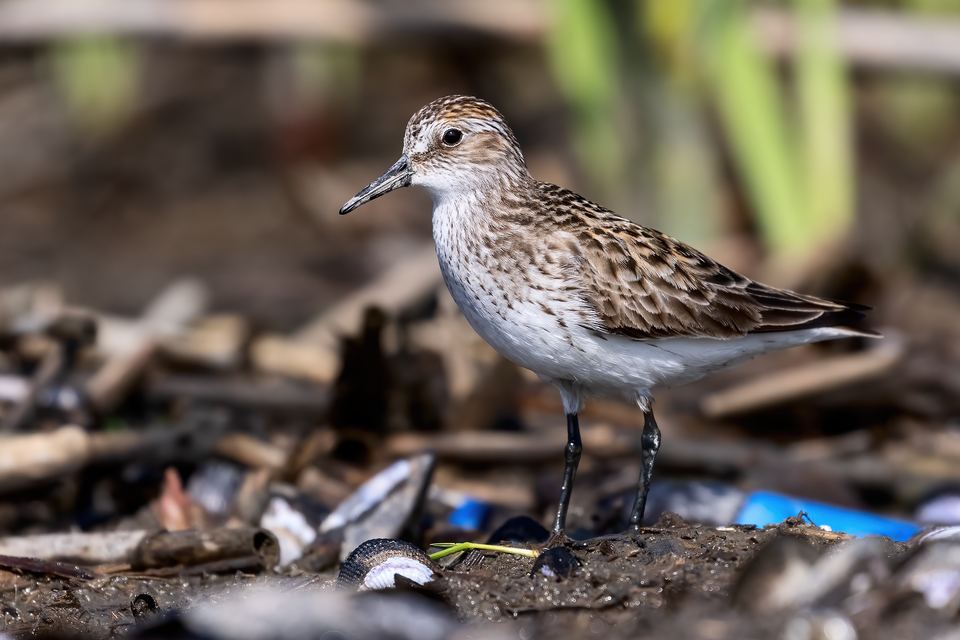
The Semipalmated Sandpiper is one of the most numerous shorebirds in the Western Hemisphere, and for many birders it is the textbook "peep", that maddening little family of sparrow-sized sandpipers that scurry across mudflats in restless flocks. Despite its abundance, it is a bird built around extremes: it nests on the wet tundra of the high Arctic, then flies a staggering nonstop route over the open Atlantic to wintering grounds in South America, fueled almost entirely by the fat it packs on at a handful of critical staging sites like the Bay of Fundy and Delaware Bay.
Its name comes from the partial webbing, "semipalmation", between its toes, a subtle feature you'll almost never see in the field. What you will see is a compact, busy little bird probing wet mud with a short, sturdy bill, often in company with thousands of its own kind. Numbers are still huge, but long-term declines have earned it a Near Threatened listing, making the protection of its few key stopover sites a real conservation priority.
This is a small, dumpy, short-necked sandpiper with a straight, fairly short black bill and black legs. Roughly sparrow-sized, it sits lower and rounder than the slimmer "stints," and its plumage is plain and gray-brown overall, there is no rich rufous, no streaky breast spotting, no long droopy bill. Sorting it from the other peeps comes down to a careful look at the bill, legs, and overall shape rather than any single bold mark.
| Bill | Short to medium, straight, blunt-tipped and black; often looks slightly thicker at the base than a Western Sandpiper's |
| Legs | Black (key for separating it from the yellow-legged Least Sandpiper) |
| Breeding plumage | Plain gray-brown above with modest dark feather centers; clean white belly and a lightly streaked, often grayish wash across the breast |
| Nonbreeding plumage | Very plain gray above, white below, a featureless, gray little peep |
| Shape | Compact and short-necked with a rounded body; stands lower and looks 'front-heavy' compared to slimmer stints |
| Toes | Partial webbing between the toes (semipalmation), diagnostic but rarely visible in the field |
Male vs. female
Males and females look essentially alike in plumage, and you cannot reliably sex one in the field by color or pattern. The one consistent difference is bill length: females average a noticeably longer bill than males, and birds breeding in the eastern part of the range tend to be longer-billed overall. A very long-billed female from the eastern Arctic can approach the look of a Western Sandpiper, which is a classic source of identification headaches.
Juveniles
Juveniles, seen on southbound migration in late summer and fall, are the freshest and neatest-looking Semipalmateds. Their upperpart feathers are crisply edged in pale buff and gray, giving a tidy, scaly pattern, and the breast shows a faint grayish wash rather than heavy streaking. They generally lack the warm rusty tones that brighten juvenile Western and Least Sandpipers, helping reinforce the bird's overall plain, cold-toned impression.
On migration and the wintering grounds, the most familiar sound is the flight call: a short, low, husky cherk or chrup, drier and more grating than the high, thin notes of other peeps. Flocks lifting off a mudflat produce a soft, churring chatter of these notes layered together.
On the breeding tundra, the male gives a very different performance, a sustained, motor-like buzzing or churring song delivered in a fluttering display flight low over his territory, an insect-like trill that carries surprisingly far across the open Arctic.
Semipalmated Sandpipers breed across the low- and sub-Arctic tundra of North America, from Alaska east across northern Canada to Labrador. They are long-distance migrants that winter primarily along the coasts of northern and eastern South America, from the Caribbean and the Guianas south to Brazil, with smaller numbers reaching coastal Mexico and Central America.
Migration is concentrated and dramatic. In spring, huge numbers funnel through interior flyways and the Delaware Bay; in late summer and fall, eastern birds stage in the Bay of Fundy, gorging on tiny mud shrimp to roughly double their body weight before launching on a multi-day, nonstop transoceanic flight to South America. This reliance on a small number of staging sites makes the species especially vulnerable to habitat loss.
Semipalmated Sandpipers feed mainly on small invertebrates: tiny crustaceans, marine worms, insect larvae, mollusks, and the abundant mud shrimp (Corophium) that fuel their famous Bay of Fundy stopover. On migration and in winter they work intertidal mudflats and the edges of shallow pools, while on the breeding grounds they switch to tundra insects and their larvae.
They feed with a quick, busy pecking and probing action, stitching the surface of wet mud with rapid jabs of the bill and sometimes wading belly-deep to glean from the waterline. They also use a "surface-tension" feeding technique, drawing tiny prey up the bill in a film of water. Foraging is highly social, flocks spread out and advance across a flat together, then wheel up in tight, synchronized clouds when a falcon or harrier passes.
Nesting takes place on open, wet Arctic tundra, often near small ponds or marshy edges. The nest is a simple shallow scrape on the ground, lined with bits of grass, sedge, and leaves, and tucked into a low tussock or dwarf vegetation for concealment. The male typically prepares several scrapes, and the pair selects one.
The female usually lays four eggs, buff to olive with dark blotches, in a single brood per season. Both parents share incubation over roughly three weeks. The chicks are precocial, downy and able to leave the nest and feed themselves soon after hatching. The female commonly departs first, leaving the male to attend the brood before he too heads south, so adults often migrate ahead of the juveniles.
This is not a backyard or feeder bird, and there is no realistic way to draw one to a typical yard. It is a long-distance migrant tied to coastal mudflats, tidal estuaries, and shallow wetlands. To see one, you go to the bird rather than the other way around.
- Visit tidal mudflats and estuaries during migration, late April to May, and again from July through September, when flocks stage in large numbers.
- Time your visit to a falling or rising tide, when receding water exposes fresh mud and concentrates feeding birds at close range.
- Check shallow freshwater pools, flooded fields, and sewage-treatment lagoons inland during migration, which can hold surprising numbers of peeps.
- Bring a spotting scope; peeps are tiny and often distant, and separating them from look-alikes needs magnification.
- If you own coastal wetland, protecting tidal flats and minimizing disturbance to roosting flocks does far more for this species than any feeder ever could.
- Western Sandpiper: Longer, slightly drooped bill (especially females), and in breeding plumage shows rufous on the crown, cheeks, and scapulars plus arrow-shaped breast spots; Semipalmated is plainer and shorter-billed.
- Least Sandpiper: Smaller, browner, and crucially has yellowish-green legs rather than black; often feeds higher on the mud and in drier vegetation.
- White-rumped Sandpiper: Larger and longer-winged with wingtips projecting past the tail, and shows a clean white rump in flight; Semipalmated has a dark-centered rump.
- Sanderling: Slightly larger, paler and chunkier, runs in and out with the surf on open beaches, and in nonbreeding plumage is strikingly white below with a black shoulder mark.
What does the name 'Semipalmated' mean?
It refers to the partial webbing between the bird's toes, 'semi' (half) plus 'palmated' (webbed). The webbing is small and rarely visible in the field, so birders almost never identify the species by it; they rely on bill shape, black legs, and overall plain coloration instead.
How do I tell a Semipalmated Sandpiper from a Western Sandpiper?
Look at the bill and plumage tone. Semipalmated has a shorter, straighter, blunter bill and a plain gray-brown look, while Western has a longer, finely drooped bill (especially on females) and, in breeding plumage, rusty tones on the crown and cheeks plus distinct dark chevrons on the breast and flanks.
How do I separate it from a Least Sandpiper?
Check the legs. Semipalmated Sandpipers have black legs, while Least Sandpipers have yellowish-green legs. Least is also smaller, browner, and more likely to feed in drier grassy edges, whereas Semipalmated favors open wet mud.
Where and when can I see Semipalmated Sandpipers?
Look on coastal mudflats, estuaries, and shallow wetlands during migration, roughly late April through May in spring, and July into September in fall. Famous staging spots include the Bay of Fundy and Delaware Bay, where flocks can number in the tens of thousands.
Are Semipalmated Sandpipers endangered?
They remain abundant but have shown significant long-term population declines and are listed as Near Threatened. Because they concentrate at a small number of migration stopover sites to fuel their long flights, they are highly sensitive to habitat loss and disturbance at those key locations.