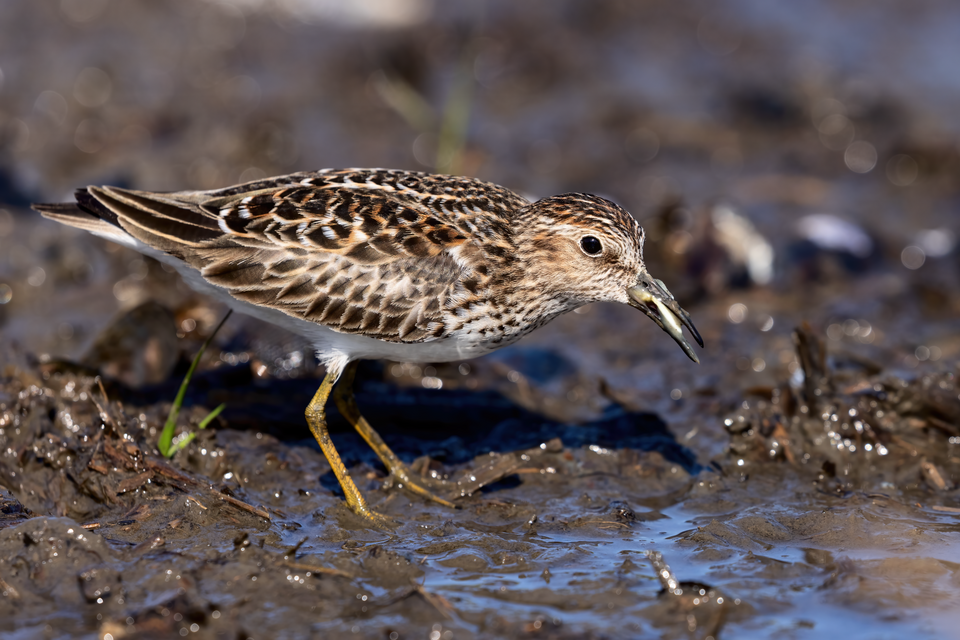
The Least Sandpiper holds a quiet world record: it is the smallest shorebird on the planet, no bigger than a House Sparrow and weighing about as much as a few coins. Despite that tiny frame, it is a long-distance traveler, breeding across the subarctic bogs of Canada and Alaska and wintering as far south as the coasts of Chile and Brazil. For most North American birders, it is one of the "peeps," a confusing group of small, brown, look-alike sandpipers that test even experienced eyes at the water's edge.
What makes the Least Sandpiper special is that, with a little practice, it is actually one of the more identifiable peeps. It tends to feed higher up on the mudflat than its relatives, often picking along the muddy margins and short vegetation rather than the open water line. Its warm brown tones, hunched posture, and a single standout field mark, yellowish-green legs, set it apart from its black-legged cousins once you know to look. It is a bird that rewards patience and a good pair of binoculars.
Think small, brown, and crouched. The Least Sandpiper is a compact peep that often feeds in a low, hunched stance with its head down and back rounded, giving it a slightly stooped silhouette. The bill is short, thin, and slightly drooped at the tip. The single most reliable field mark is leg color: yellowish to greenish-yellow legs, never black, though mud frequently coats them and can hide the color, so check a clean-legged bird.
| Size | Tiniest shorebird, sparrow-sized at about 5-6 in; noticeably smaller than most peeps it mixes with |
| Legs | Yellowish-green to dull yellow, the key mark separating it from black-legged peeps (often mud-coated, so look carefully) |
| Bill | Short, fine, and slightly decurved at the tip; dark |
| Upperparts | Warm brown to rusty-brown back, often scaly-looking; browner overall than the grayer Western and Semipalmated Sandpipers |
| Breast | Brown-streaked wash across the upper breast forming a soft band, contrasting with a white belly |
| Posture | Often feeds in a low, crouched, hunched-over stance, head down, picking at the mud |
Male vs. female
Males and females look essentially identical in the field, and you cannot reliably tell them apart by plumage or color. Females average very slightly larger with marginally longer bills, but the overlap is so wide that this is not a usable field mark for a single bird. Both sexes share the same warm-brown back, streaked breast band, and yellow-green legs throughout the year.
Juveniles
Juveniles, seen during fall migration, are the brightest and most crisply marked Least Sandpipers of all. Their fresh feathers are neatly edged with rusty and buff tones, giving the back a bright, scalloped, scaly appearance, and many show pale lines forming a faint "V" down the back. They tend to look cleaner and more colorful than worn adults, with a buffy wash across the breast. The yellowish legs remain the clinching mark at any age.
The Least Sandpiper's flight call is its most useful sound, a high, rolling, reedy kreee or preeep that rises slightly and has a thin, drawn-out quality. It is higher and more rolling than the flatter calls of other peeps, and flocks lifting off a mudflat give a chorus of these reedy notes. Birders often describe it as a buzzy, ascending jeet or treep.
On the breeding grounds, displaying males give a longer, trilling, undulating song delivered in a fluttering flight over the tundra, a churring, vibrant trill that carries across the bog. Away from the nesting grounds, you are far more likely to hear only the sharp flight calls as birds shuffle around a wetland.
Least Sandpipers breed across the northern reaches of North America, from Alaska eastward through subarctic Canada to the maritime provinces and Newfoundland, favoring wet sedge meadows, bogs, and tundra edges. They are among the earliest shorebirds to head south, with adults beginning to move in late summer and juveniles following into fall.
During migration they turn up across the entire continent, at coastal mudflats, inland lakeshores, flooded fields, sewage ponds, and the muddy margins of almost any wetland. Winter range stretches from the southern United States and the Gulf Coast down through Mexico, Central America, the Caribbean, and into South America. They are one of the most widespread and frequently encountered small sandpipers in the Americas.
Least Sandpipers feed mainly on tiny invertebrates: midge and fly larvae, small crustaceans, aquatic insects, snails, and worms picked from wet mud and shallow water. Unlike longer-billed shorebirds that probe deep, the Least mostly pecks and surface-gleans, working the soft top layer of mud with quick, delicate jabs of its short bill.
A distinctive habit is that it often feeds higher on the flat than other peeps, along grassy edges, drier mud, and vegetated margins rather than the open waterline. It also uses surface tension to draw small prey up the bill, a feeding technique shared with several small sandpipers, and frequently forages in loose flocks that may include other peeps.
Nesting takes place on the northern breeding grounds, where the pair selects a spot on the ground, often a slightly raised, dry hummock surrounded by sedges or low vegetation near water. The nest is a shallow scrape lined with grasses, leaves, and bits of moss, well hidden in the tundra or bog.
The female typically lays four eggs, buff to olive and heavily blotched with brown, arranged points-inward in the cup. Both parents share incubation over roughly three weeks. The downy chicks leave the nest soon after hatching and feed themselves, with the parents standing guard. The female often departs first, leaving the male to tend the brood through the final stretch before the young fledge.
The Least Sandpiper is not a backyard or feeder bird, so you will not draw it in with seed or suet. It needs wet, muddy, open habitat, and the way to enjoy one is to go where it feeds rather than to bring it to you. Still, there are real ways to improve your odds and your views.
- Visit mudflats, shorelines, and flooded fields during spring and fall migration, when peeps move through in numbers.
- Check the muddy and grassy edges of the flat, not just the open water, since Leasts feed higher up than most other peeps.
- If you manage a pond or wetland, exposing shallow mud and gentle margins draws foraging shorebirds; even temporary rain pools and sewage lagoons attract them.
- Bring a spotting scope or good binoculars and look low at the bird's legs, the yellow-green color is your fastest path to a confident ID.
- Go at lower tides or receding water levels, when fresh mud is exposed and feeding activity peaks.
- Western Sandpiper: Black legs, grayer back, longer bill with a slight droop; feeds more in open water and shallows rather than the muddy edges.
- Semipalmated Sandpiper: Black legs, grayer and plainer than the warm-brown Least, with a shorter straight bill; favors open mud and water.
- Baird's Sandpiper: Larger, longer-winged with wingtips extending past the tail, buffier scaly back, and black legs; prefers drier upper edges.
- White-rumped Sandpiper: Larger with long wings projecting past the tail and a clean white rump visible in flight; legs dark, not yellow.
What is the smallest sandpiper in the world?
The Least Sandpiper is the smallest shorebird on Earth, measuring about 5 to 6 inches long and weighing roughly an ounce, similar in size to a House Sparrow. Its tiny size, combined with its yellow-green legs, helps separate it from other small sandpipers.
How do you tell a Least Sandpiper from other peeps?
The fastest clue is leg color. Least Sandpipers have yellowish-green legs, while the very similar Western and Semipalmated Sandpipers have black legs. Leasts also look browner and more hunched, with a short fine bill, and they often feed on the muddy or grassy edge of a flat rather than out in the open water. Watch for mud-covered legs, which can hide the yellow color.
Why do Least Sandpipers have yellow legs?
The yellowish-green leg color is simply a species trait, the natural pigmentation of their legs, and it is one of the most reliable ways to identify them. Among the small peeps, only the Least shows this color; its closest relatives all have black legs. Just be sure to check a bird with clean legs, since fresh mud can mask the color.
Where do Least Sandpipers live?
They breed in the subarctic bogs and tundra of Alaska and Canada, then migrate across all of North America. They winter from the southern United States and Gulf Coast through Mexico, Central America, the Caribbean, and into South America. During migration you can find them at mudflats, lakeshores, flooded fields, and wetland edges almost anywhere.
What do Least Sandpipers eat?
They eat tiny invertebrates such as fly and midge larvae, small crustaceans, aquatic insects, snails, and worms. With their short bills they peck and glean prey from the surface of soft mud and shallow water rather than probing deep like longer-billed shorebirds.