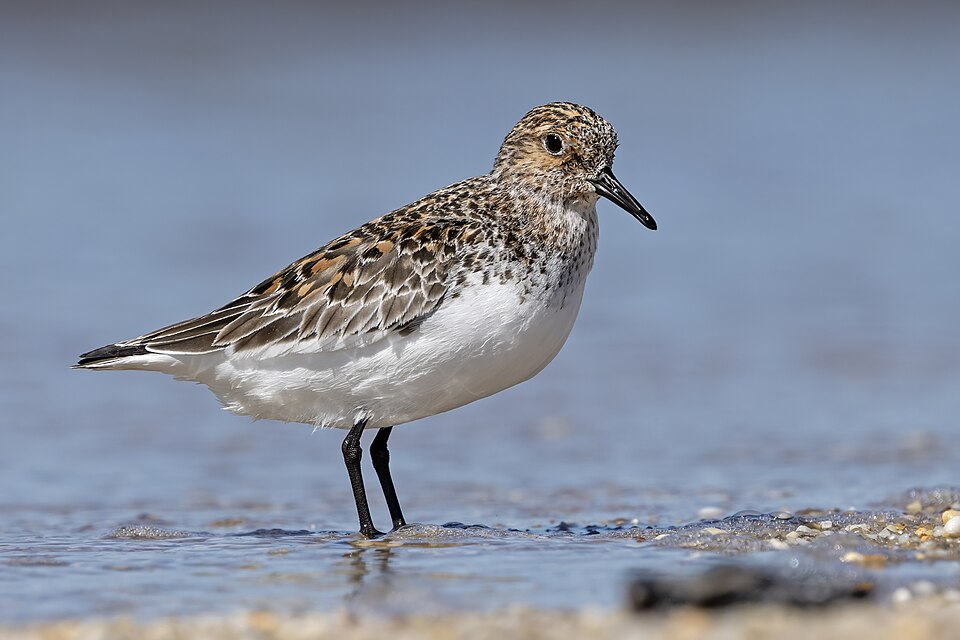
If you have ever stood on an ocean beach and watched a little flock of pale, round-bodied birds sprint down the wet sand after a receding wave, then wheel and scamper back up just ahead of the next one, you have met the Sanderling. No other shorebird plays the surf line quite so obsessively. They run on twinkling black legs like clockwork toys, probing the foam for tiny prey the waves stir loose, and they are one of the few sandpipers nearly anyone can find without a marsh, a scope, or a tide chart, just a beach.
The Sanderling is a true world traveler. It nests on the high Arctic tundra of the far north and winters on sandy coastlines across six continents, from California to Chile, from Britain to South Africa, from India to Australia. The non-breeding bird most North Americans see is the palest sandpiper on the beach, almost ghostly white, which makes it a great gateway species for anyone learning the notoriously confusing small shorebirds known collectively as "peeps."
The Sanderling is a small, plump, medium-sized sandpiper with a straight black bill of moderate length, a rounded head, and short black legs. In its pale winter plumage it is unusually clean and bright for a shorebird, and its frantic wave-chasing run is itself a field mark, no other common beach sandpiper behaves quite like it.
| Winter plumage | Palest of the small sandpipers: gleaming white underparts and very pale gray upperparts, often looking almost white at a distance. |
| Black shoulder mark | A dark patch at the bend of the wing (the 'shoulder') is a key mark, especially on otherwise pale winter birds. |
| Bill and legs | Short, straight, stout black bill and black legs. Crucially, it lacks a hind toe, a detail that separates it from most other peeps. |
| Breeding plumage | Rusty-red head, neck, and breast streaked and spotted with black, contrasting with a white belly. Seen mainly in spring and on the breeding grounds. |
| Flight | Bold white wing stripe flashing against blackish flight feathers, with a white-sided rump, striking in fast, low flocks over the surf. |
| Size and shape | Plump and round-shouldered, larger and chunkier than a Least or Semipalmated Sandpiper, smaller than a Dunlin. |
Male vs. female
Males and females look essentially alike and cannot be reliably told apart in the field. In breeding plumage males often average slightly brighter and more heavily marked with rufous on the head and breast, but there is so much individual variation and overlap that plumage is not a dependable way to sex a Sanderling. In the pale gray-and-white winter plumage that most birders encounter, the sexes are identical.
Juveniles
Juvenile Sanderlings, seen in late summer and fall, are distinctive and rather beautiful: the upperparts are spangled black and white in a checkered, almost pebbled pattern, the crown is dark and streaked, and the underparts are clean white with a faint buffy or peachy wash across the upper breast. This crisp, spangled look is quite different from the smooth gray of winter adults and is one of the more striking juvenile plumages among the small sandpipers.
Sanderlings are not songbirds in the usual sense, and on their wintering beaches they are mostly heard giving short flight and contact calls. The typical call is a sharp, hard "kip" or "plit," often run together into a quick rattling series when a flock flushes, a dry, slightly metallic sound that carries over the noise of the surf.
On the Arctic breeding grounds the male performs a display flight while giving a churring, frog-like or trilling song, sometimes described as a rapid "churr-churr-churr" or a hoarse rattling jingle. Few birders ever hear this; for most of us, the Sanderling's voice is simply that crisp kip from a flock racing low along the waterline.
The Sanderling has one of the largest ranges of any shorebird on Earth. It breeds in the high Arctic, on the tundra of northern Canada, Greenland, and Siberia, in a short, intense summer season. After nesting, the birds undertake very long migrations to spend the rest of the year on sandy coastlines around the globe.
In the Americas, wintering Sanderlings line beaches from the Pacific Northwest and New England south to the tip of South America. Migration is spread across spring and fall, with peak movements along both U.S. coasts and the Gulf, and smaller numbers passing through the interior on the way to and from the Arctic. Because individual birds winter at such wildly different latitudes, you can find Sanderlings on a given beach for much of the year, though numbers swell during migration.
Sanderlings feed largely on small invertebrates churned up by the waves. As a wave retreats, they dash into the wet sand and probe rapidly with a "stitching" motion of the bill, snatching tiny mole crabs (sand crabs), amphipods, marine worms, small mollusks, and other prey before the next wave forces them back up the slope. This run-and-probe rhythm, timed to the swash of the surf, is the heart of their feeding behavior and the reason they seem in perpetual motion.
Away from the open surf they will also pick at mudflats, lagoon edges, and tide wrack, taking insects and their larvae, small crustaceans, and even bits of carrion. On the Arctic breeding grounds, where the sea is no help, they switch to insects, spiders, and some plant material such as seeds and buds. Sanderlings can be feisty around good food, chasing rivals away from a productive patch of sand.
Sanderlings nest on dry, open Arctic tundra, often on stony ground near water. The nest is a simple shallow scrape on the ground, lined sparsely with bits of leaf, lichen, and other tundra vegetation. The clutch is usually four eggs, olive to greenish and spotted with darker markings that camouflage them against the tundra.
Their breeding system is unusual and flexible. A female may lay one clutch tended by the male and a second clutch that she incubates herself, a "double-clutch" strategy that takes advantage of the brief but productive Arctic summer; in other cases a pair shares duties more conventionally. Incubation lasts roughly three to four weeks. The chicks are precocial, downy and able to leave the nest and feed themselves within a day of hatching, though the attending parent broods them and leads them to food. They fledge in a few weeks, in time to begin the long journey south.
The Sanderling is not a backyard or feeder bird, and there is essentially no way to attract one to a typical yard, it is a creature of open sandy ocean beaches and, less often, large lakeshores. The good news is that it is one of the easiest shorebirds to actually go and watch, because it lives right where people walk.
- Go to a wide, sandy ocean beach and watch the surf line itself, Sanderlings work the zone where waves wash up and retreat, not the dry upper beach.
- Time your visit around migration (spring and fall) for the biggest flocks, though wintering birds are present on many coasts for months.
- Move slowly and parallel to the water rather than walking straight at the flock; Sanderlings will tolerate a patient birder surprisingly close.
- Check large inland lakeshores and reservoirs during migration, Sanderlings turn up on sandy beaches far from the ocean.
- On busy recreational beaches, give roosting and feeding flocks space and keep dogs leashed; repeated flushing wastes energy these long-distance migrants can't spare.
- Bring close-focusing binoculars, the birds often work within 30 or 40 feet, so you rarely need a spotting scope.
- Dunlin: Larger and dingier than a Sanderling, with a longer, distinctly drooping bill and (in breeding plumage) a black belly patch. Sanderling's bill is shorter and straight, and winter birds are far paler.
- Semipalmated Sandpiper: Noticeably smaller and grayer-brown with a shorter bill; lacks the Sanderling's clean white winter look and surf-chasing habit. Has a hind toe, which Sanderling lacks.
- Western Sandpiper: Smaller, with a longer, slightly drooping bill and more rufous in breeding plumage. Favors mudflats over the open surf line where Sanderlings dominate.
- Red Knot: Bigger and bulkier with a longer bill and (in spring) a deep rusty-red breast. Knots feed more deliberately and gather on flats rather than sprinting after waves.
Why do Sanderlings chase the waves?
They are feeding. Each retreating wave uncovers wet sand full of tiny mole crabs, worms, and amphipods, so Sanderlings rush in to probe for them and then dash back up the beach to avoid being swamped by the next wave. The constant running is simply the most efficient way to harvest the swash zone.
What is the difference between a Sanderling and a sandpiper?
A Sanderling IS a sandpiper, it's one species in the large sandpiper family. 'Sandpiper' is the broad group name; 'Sanderling' is the specific bird. It stands out as the palest small sandpiper on the beach and the one that famously chases the surf.
Are those white birds running on the beach Sanderlings?
Very likely, yes. On open sandy ocean beaches, the small, pale, plump birds sprinting in and out with the waves on twinkling black legs are almost always Sanderlings in their gray-and-white winter plumage. Few other shorebirds are that pale or behave that way.
Do Sanderlings come to bird feeders or backyards?
No. Sanderlings are coastal shorebirds that eat invertebrates from wet sand and surf, so they have no interest in feeders and won't visit a typical yard. To see one you need to go to a sandy beach or, during migration, a large lakeshore.
Where do Sanderlings go in summer?
They fly north to breed on the high Arctic tundra of Canada, Greenland, and Siberia. There they trade their pale winter coat for a rusty-red head and breast, nest on the open ground, and raise chicks during the brief Arctic summer before migrating back to coastal beaches.