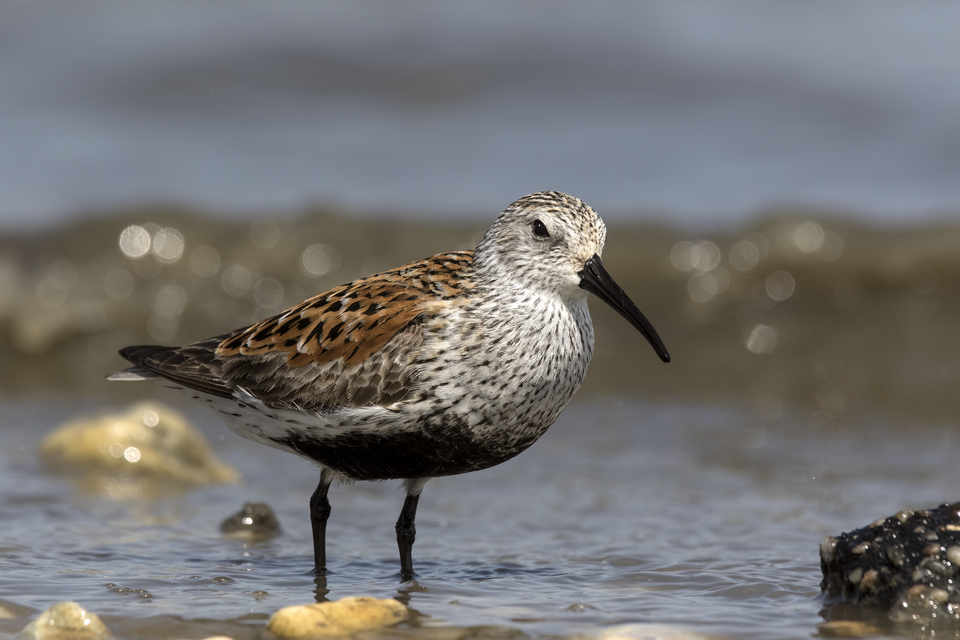
The Dunlin is one of the most numerous shorebirds of the Northern Hemisphere, and for many birders it is the small sandpiper they learn first. In winter it gathers on coastal mudflats, estuaries, and sandy beaches in flocks that can number in the thousands, twisting and turning over the water in tight aerial wheels that flash dark and pale as the birds bank in unison. It is a member of the genus Calidris, the group of small "peeps" and stints, but the Dunlin sits at the larger, dumpier end of that family, with a hunched posture and a bill that gives it away.
What makes the Dunlin special is the dramatic difference between its drab winter self and its handsome breeding plumage. The bird most people see is gray-brown and unremarkable, but on the Arctic tundra it wears a bright rusty back and a startling black belly patch that no other small sandpiper shares. Because Dunlin are so widespread and so abundant, they are an excellent "reference bird" for learning shorebirds: once you know the Dunlin's shape and call, the rarer peeps become much easier to pick out of a crowd.
Look for a small, stocky, somewhat hunch-backed sandpiper a bit larger than a peep but smaller than a Black-bellied Plover. The most reliable structural clue at any season is the bill: long for its body, slightly thicker at the base, and noticeably drooped toward the tip, as if dipped downward at the very end. In flight it shows a thin white wing-stripe and a white-sided rump bisected by a dark line.
| Bill | Longish, black, thick at the base and distinctly drooped at the tip, the key field mark |
| Breeding plumage | Bright rufous back and crown with a bold solid-black belly patch, unique among small sandpipers |
| Winter plumage | Plain gray-brown above, dingy white below with a grayish wash across the breast; no belly patch |
| Size & shape | Stocky and hunched, larger than a peep; about 7 inches with a relatively short neck |
| Legs | Black, medium length |
| In flight | Narrow white wing-stripe and a dark line down the center of a white-sided rump |
Male vs. female
Male and female Dunlin look essentially alike and cannot be reliably told apart in the field. Both sexes wear the same rusty back and black belly in breeding plumage and the same plain gray in winter. On average females are slightly larger with a marginally longer bill, but this overlaps so much between individuals that it is not useful in the field. There is no difference in color or pattern between the sexes.
Juveniles
Juvenile Dunlin, seen mostly during fall migration, are warmer and more patterned than winter adults. They show neat buff and rufous edgings on the back feathers, creating a scaly look, and, importantly, rows of dark streaks and spots scattered across the lower breast and flanks rather than the clean black belly patch of breeding adults. As fall progresses these juveniles molt toward the plain gray winter plumage, so late-season birds can look mixed and worn.
The Dunlin's most familiar sound is its flight call, a harsh, grating, slightly buzzy "kreep" or "treep," often described as rough-edged or reedy compared to the cleaner notes of other peeps. Flocks erupt in a chorus of these scratchy calls when flushed, and learning this single note is one of the fastest ways to pick Dunlin out of a mixed shorebird flock.
On the breeding grounds the male gives a remarkable display song during a fluttering flight over the tundra: a long, descending series of buzzy, trilling, almost mechanical notes, sometimes rendered as a drawn-out "krrreee-krrreee-krrreee" that rises and then reels downward. Away from the Arctic, birders rarely hear anything but the harsh flight call.
The Dunlin breeds across the Arctic and subarctic of North America, Greenland, northern Europe, and Siberia, nesting on wet coastal tundra and boggy uplands. Several distinct subspecies breed in different regions and follow different flyways, which is why Dunlin from Alaska, eastern Canada, and Eurasia can look subtly different in bill length and plumage tone.
In winter it is a coastal bird, abundant along both the Atlantic and Pacific coasts of North America, throughout western Europe, and along the shores of eastern Asia, with some birds reaching as far south as Mexico and the Mediterranean. Dunlin are relatively late fall migrants and among the hardiest small shorebirds, with many lingering on temperate coasts through winter. During migration they also turn up at inland lakes, flooded fields, and large rivers, but the great concentrations are always tidal estuaries and mudflats.
Dunlin feed mainly on small invertebrates pulled from soft mud and wet sand. Their staples include marine worms (especially polychaetes), tiny clams and snails, amphipods, small crustaceans, and insect larvae; on the breeding tundra they switch to insects such as midges and crane fly larvae. They probe rapidly and repeatedly with that sensitive drooped bill, often working with a quick "stitching" motion, and they also pick prey from the surface.
Feeding is tightly tied to the tides. Dunlin spread out to forage on exposed mud as the tide drops and pack into dense roosts as it rises, frequently feeding shoulder to shoulder with other shorebirds. Their probing rhythm and habit of scattering across open flats, rather than running at the water's edge, helps separate them from plovers nearby.
Dunlin nest on open Arctic and subarctic tundra, choosing wet meadows, sedge bogs, and grassy hummocks. The nest is a simple shallow scrape on the ground, often tucked into a grass tussock and lined with leaves and fine vegetation, which conceals the eggs and the incubating bird remarkably well.
The typical clutch is four eggs, pale with dark blotches, laid in a single brood per season. Both the male and female share incubation over roughly three weeks, and both tend the young. The chicks are precocial, down-covered and able to leave the nest and feed themselves soon after hatching, with the parents guarding and brooding them. Females often depart the breeding grounds first, leaving males to finish escorting the young.
The Dunlin is not a backyard or feeder bird, so there is no way to draw one to a yard with seed or suet. It is a specialist of open tidal mud, sand, and shoreline, and it visits feeders or gardens essentially never. Instead of attracting it, the goal is to go find it, and that is easy in the right place and season.
- Go coastal in winter. Estuaries, tidal mudflats, and wide sandy beaches along the Atlantic and Pacific coasts host the biggest flocks from late fall through early spring.
- Time the tide. Arrive on a falling or low tide when mud is exposed and birds are spread out feeding; a rising tide pushes them into dense, viewable roosts.
- Scan flocks for the bill and belly. Look for the drooped bill year-round and the black belly patch in spring, it instantly separates Dunlin from other small sandpipers.
- Bring a scope. Flocks are often distant on open flats, and a spotting scope turns a gray smudge into a countable, identifiable group.
- Watch the wheeling flocks. A tight, fast-banking flock flashing dark-then-pale over the water is a classic Dunlin spectacle, especially when a falcon is hunting nearby.
- Check inland during migration. Flooded fields, sod farms, and lake edges can pull in migrant Dunlin away from the coast in spring and fall.
- Western Sandpiper: Much smaller (a true peep) with a thinner, only slightly drooped bill; lacks the Dunlin's solid black belly and bulky, hunched build.
- Curlew Sandpiper: Similar drooped bill but slimmer and longer-legged, with a clean white rump in flight (Dunlin's rump is dark-centered); breeding adults are rich brick-red below, not black-bellied.
- Sanderling: Paler and chunkier with a straight, stubby black bill; chases retreating waves on sandy beaches and shows a bold white wing-stripe, never a drooped bill or black belly.
- Black-bellied Plover: Much larger and round-headed with a short stout bill; a plover that runs-and-pauses rather than probing, and shows black 'wingpits' in flight.
How do you identify a Dunlin?
Look for a small, stocky, hunch-backed sandpiper with a longish black bill that droops at the tip. In breeding plumage it has a rusty back and a bold black belly patch unique among small sandpipers; in winter it is plain gray-brown above and dingy white below. The harsh, buzzy 'kreep' flight call is also distinctive.
Why is it called a Dunlin?
The name 'Dunlin' is thought to come from 'dun,' an old word for a dull grayish-brown color, with a diminutive ending, essentially 'the little dun-colored bird.' It fits the plain gray-brown winter plumage in which the species is most often seen.
What is the black-bellied sandpiper?
That is a common nickname for the breeding-plumage Dunlin. In spring and summer the Dunlin develops a solid black patch on its lower belly, which no other small sandpiper has, making 'black-bellied sandpiper' an easy way to describe it. Note this is different from the Black-bellied Plover, a much larger bird.
Where and when can I see Dunlin?
Along temperate coasts, Dunlin are most common from late fall through early spring on tidal mudflats, estuaries, and beaches, often in large flocks. They breed on Arctic tundra in summer, so to see them in their bright black-bellied plumage you would need to catch them on migration in spring or visit the far north.
Are Dunlin endangered?
Dunlin are listed as Least Concern and remain one of the most abundant shorebirds in the world, but several populations have declined, largely due to the loss and degradation of coastal wetlands and estuaries that they depend on for feeding. Protecting tidal habitat is the main conservation concern.