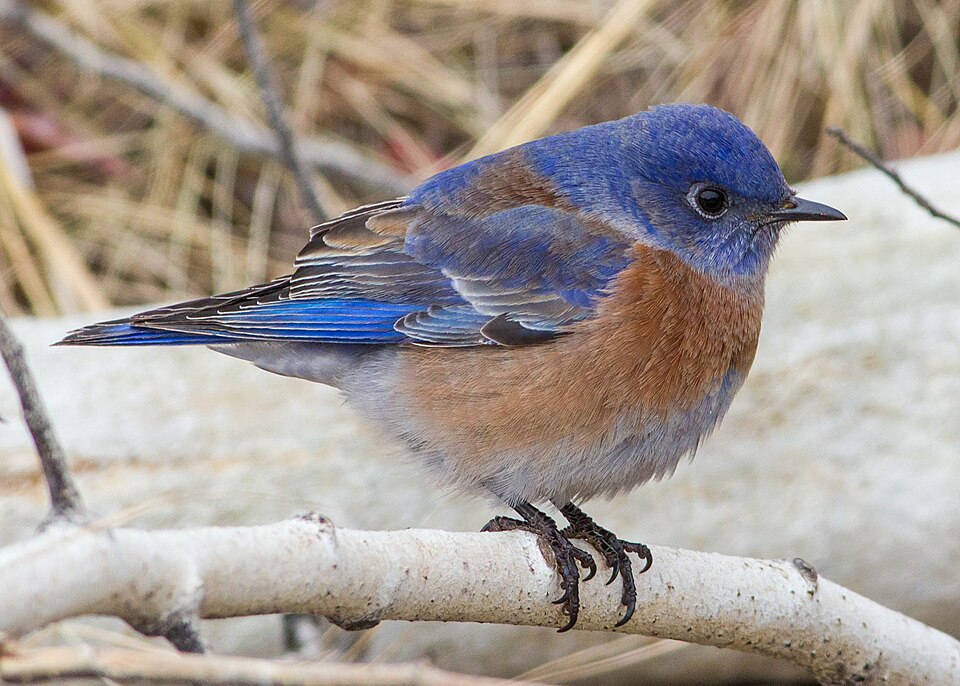
The Western Bluebird is a small, plump thrush of the western United States, Mexico, and the dry interior of the West, the regional counterpart to the more famous Eastern Bluebird. Males are a rich, almost violet-blue above with a warm chestnut wash across the breast and shoulders, while females wear a softer, grayer version of the same pattern. You will most often spot one perched upright on a fence wire, a low snag, or a roadside post, scanning the ground below before dropping down to grab an insect. It is a bird of edges and openings: oak savanna, open pine and pinyon-juniper woodland, burned forest, ranchland, orchards, and the grassy margins of suburbs.
Western Bluebirds matter to backyard birders and land stewards alike because they are enthusiastic cavity nesters that readily accept nest boxes. Across much of the West, bluebird trails and box programs have helped local populations recover from the loss of natural cavities and competition with introduced starlings and House Sparrows. They are social, often traveling in loose family groups or small winter flocks, and their gentle, low-key calls and habit of clustering on a wire make them one of the most rewarding birds to learn in open western country.
Look for a small, round-headed, big-eyed thrush that perches very upright, often hunched, with a short tail and a posture more compact than a robin. At a glance the male reads as simply "blue and rusty," but the details of where the chestnut and gray fall are what separate this species from its relatives.
| Male upperparts | Deep, saturated blue on head, back, wings, and tail |
| Male underparts | Chestnut-rust breast and flanks; blue (not rusty) throat; gray belly and undertail |
| Chestnut shoulders | Rusty patch often visible across the upper back/scapulars, unlike Eastern Bluebird |
| Female | Soft gray-brown overall with bluish wash in wings and tail and a muted orange-buff breast |
| Shape | Plump, round-headed, upright posture; short tail and thin bill |
| Size | Sparrow-sized, noticeably smaller and chunkier than an American Robin |
Male vs. female
Males and females are distinguishable with a decent look. The male is unmistakably bright: glossy deep blue covering the head, throat, back, wings, and tail, set against a chestnut breast and shoulders and a grayish belly. The blue throat is a key mark, since the closely related Eastern Bluebird has a rusty throat. The female is far more subdued, a gentle gray-brown on the head and back with only a blue tint glowing in the wings and tail, and a pale, washed-out orange across the breast. In poor light a female can look almost plain gray, so watch for the soft blue in the flight feathers as she moves.
Juveniles
Juveniles look strikingly different from adults and confuse many first-time observers. Fresh out of the nest they are heavily spotted, with a grayish-brown body marked by pale spots and scaling on the breast and back, the classic "spotted thrush" look that places them in the same family as robins. They show blue in the wings and tail from early on, which is the best clue to their identity. As summer wears on, young males begin showing patches of adult blue and chestnut, giving them a mottled, patchwork appearance through their first fall.
Western Bluebirds are soft-voiced and easy to overlook by ear. The most common sound is a mellow, slightly nasal few or phew call, often given as a gentle kew-kew when birds keep in contact within a flock or family group. It carries a relaxed, almost conversational quality rather than anything loud or insistent.
The song is a short, low, warbled series of these soft notes, sometimes rendered as chuk chuk few few, typically delivered quietly at dawn during the breeding season. It is far less musical and carrying than the rich caroling of an American Robin, and you are often more likely to hear the simple contact calls of a passing flock than a full song.
Western Bluebirds range across the western United States and into Mexico. Breeding birds occupy the Pacific states, the Southwest, the Great Basin, the Rocky Mountain region, and the mountains and oak country of Mexico. They favor open woodland with grassy ground for foraging, from coastal oak savanna and chaparral edges to montane pine and pinyon-juniper forests, often shifting to lower elevations in winter.
Movement is partial and altitudinal rather than dramatic long-distance migration. Many populations along the Pacific coast and in mild lowlands are year-round residents, while mountain breeders typically drop downslope to warmer valleys and foothills for the winter. In the cold months they gather in loose flocks, sometimes mixing with other bluebirds, and wander in search of berry-rich habitat such as juniper, mistletoe, and elderberry.
In the warmer months Western Bluebirds are primarily insectivores, and their hunting style is a pleasure to watch. They perch on a low wire, fence post, or bare branch, scan the ground intently, then drop straight down to seize a grasshopper, beetle, caterpillar, ant, or spider before flying back up to a perch, a technique called drop-foraging or "ground sallying." They will also snatch flying insects from the air.
As insects become scarce in fall and winter, the diet shifts heavily toward fruit. Berries of juniper, mistletoe, elderberry, sumac, grape, and other native shrubs become staples, and access to good berry crops largely dictates where wintering flocks settle. This seasonal flexibility, hunting insects in summer and switching to fruit in winter, is a big reason the species thrives across such varied western habitats.
Western Bluebirds are secondary cavity nesters, meaning they cannot excavate their own holes and instead rely on old woodpecker holes, natural tree cavities, and nest boxes. The female builds a loose cup of grasses, weed stems, and pine needles inside the cavity, sometimes lined with finer material. Pairs often favor open situations with nearby perches and short grass for foraging, which is exactly why fence-line nest boxes work so well.
The female lays a clutch of pale blue (occasionally white) eggs and does most or all of the incubation, while the male helps feed her and later the young. Western Bluebirds frequently raise two broods in a season, and they are notable for cooperative breeding: in some pairs, helpers, often young from an earlier brood, assist in feeding nestlings. Both parents work hard to deliver a steady stream of insects to the growing chicks.
Yes, the Western Bluebird is one of the most attractable birds in the West, though not through a typical seed feeder. They come for nest boxes, water, native berries, and live food rather than sunflower seed, so a bluebird-friendly yard is really about habitat and the right offerings.
- Put up a nest box with a 1.5-inch entrance hole mounted on a pole 4-6 feet up, facing open ground, ideally along a fence line or field edge away from dense brush.
- Offer live or dried mealworms in an open dish or platform feeder; this is the single most reliable way to draw bluebirds in, especially during nesting season.
- Provide water, particularly a shallow, moving source like a bubbler or dripping bath; bluebirds are strongly drawn to the sight and sound of water.
- Plant native berry shrubs and trees such as elderberry, juniper, serviceberry, and sumac to feed wintering flocks.
- Keep an open, short-grass area with low perches nearby so birds can drop-hunt for insects; avoid pesticides that wipe out their prey.
- Use a sparrow-resistant box design and monitor it, since House Sparrows and starlings compete aggressively for the same cavities.
- Eastern Bluebird: Nearly identical in shape, but the male has a rusty (not blue) throat and lacks chestnut on the back; ranges barely overlap, mostly meeting in the southern Great Plains.
- Mountain Bluebird: Male is sky-blue all over with no chestnut at all; female is grayer with blue wings and lacks the warm orange breast. Often hovers while hunting.
- Lazuli Bunting: A finch, not a thrush; smaller with a conical seed-eating bill, white wingbars, and a sharper turquoise blue. Sings a lively, bright song unlike the bluebird's soft notes.
- American Robin: Much larger with a long tail, gray-brown (not blue) back, and a fuller rusty breast; shares the upright thrush posture but is far bigger and louder.
What is the difference between a Western Bluebird and an Eastern Bluebird?
The easiest mark is the throat: a male Western Bluebird has a blue throat, while a male Eastern Bluebird has a rusty-orange throat. Western Bluebirds also usually show chestnut on the shoulders and upper back, whereas Eastern Bluebirds have an all-blue back. Their ranges barely overlap, so location is a strong clue too.
How do I attract Western Bluebirds to my yard?
Put up a nest box with a 1.5-inch hole in open habitat, offer mealworms on a platform or dish, provide a shallow water source or bubbler, and plant native berry shrubs like elderberry and juniper. They rarely visit seed feeders, so live food, water, and nest boxes are the keys.
What do Western Bluebirds eat?
In spring and summer they eat mostly insects such as grasshoppers, beetles, caterpillars, and ants, which they catch by dropping to the ground from a perch. In fall and winter they switch heavily to berries, including juniper, mistletoe, elderberry, and sumac.
Will Western Bluebirds use a nest box?
Yes, very readily. They are cavity nesters that cannot make their own holes, so a properly sized box (1.5-inch entrance) mounted on a pole in open country is highly attractive. Nest box programs and bluebird trails have helped support populations across the West.
What color are Western Bluebird eggs?
They are typically pale blue, though some clutches are white. The female usually lays several eggs per clutch and often raises two broods in a season, doing most of the incubation while the male helps feed.