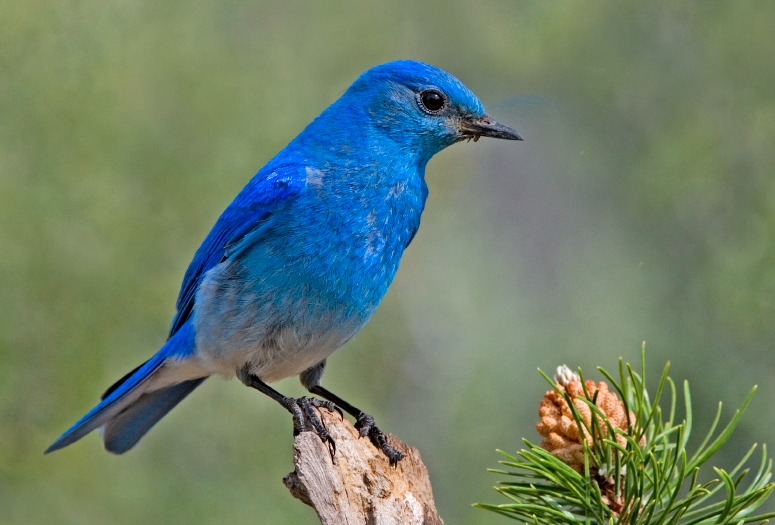
Few North American birds deliver a jolt of color quite like a male Mountain Bluebird. Where the Eastern and Western bluebirds wear rusty breasts, the male Mountain is sky-blue from head to tail, the kind of pure cerulean that looks almost unreal hovering over a sagebrush flat or a high mountain meadow. It is a bird of wide-open western country: short-grass prairie, alpine meadows above treeline, recently burned forest, ranchland, and high desert dotted with junipers. Wherever there is open ground to hunt over and a cavity to nest in, you have a good chance of finding one.
Mountain Bluebirds are thrushes, close cousins of the American Robin, and they share that family's upright posture and gentle disposition. They are best known for a distinctive feeding style: hovering on fluttering wings several feet above the grass before dropping onto an insect, almost like a tiny blue kestrel. Conservation-minded birders have a special fondness for them because, like other bluebirds, they readily accept nest boxes. Decades of "bluebird trails", long lines of boxes maintained by volunteers across western ranchland, have helped this species hold steady even as natural nesting cavities have grown scarce.
Mountain Bluebirds are slim, small-headed thrushes a touch larger and longer-winged than the other two North American bluebirds. They sit upright on fences, wires, and tall weed stalks, and they look notably long and slender in flight. The single most useful field mark is the color: this is the only bluebird without any rusty orange on the breast.
| Male color | Brilliant sky-blue overall, slightly paler and whiter on the belly. No rusty breast. |
| Female color | Soft gray-brown body with blue washing into the wings, tail, and rump. |
| Shape | Slim and small-headed with proportionately long wings; upright thrush posture. |
| Bill | Thin, straight, all-black bill typical of an insect-eating thrush. |
| Belly | Whitish on the lower belly and undertail in both sexes, fading from the blue or gray above. |
| Behavior cue | Frequently hovers over open ground before dropping on prey, unique among the bluebirds. |
Male vs. female
The sexes look quite different. The male is unmistakable: an even, glowing sky-blue across the head, back, wings, and tail, turning paler and whiter toward the lower belly, with no trace of the orange or chestnut found on Eastern and Western bluebirds. The female is much plainer, an overall gray-brown with a soft, dovelike tone, but she gives herself away with cool blue tints that wash into the wings, rump, and tail, brightening especially in flight. In good light some females also show a faint paler eye-ring and a hint of warm buff on the throat.
Juveniles
Juveniles, like all young thrushes, are heavily spotted below, showing pale gray-brown plumage marked with whitish scaling and speckling on the breast and back. They lack the adults' clean coloring but still flash blue in the wings and tail, which points to their identity. As summer progresses they molt toward adult-like plumage, with young males beginning to show increasing blue and young females settling into the muted gray-brown of the adult hen.
The Mountain Bluebird is a quiet singer compared with many thrushes. Its song is a short, low, warbling phrase, a soft, slightly burry series of chur or tru-lee notes, often delivered well before dawn from a high perch or even in flight. It carries a mellow, unhurried quality rather than the rich fluting of a robin or hermit thrush.
The common call is a low, gravelly chur or tew, frequently given as birds move between perches or keep contact with a mate. You may also hear a thin, slightly nasal fee note. None of the calls are loud, so on a windy western flat you often spot the bird before you hear it.
Mountain Bluebirds are birds of western North America. They breed from Alaska and western Canada south through the Rocky Mountains and Great Basin into the higher country of the western United States, favoring open landscapes at moderate to high elevations, mountain meadows, sagebrush steppe, alpine grassland, and burned or logged forest openings. In summer they push to surprisingly high altitudes, sometimes nesting above treeline.
They are migratory across most of their range. In fall they move downslope and south, wintering across the southwestern United States and well into Mexico, where loose flocks roam open grasslands and desert valleys, often gathering at fruiting junipers and mistletoe. During migration and winter wandering, individuals occasionally turn up far east of the normal range, which makes a stray Mountain Bluebird a prized find for birders in the central and eastern states.
In the warmer months Mountain Bluebirds are primarily insect eaters, taking grasshoppers, beetles, caterpillars, ants, crickets, and other invertebrates. Their signature hunting move is hovering: a bird will hang on rapidly beating wings several feet above the grass, scanning, then drop straight down to seize prey on the ground. They also hunt from a perch in classic bluebird fashion, sallying out to grab insects in the air or pouncing on them in the open. This reliance on open ground for foraging is exactly why they favor sparse, low vegetation.
In fall and winter, when insects vanish, they shift heavily to fruit, feeding on the berries of junipers, mistletoe, sumac, hackberry, currants, and other shrubs. This seasonal switch lets wintering flocks survive in dry country where little else is moving, and it explains why a fruiting juniper can suddenly host a scattering of bluebirds on a cold morning.
Mountain Bluebirds are cavity nesters. They cannot excavate their own holes, so they depend on old woodpecker holes, natural cavities in trees and cliffs, and, very willingly, nest boxes. The female builds a loose cup of grasses, plant stems, and fine fibers inside the cavity, sometimes adding feathers or hair, while the male accompanies her and defends the territory but does little of the actual building.
She typically lays four to eight pale blue (occasionally whitish) eggs and does the incubating herself over roughly two weeks. Both parents feed the nestlings, which leave the cavity about three weeks after hatching. In the long summers of lower elevations a pair may raise two broods, and fledged young from an early brood have been known to help feed a later one. Competition for cavities is fierce, Tree Swallows, House Sparrows, and other bluebirds all want the same holes, so nest-box landlords play an outsized role in this bird's success.
Mountain Bluebirds are not seed-feeder birds, so you won't lure them with sunflower or millet. But if you live within their open-country range in the West, they are one of the most rewarding birds you can attract, chiefly through nest boxes and the right kind of habitat. They need open ground and a cavity; supply both and you have a real chance.
- Put up a nest box with a 1 9/16-inch entrance hole, mounted 4-6 feet up on a post or fence in open habitat, they prefer expansive, low-vegetation settings over wooded yards.
- Place boxes along fence lines bordering pasture, sagebrush, or meadow, and space multiple boxes well apart to reduce territorial squabbles; pairing boxes can also reduce conflict with Tree Swallows.
- Skip the seed and instead offer live or dried mealworms on a platform or open dish, especially during the breeding season when adults are feeding young.
- Provide a ground-level or shallow birdbath; bluebirds use water for drinking and bathing more reliably than they use feeders.
- Plant or preserve native berry shrubs, junipers, sumac, currants, and hackberry, to draw migrating and wintering birds.
- Add perches like a fence wire or a tall snag near the box so birds have a hunting lookout over open ground.
- Western Bluebird: Male has a deep blue head and a rusty-orange breast and upper back; Mountain males are pure blue with no rust at all.
- Eastern Bluebird: Male shows a brick-red breast and throat with a white belly; range overlaps little with Mountain, which is plainer blue and unmarked below.
- Lazuli Bunting: A much smaller finch-like bird; the male has a turquoise hood but a cinnamon breast and bold white wing bars, plus a thick seed-eating bill.
- Blue Grosbeak: Deeper, more purple-blue with rusty wing bars and a heavy conical bill, nothing like the slim, thin-billed bluebird.
How do I tell a Mountain Bluebird from a Western Bluebird?
Look at the breast. A male Mountain Bluebird is sky-blue all over with no rusty color, while a male Western Bluebird has a distinct rusty-orange breast and often a rusty patch on the back. Females are trickier, but the Mountain female is grayer overall and shows colder, paler blue tones, whereas the Western female has warmer, more orange-tinged underparts.
Why do Mountain Bluebirds hover?
Hovering is their signature hunting style. A bird hangs on fluttering wings a few feet above open ground, scans for insects, then drops straight down to grab them. This lets them hunt over sparse grassland where there may be few good perches, and it's a quick way to tell them from the other bluebirds, which hunt mostly from perches.
What kind of nest box attracts Mountain Bluebirds?
Use a box with about a 1 9/16-inch entrance hole, mounted 4-6 feet up on a post or fence in open habitat with short vegetation and a nearby perch. They favor wide, treeless country over wooded backyards, so the more open the surroundings, the better your odds.
What do Mountain Bluebirds eat?
In spring and summer they eat mostly insects, grasshoppers, beetles, caterpillars, ants, and crickets, caught by hovering or sallying from a perch. In fall and winter they switch heavily to berries such as juniper, mistletoe, sumac, and hackberry, which lets wintering flocks survive in dry country.
Where do Mountain Bluebirds go in winter?
Most move downslope and south, wintering across the southwestern United States and into Mexico in open grasslands and desert valleys, often gathering at fruiting junipers. Some wander east of their normal range, so a stray Mountain Bluebird is a notable sighting for birders in the central and eastern states.