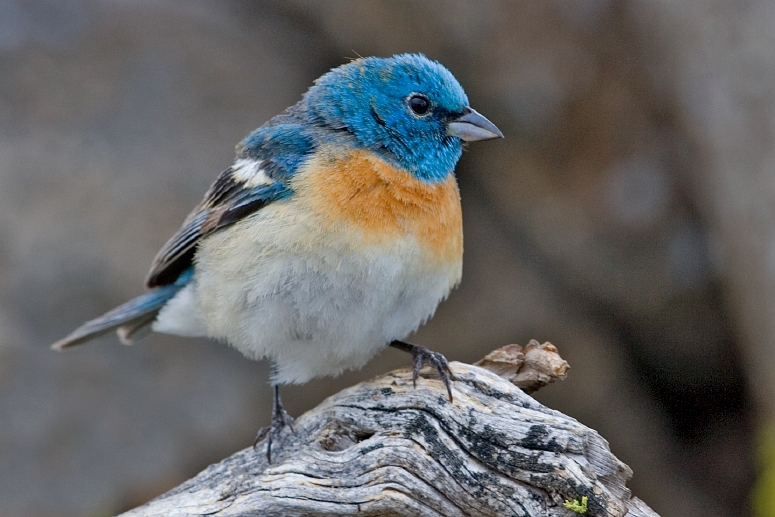
The Lazuli Bunting is one of the most photogenic songbirds of the American West, a small finch-billed bird that males wear in spring like a piece of polished turquoise. Named for the deep blue gemstone lapis lazuli, the breeding male combines a sky-blue head and back with a warm cinnamon breast band and a clean white belly, a color scheme that looks almost painted on. It is a close relative of the Indigo Bunting, and where their ranges overlap on the Great Plains the two species sometimes interbreed.
Despite its tropical-looking plumage, the Lazuli Bunting is a bird of dry, shrubby, sun-baked country: chaparral, brushy hillsides, streamside thickets, weedy old fields, and the brush that springs up after a wildfire. It is a long-distance migrant that breeds across much of the West and winters in western Mexico. Backyard birders within its range stand a real chance of luring one in, because this bunting readily visits feeders stocked with small seed, especially during spring migration.
This is a small, compact songbird about the size of a House Finch, with a short conical seed-cracking bill, a fairly short notched tail, and a rounded head. Even when the brilliant blue is hidden, the bold whitish wingbars are one of the most reliable marks to look for.
| Breeding male | Bright turquoise-blue head, throat, and upperparts; broad cinnamon-orange breast band; clean white belly |
| Wingbars | Two whitish wingbars, the upper one bolder and wider; visible in all plumages and a key field mark |
| Female | Warm grayish-brown overall, palest on the belly, with a faint buffy wash on the breast and subtle wingbars; often a hint of blue in the wings and rump |
| Bill | Short, thick, conical; pale grayish lower mandible, typical of a seed-eating bunting |
| Size & shape | Small and compact, roughly House Finch sized, with a rounded head and short notched tail |
| Tail & rump | Male's rump and tail wash blue; females show a soft bluish tint to the rump and shoulders |
Male vs. female
The sexes look strikingly different in breeding plumage. The male is unmistakable: an intense turquoise-blue hood and back, a rusty cinnamon band across the upper breast, and a white belly. The female is far more subdued, a plain warm grayish-brown bird with a paler belly, a faint buffy breast, and only a whisper of blue in the wings, shoulders, and rump. Her two pale wingbars and overall warm tone help separate her from other drab finches. In fall and winter, males molt into a duller, more scaled-looking plumage with brownish feather edges veiling the blue, but they still show the cinnamon breast and bold wingbars.
Juveniles
Juveniles and first-year birds resemble the adult female: a soft brown bird with a lightly streaked or smudgy breast and pale wingbars. Young males begin showing patchy blue feathering as they molt, so a bird in spring that looks like a brown female blotched with bits of turquoise is almost certainly a first-spring male still acquiring adult colors. These immature males can sing and breed even while their plumage looks unfinished.
The male's song is a bright, jumbled warble of paired phrases, typically delivered from an exposed perch atop a shrub or small tree. It has a hurried, slightly squeaky quality, often described as a series of sweet, rising-and-falling notes in couplets, something like sweet-sweet, chew-chew, seet-seet, zeeer. Each male tends to sing his own signature arrangement of phrases, and young males learn their songs from neighbors, so local "song neighborhoods" develop where nearby males share similar phrasing.
The common call note is a sharp, dry spit or pit, and birds also give a thin, buzzy flight note. Compared with the Indigo Bunting's song, the Lazuli's tends to sound a bit less evenly paired and a touch buzzier in places, though the two are similar enough that song alone is not always conclusive where they overlap.
The Lazuli Bunting breeds across much of western North America, from southern British Columbia and the northern Rockies south through the Great Basin, the Pacific states, the Southwest, and into the western Great Plains. Its range butts up against the Indigo Bunting's on the central plains, where mixed pairs and hybrids occur. It favors brushy, semi-open habitats at low to middle elevations.
It is a complete, long-distance migrant. Birds leave the breeding grounds in late summer and winter in western Mexico, where many undergo a remarkable molt-migration: they pause at monsoon-greened stopover sites in northwestern Mexico and the Southwest to molt before continuing south. Spring migration brings them back north from roughly April into May, which is also the best window to catch one at a feeder.
Lazuli Buntings eat a mix of small seeds and insects, shifting with the seasons. In the breeding season they take many insects and other small invertebrates, including caterpillars, beetles, grasshoppers, and ants, which provide the protein needed for nesting and feeding young. Seeds from grasses and weedy forbs make up much of the rest of the diet, and they will also eat berries and other small fruits.
They forage low, hopping through brush and weeds and along the ground, picking food from foliage and seed heads. During migration and at feeders they are especially fond of small grains and grass seeds, and you will often see them clinging to weed stalks or shuffling through low vegetation rather than feeding high in trees.
The female builds the nest, a fairly loose open cup of grasses, weed stems, and plant fibers bound with spider silk and lined with finer material and sometimes hair. It is usually placed low in a dense shrub, vine tangle, or weedy thicket, typically only a few feet off the ground and well hidden in cover near edges or openings.
She lays a clutch of pale bluish or whitish unmarked eggs and does almost all of the incubation, with the male helping feed the nestlings once they hatch. Pairs often raise two broods in a season where the climate allows. Like other open-cup nesters of brushy edges, Lazuli Buntings are frequent hosts to Brown-headed Cowbirds, which can reduce nesting success.
Yes, within its western range the Lazuli Bunting is a genuine feeder bird, and spring migration is your best shot. They are drawn to small seeds and to brushy, water-rich yards that mimic their natural habitat.
- Offer white proso millet and nyjer (thistle) seed, plus fine sunflower chips, in tube or hopper feeders or scattered on a ground tray
- Watch closely during spring migration (April-May), when buntings are hungry, on the move, and most likely to drop into yards
- Provide a shallow water source or a gentle dripper or mister; moving water is a strong draw in dry western country
- Keep brushy cover and weedy edges nearby; buntings feel safest feeding near dense low shrubs they can dart into
- Let a patch of native grasses and weeds go to seed rather than mowing it all, since natural seed heads are a favorite food
- Plant or preserve shrubby thickets and chaparral-type vegetation to encourage nesting if you live within the breeding range
- Indigo Bunting: Male is blue all over with no cinnamon breast band or white belly; ranges overlap on the Great Plains where the two hybridize. Females are very similar but Indigo lacks the obvious wingbars.
- Eastern Bluebird: Larger with a thin, straight bill (not a thick seed-cracking bill) and a rusty throat and breast; lacks bunting wingbars and behaves more like a thrush, perching upright and dropping to the ground.
- Western Bluebird: Overlaps in the West but is bigger, longer, and slimmer-billed, with rusty extending onto the upper back; no bold wingbars and a very different flycatching feeding style.
- Blue Grosbeak: Deep cobalt-blue male is noticeably larger with a much heftier bill and two broad rusty wingbars; lacks the Lazuli's clean white belly and cinnamon breast band.
How do I tell a Lazuli Bunting from an Indigo Bunting?
Look at the male's underparts. A Lazuli Bunting has a cinnamon-orange breast band and a white belly with bold whitish wingbars, while a male Indigo Bunting is blue essentially all over with no rusty band and no obvious wingbars. The two overlap on the Great Plains and occasionally hybridize, producing in-between birds.
Is the Lazuli Bunting found in the eastern United States?
No, it is primarily a Western bird. It breeds across the western states and provinces and winters in western Mexico. The very similar Indigo Bunting replaces it in the East. A Lazuli east of the Great Plains would be a notable rarity.
What does a female Lazuli Bunting look like?
She is a plain, warm grayish-brown bird, palest on the belly, with a faint buffy breast and subtle pale wingbars. Many females also show a soft bluish tint in the wings, shoulders, or rump. The combination of warm brown tone and visible wingbars helps separate her from other drab finches.
Will Lazuli Buntings come to a backyard feeder?
Yes, within their range they will, especially during spring migration. They favor small seeds like white proso millet and nyjer, prefer feeders or ground trays near brushy cover, and are strongly attracted to shallow or moving water in dry country.
Why is it called a Lazuli Bunting?
The name comes from lapis lazuli, the deep blue semiprecious stone, a nod to the brilliant turquoise-blue plumage of the breeding male. The species name amoena is Latin for lovely or pleasing, an apt description of the bird.