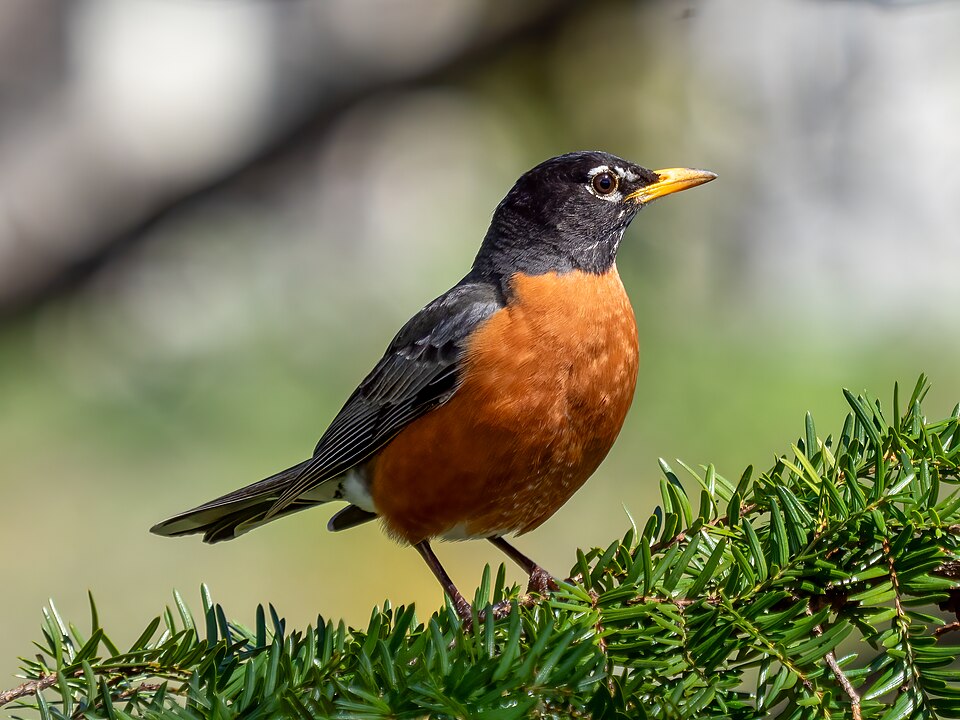
Few birds are as woven into everyday life as the American Robin. With its warm orange breast, charcoal-gray back, and habit of hopping across lawns with head cocked, it's the bird most North Americans picture first when they think "bird." Despite being one of our most familiar species, the robin is genuinely interesting: it's a true thrush, a relative of the bluebirds and the nightingale, and its early-morning song is one of the first and last voices of the daily chorus.
Robins thrive almost everywhere people do, suburban yards, city parks, farm hedgerows, mountain forests, and northern tundra edges alike. They are also a famous (if not entirely reliable) sign of spring. While many of us watch for the "first robin" each March, the truth is that plenty of robins quietly tough out winter in flocks, shifting from worm-hunting on lawns to gorging on berries in woods and thickets. Their adaptability, abundance, and bold presence make them one of the best birds for new birders to learn well.
The American Robin is a large, round-bellied songbird with a fairly long tail, long legs, and an upright, alert posture. At a glance it's defined by the contrast between its dark upperparts and rich orange underparts. Even non-birders recognize the silhouette: a plump bird standing tall on a lawn, then running a few steps and freezing to listen for prey.
| Breast & belly | Warm brick-orange to rusty red, fading to white on the lower belly and undertail |
| Head | Blackish (males) to dark gray, with bold white crescents above and below the eye (broken eye-ring) |
| Throat | White with heavy black streaking, like a streaked 'bib' |
| Back & wings | Plain slate-gray to brownish-gray, unmarked |
| Bill | Yellow, often with a dark tip, fairly long and straight |
| Tail | Dark with small white corners visible from below, especially in flight |
Male vs. female
Males and females look similar, but with practice you can tell them apart. Males tend to be more richly colored, a deeper, more saturated orange breast and a darker, often nearly black head that contrasts sharply with the gray back. Females are a bit washed out by comparison: paler orange underparts and a grayer head that blends more smoothly into the back. Side by side, especially in spring, the difference is usually obvious; a lone bird can be trickier, and many fall in an intermediate range.
Juveniles
Juvenile robins look noticeably different from adults and confuse many backyard watchers. Freshly fledged young have a heavily spotted breast, dark spots scattered over a pale orange or buffy background, which is a classic thrush trait that reveals the robin's family ties. They also show pale spotting or scaling on the back and wings. As summer progresses they molt into adult-like plumage, but the spotted-breasted "teenager" look is common from late spring through midsummer.
The robin's song is a clear, rolling series of short, liquid phrases often described as cheerily, cheer-up, cheerio, cheerily. The phrases rise and fall and pause between them, giving a relaxed, conversational rhythm rather than a single repeated note. Robins are famous early risers, frequently the first birds singing in the pre-dawn darkness and among the last to fall silent at dusk.
Their calls are just as useful for identification. A sharp, repeated tut-tut-tut or cuck-cuck signals mild alarm, and an emphatic, descending peek! or a high, thin seee warns of hawks. When a cat or other ground threat appears, robins often erupt into a loud, scolding tut series that pulls in nearby birds.
American Robins breed across virtually all of North America, from the tree line in Alaska and northern Canada south through the United States and into the highlands of central Mexico. They occupy an enormous range of habitats, backyards, parks, forests, farmland, and mountain meadows, wherever there's open ground for foraging and trees or structures for nesting.
Their movements are more complicated than the "robin equals spring" story suggests. Northern populations migrate south for winter, but many robins simply shift behavior and location rather than leaving entirely, forming large nomadic flocks that wander in search of fruit. This is why you might see no robins on your lawn in January, then a sudden swarm descend on a berry-laden tree, and finally singing territorial males appear as days lengthen.
Robins have a famously split diet that changes with the seasons. In spring and summer they are classic lawn hunters, eating earthworms, beetle grubs, caterpillars, and other invertebrates. That iconic pose, running, stopping, and tilting the head toward the ground, is the bird hunting by sight (and likely sound and vibration) for movement in the soil before lunging to pull a worm free.
In fall and winter, when the ground freezes and insects vanish, robins switch heavily to fruit. They feast on berries and small fruits from sumac, juniper, holly, crabapple, hawthorn, dogwood, and many ornamental plantings. Flocks can strip a fruiting tree in a day, and robins that gorge on fermented winter berries occasionally turn up acting tipsy and uncoordinated.
The female robin builds a sturdy cup nest of grass and twigs reinforced with a layer of mud, which she shapes by pressing her body into it, then lines with fine soft grasses. Nests are placed in a wide variety of spots, tree branches, shrubs, and very often on human structures like porch lights, gutters, window ledges, and eaves, which is why robins so frequently end up nesting right beside our front doors.
She typically lays three to four eggs of the famous "robin's-egg blue," a sky-blue color so distinctive it named a shade. The female does nearly all the incubating, which lasts roughly two weeks, and the young leave the nest about two weeks after hatching. Robins are prolific, often raising two and sometimes three broods in a single season, with the male tending fledglings from the first brood while the female starts the next.
Robins are common backyard birds, but they rarely visit seed feeders since they aren't seed-eaters. The way to attract them is through habitat and food they actually want, open foraging ground, water, and fruit.
- Provide water, robins love birdbaths for both drinking and bathing; a shallow bath or a dripper is a strong draw, especially in winter when open water is scarce.
- Plant native fruiting trees and shrubs like dogwood, serviceberry, hawthorn, holly, and crabapple to feed wintering flocks.
- Keep a pesticide-free lawn or garden bed, robins hunt worms and grubs on open ground, and chemicals reduce their food and can poison them.
- Offer mealworms (live or dried, sometimes softened in water) on a platform or ground feeder rather than tube feeders.
- Leave a patch of leaf litter or mulch they can flip through for invertebrates, and avoid over-tidying garden edges.
- Put up an open nesting shelf on a sheltered wall or under an eave, robins readily use flat ledges instead of enclosed boxes.
- Eastern Bluebird: Much smaller with a rounder head; males are vivid blue above (not gray) with a rusty throat and breast. Robins are far larger and never show blue.
- Spotted Towhee: Has rusty orange only on the sides/flanks with a black hood and white belly, plus white wing spots. Robin's orange covers the whole breast and it lacks the towhee's bold pattern.
- Varied Thrush: A western forest thrush with orange underparts but a bold black breast band and orange eyebrow and wingbars. Robins lack the breast band and orange wing markings.
- Black-headed Grosbeak: Orange-bodied but has a huge conical seed-cracking bill and bold white wing patches. Robin has a slender yellow bill and plain wings.
Does seeing a robin really mean spring is here?
Not always. Many robins stay north all winter in roving flocks, switching from lawns to berry trees, so a 'first robin' may just be a winter bird becoming visible. The truer sign of spring is hearing males sing their cheerily, cheer-up song and seeing them defend lawn territories.
Why do robins run, stop, and tilt their heads on the lawn?
They're hunting. By stopping and cocking the head, a robin gets a clear look (and probably listens and feels for vibrations) at the ground to detect earthworms and grubs moving in the soil before grabbing them.
What do baby robins and their eggs look like?
The eggs are a famous sky-blue ('robin's-egg blue'), usually three to four per clutch. Hatchlings are naked and helpless, and once fledged, young robins have heavily spotted breasts over a pale orange background, quite different from the smooth orange of adults.
How do I attract robins if they won't come to my feeder?
Robins aren't seed-eaters, so skip the tube feeder. Offer a birdbath, plant native fruiting shrubs like dogwood and serviceberry, put out mealworms on a platform, and keep your yard pesticide-free so worms and insects thrive.
Why is a robin attacking my window or car mirror?
During breeding season males are highly territorial and may mistake their own reflection for a rival, repeatedly flying at windows or mirrors. It usually stops after nesting; covering the reflective surface with cardboard or soap for a few days helps.