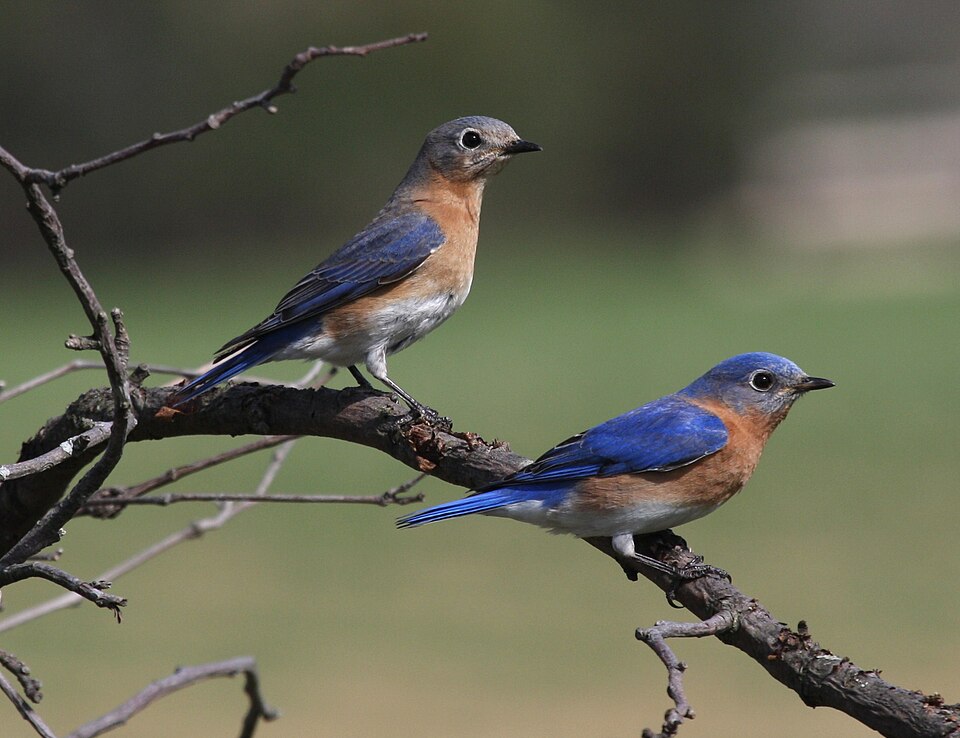
Few backyard birds turn heads like a male Eastern Bluebird in good light. He is a compact, round-shouldered thrush wrapped in deep sky-blue above and a warm rusty-orange across the throat and chest, and when he drops from a fence wire to grab a beetle, the color seems almost too vivid to be real. Eastern Bluebirds are birds of open and semi-open country: pastures, orchards, golf courses, roadsides, cemeteries, and any grassy clearing dotted with scattered trees, fence posts, or perches to hunt from. They are one of three bluebird species in North America and the only one found across most of the eastern half of the continent.
This is also a great conservation success story. Bluebird numbers fell sharply through the mid-1900s as old orchards disappeared and aggressive introduced birds like House Sparrows and European Starlings took over the tree cavities bluebirds depend on for nesting. A grassroots movement of nest-box builders and "bluebird trail" monitors helped turn that around, and the species has rebounded strongly. Today the Eastern Bluebird is one of the most rewarding birds a homeowner can host, because a properly placed box really can bring a nesting pair right into the yard.
Look for a small, plump, big-headed songbird that sits upright on a wire or low perch and often hunches its shoulders. It is noticeably smaller and rounder than an American Robin, with a short, thin bill and a relatively short tail. The combination of blue upperparts and a rusty-orange breast is the giveaway, but lighting matters enormously: in shade or flat light the blue can look gray-brown until the bird shifts and the color flares.
| Upperparts | Brilliant deep blue on the head, back, wings, and tail in males; grayer with blue highlights in females. |
| Breast & throat | Warm rusty cinnamon-orange across the throat and chest, sharply set off from a white belly and undertail. |
| Belly | Clean white on the lower belly and under the tail, contrasting with the orange chest. |
| Shape | Small, plump, large-headed and short-tailed; sits upright with a hunched posture. |
| Bill & legs | Short, straight, thin black bill; thin dark legs. |
| In flight | Flashes of blue in the wings and tail; an undulating flight, often dropping to the ground from a perch. |
Male vs. female
The sexes differ enough to tell apart with a decent look. The male is intensely blue above, with a rich rusty-orange throat and breast and a crisp white belly, the whole package looking almost enameled in sunlight. The female is a softer, grayer version: her head and back are grayish-brown washed with blue, her wings and tail show clear blue (especially in flight), and her breast is a paler, more muted orange. Females also tend to show a thin pale eye-ring that gives them a gentle expression. As a rule of thumb, if the bird glows electric blue it is a male, and if it looks dusty gray-blue with restrained color it is a female.
Juveniles
Juvenile Eastern Bluebirds look strikingly different from adults and can briefly puzzle observers. They are grayish overall with a heavily spotted, scaly breast, a classic thrush trait shared with young robins, and they show whitish streaks on the back. The clue that gives them away is the blue already showing in the wings and tail, inherited even before the rest of their adult plumage comes in. As summer wears on, young birds molt and gradually take on adult colors, with the spotting fading and the blue and orange filling in.
The Eastern Bluebird's song is a soft, mellow, slightly burry warble, usually a short phrase of a few low notes often written as tu-a-wee or chir-wi, chur-lee. It is gentle and unhurried rather than loud or showy, and males sing it from exposed perches in spring to claim territory and court a mate. The overall quality is sweet and a little wistful, easy to overlook against flashier singers.
The most useful sound to learn is the contact call, a rich, low chur-lee or tu-wheet that pairs and family groups give constantly as they move around. Once you know this soft, musical call note, you will often detect bluebirds passing overhead or perched out of sight before you ever see them. Alarm calls are harsher and more chattering.
Eastern Bluebirds range across the eastern United States and southern Canada, west to about the Great Plains, and south through the Southeast into parts of Mexico and Central America. Across much of the southern and central parts of this range they are present year-round, while birds breeding in the northern states and Canada move south for winter.
Movement is more about weather and food than strict calendar dates. In fall and winter bluebirds form loose flocks and roam in search of berries and open ground, and they can appear in surprising numbers at a fruiting tree or a row of nest boxes. Mild winters and the wide availability of berry-bearing shrubs and feeding stations have allowed more bluebirds to stay farther north than they once did.
Eastern Bluebirds eat insects and fruit, and the balance shifts with the seasons. From spring through fall they are primarily insect hunters, favoring beetles, grasshoppers, crickets, caterpillars, and spiders. Their classic hunting style is "drop-hunting": the bird perches on a low branch, fence wire, or post, scans the grass below, then flutters or pounces down to seize prey before returning to its perch. This is why they thrive in open habitats with short grass and scattered perches.
In late fall and winter, when insects are scarce, they switch heavily to fruit. They eat the berries of sumac, dogwood, holly, eastern red cedar, Virginia creeper, pokeweed, mistletoe, and many other native plants. A reliable winter berry crop can hold flocks in an area through cold weather, which is one reason bluebird numbers track so closely with the landscape around them.
Eastern Bluebirds are cavity nesters that cannot excavate their own holes. In the wild they rely on old woodpecker holes and natural cavities in trees and fence posts, and they readily accept human-made nest boxes, which is the foundation of bluebird conservation. The female builds a cup of woven grasses and fine plant stems, often lined with finer material, tucked inside the cavity.
A clutch is typically four to five pale blue eggs, though a small percentage of females lay white eggs. The female does the incubating for roughly two weeks, and both parents feed the nestlings, which fledge at around two and a half to three weeks old. Pairs commonly raise two broods in a season and sometimes three in the south, and young from an earlier brood occasionally help feed later siblings. Competition for cavities is fierce, so monitored nest boxes with proper dimensions and predator guards dramatically improve nesting success.
Yes, this is one of the most attractable native songbirds, but the path to bluebirds runs through housing and the right food, not standard seed feeders. If you have open or semi-open space, a well-placed nest box can bring a breeding pair right into your yard, and mealworms can pull them to a feeder.
- Put up a proper nest box. Use a box with a 1.5-inch entrance hole (which excludes starlings) mounted on a smooth pole 4-6 feet up, facing an open grassy area, ideally with a perch tree 25-100 feet away.
- Add a predator baffle. A cone or stovepipe baffle on the mounting pole stops raccoons, snakes, and cats from raiding eggs and nestlings, which is the single biggest factor in nesting success.
- Offer mealworms. Live or dried mealworms in a small dish or dome feeder are the most reliable way to draw bluebirds to feed; they generally ignore mixed seed.
- Plant native berry shrubs. Dogwood, sumac, holly, serviceberry, and eastern red cedar provide the winter fruit that keeps bluebirds in the area when insects vanish.
- Keep grass short and open. Bluebirds hunt by dropping onto insects in low grass, so a mowed or grazed area near the box gives them productive foraging.
- Provide water and skip pesticides. A shallow birdbath, especially a moving or dripping one, is a strong draw, and avoiding lawn insecticides protects their food supply.
- Western Bluebird: Overlaps only in the central U.S.; males have a blue (not rusty) throat and orange often extends onto the upper back.
- Mountain Bluebird: A western bird; males are sky-blue all over with little or no orange, and females are grayer with no warm breast.
- Indigo Bunting: Male is entirely deep blue with no orange breast and a thicker, conical seed-eating bill; favors brushy edges.
- Blue Grosbeak: Larger, deep blue with rusty wingbars and a heavy bill; lacks the bluebird's orange breast and upright perching posture.
How do I attract bluebirds to my yard?
The two best moves are putting up a correctly built nest box (1.5-inch hole, smooth pole, predator baffle, facing open grass) and offering mealworms in a small dish. Bluebirds rarely use standard seed feeders, so housing and live or dried mealworms work far better than birdseed. Native berry shrubs and a shallow birdbath help, too.
What do bluebirds eat?
In the warmer months they eat mostly insects and spiders, hunting beetles, grasshoppers, crickets, and caterpillars by dropping onto them from a perch. In fall and winter they switch to fruit, feeding heavily on berries like sumac, dogwood, holly, and eastern red cedar.
What color are bluebird eggs?
Most Eastern Bluebird eggs are pale powder-blue, with a clutch usually of four or five eggs. A small percentage of females lay pure white eggs instead, which is normal and still produces healthy young.
Do bluebirds stay all winter or migrate?
It depends on location. Across the southern and central parts of their range many bluebirds stay year-round, while northern breeders move south. They roam in winter flocks chasing berries, so a good fruit crop or feeding station can keep them around through cold weather, sometimes farther north than expected.
How can I keep House Sparrows and starlings out of my bluebird box?
A 1.5-inch entrance hole physically excludes European Starlings, which are too large. House Sparrows are tougher because they fit through the same hole, so monitor the box, remove sparrow nests promptly, and place boxes away from buildings and feeders where sparrows concentrate.